Home > Press > Flexible pressure-sensor film shows how much force a surface 'feels' -- in color
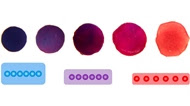 |
| Using colors from deep blue to rich coral, a novel sensor can tell us how much force and pressure objects such as crash-test dummies “feel.” Credit: American Chemical Society |
Abstract:
A newly developed pressure sensor could help car manufacturers design safer automobiles and even help Little League players hold their bats with a better grip, scientists report. The study describing their high-resolution sensor, which can be painted onto surfaces or built into gloves, appears in the ACS journal Nano Letters.
Flexible pressure-sensor film shows how much force a surface 'feels' -- in color
Washington, DC | Posted on April 30th, 2014Yadong Yin and colleagues explain that pressure is a part of our daily lives. We and the objects around us constantly exert pressure on surfaces, from a simple, light touch of a finger on a smartphone screen to the impact of a head-on car collision. To design better cars, smartphones and other objects we use every day, scientists need to know how much force they can withstand. Most pressure gauges are bulky hunks of metal that can't fit into tight spaces. Other sensors on the market are thin and can indicate stresses with different shades of the same color, but they are difficult to interpret and have low resolution and contrast, says Yin. To overcome these challenges, the team turned to nanoparticles — which are so small that 1,000 would fit across the width of a human hair.
Tiny gold nanoparticles can join together in chains, and disrupting these chains results in a change in color. The researchers took advantage of that unique property to design a new type of pressure-sensor film, which is a deep blue color when the nanoparticles are linked together, but becomes ruby red when the nanoparticles irreversibly disassemble under stress. "Our colorimetric sensor film changes color, not just color intensity, which gives us the benefit of higher contrast and resolution," says Yin. "We also can make it into a liquid, which can be painted on objects such as crash test dummies that have complex surfaces."
###
The authors acknowledge funding from the National Science Foundation.
####
About American Chemical Society
The American Chemical Society is a nonprofit organization chartered by the U.S. Congress. With more than 161,000 members, ACS is the world's largest scientific society and a global leader in providing access to chemistry-related research through its multiple databases, peer-reviewed journals and scientific conferences. Its main offices are in Washington, D.C., and Columbus, Ohio.
For more information, please click here
Contacts:
Michael Bernstein
202-872-6042
Yadong Yin, Ph.D.
Department of Chemistry
Materials Science and Engineering Program
University of California
Riverside, Calif. 92521
Phone: 951-827-4965
Copyright © American Chemical Society
If you have a comment, please Contact us.Issuers of news releases, not 7th Wave, Inc. or Nanotechnology Now, are solely responsible for the accuracy of the content.
Bookmark:


| Related Links |
| Related News Press |
News and information
 Quantum computer improves AI predictions April 17th, 2026
Flexible sensor gains sensitivity under pressure April 17th, 2026
A reusable chip for particulate matter sensing April 17th, 2026
Detecting vibrational quantum beating in the predissociation dynamics of SF6 using time-resolved photoelectron spectroscopy April 17th, 2026
Govt.-Legislation/Regulation/Funding/Policy
Quantum computer improves AI predictions April 17th, 2026
Metasurfaces smooth light to boost magnetic sensing precision January 30th, 2026
New imaging approach transforms study of bacterial biofilms August 8th, 2025
Sensors
Flexible sensor gains sensitivity under pressure April 17th, 2026
Tiny nanosheets, big leap: A new sensor detects ethanol at ultra-low levels January 30th, 2026
From sensors to smart systems: the rise of AI-driven photonic noses January 30th, 2026
Sensors innovations for smart lithium-based batteries: advancements, opportunities, and potential challenges August 8th, 2025
Discoveries
Quantum computer improves AI predictions April 17th, 2026
Flexible sensor gains sensitivity under pressure April 17th, 2026
A reusable chip for particulate matter sensing April 17th, 2026
Detecting vibrational quantum beating in the predissociation dynamics of SF6 using time-resolved photoelectron spectroscopy April 17th, 2026
Announcements
A fundamentally new therapeutic approach to cystic fibrosis: Nanobody repairs cellular defect April 17th, 2026
UC Irvine physicists discover method to reverse ‘quantum scrambling’ : The work addresses the problem of information loss in quantum computing system April 17th, 2026
Interviews/Book Reviews/Essays/Reports/Podcasts/Journals/White papers/Posters
A fundamentally new therapeutic approach to cystic fibrosis: Nanobody repairs cellular defect April 17th, 2026
UC Irvine physicists discover method to reverse ‘quantum scrambling’ : The work addresses the problem of information loss in quantum computing system April 17th, 2026
Automotive/Transportation
Decoding hydrogen‑bond network of electrolyte for cryogenic durable aqueous zinc‑ion batteries January 30th, 2026
Sensors innovations for smart lithium-based batteries: advancements, opportunities, and potential challenges August 8th, 2025
Simple algorithm paired with standard imaging tool could predict failure in lithium metal batteries August 8th, 2025
Alliances/Trade associations/Partnerships/Distributorships
Chicago Quantum Exchange welcomes six new partners highlighting quantum technology solutions, from Chicago and beyond September 23rd, 2022
University of Illinois Chicago joins Brookhaven Lab's Quantum Center June 10th, 2022
 |
||
 |
||
| The latest news from around the world, FREE | ||
 |
||
|
|
||
| Premium Products | ||
 |
||
|
Only the news you want to read!
Learn More |
||
 |
||
|
Full-service, expert consulting
Learn More |
||
|
|
||