Home > Press > Picodeon’s PLD technology enables microstructural control
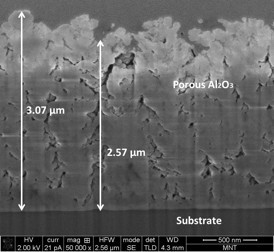 |
| Porous Al2O3 |
Abstract:
Finnish thin film coating specialist Picodeon Ltd Oy has developed its ultra-short pulsed laser deposition (USPLD) surface coating technology to be able to create either porous or dense aluminium oxide (Al2O3) coatings on heat-sensitive substrates for use in a wide range of industrial metallisation applications.
Picodeon’s PLD technology enables microstructural control
Ii, Finland | Posted on March 21st, 2014Porous Al2O3 layers are used for instance as filters and electrical insulation layers. Dense Al2O3 is used as a barrier layer and is also an excellent optical coating with high transmittance properties.
The Picodeon process enables precise micro-structural control of Al2O3 coatings, and therefore coating characteristics, by the simple management and maintenance of coating process parameters on Coldab® Series4 USPLD batch process coating equipment.
"This development has enormous potential for new applications of dense and porous aluminium oxide coatings on heat sensitive materials," said Picodeon VP Sales and Business Development Marko Mylläri. "It is currently very difficult to achieve these results using physical vapour deposition (PVD), sputtering or chemical vapour deposition (CVD) surface coating technologies."
The Coldab® Series4 equipment has built-in online plasma monitoring and laser power measurement that enable very precise management of coating process parameters, as well as a PC controlled automation that records the actions of the coating process.
The metrics provided by these systems mean that the coating process, and especially the thin film quality, can be controlled with great accuracy to achieve coating characteristics within highly targeted parameters.
Test production runs, for example, showed that the system could improve the porosity of a 3µm Al2O3 coating, for example, from 10 percent to as much as 45 percent by tuning the scanning speed and laser power repetition rate.
Al2O3 coatings on heat-sensitive materials
The Al2O3 coatings were applied on heat-sensitive polyethylene (PE) and thermoplastic polyurethane (TPU) polymer film substrates. This is possible due to the low process temperatures required for surface coating using Picodeon's Coldab® USPLD system - one of the major benefits of the process.
In addition to Al2O3, the new Picodeon process technology can be used for other coatings as well. Picodeon has produced metallic coatings using Au and Cu, and oxides such as TiO2.
Picodeon's recently released ColdAb Series4 equipment is currently being installed in commercial applications, and the company is continuing development to industrialise its USPLD processes and tools towards even larger scale volume production capabilities.
####
About Picodeon Ltd Oy
Picodeon is a Finnish nanotechnology company specializing in thin film coatings and surface treatments with its patented Coldab® Ultra-Short Pulsed Laser Deposition (USPLD) process. Picodeon provides equipment, solutions and services for its clients worldwide.
For more information, please click here
Contacts:
Camille Closs
+44 (0)20 8286 0654
Watch PR
Copyright © Picodeon Ltd
If you have a comment, please Contact us.Issuers of news releases, not 7th Wave, Inc. or Nanotechnology Now, are solely responsible for the accuracy of the content.
Bookmark:


| Related News Press |
News and information
 Quantum computer improves AI predictions April 17th, 2026
Flexible sensor gains sensitivity under pressure April 17th, 2026
A reusable chip for particulate matter sensing April 17th, 2026
Detecting vibrational quantum beating in the predissociation dynamics of SF6 using time-resolved photoelectron spectroscopy April 17th, 2026
Thin films
Tiny nanosheets, big leap: A new sensor detects ethanol at ultra-low levels January 30th, 2026
Utilizing palladium for addressing contact issues of buried oxide thin film transistors April 5th, 2024
Understanding the mechanism of non-uniform formation of diamond film on tools: Paving the way to a dry process with less environmental impact March 24th, 2023
New study introduces the best graphite films: The work by Distinguished Professor Feng Ding at UNIST has been published in the October 2022 issue of Nature Nanotechnology November 4th, 2022
Announcements
A fundamentally new therapeutic approach to cystic fibrosis: Nanobody repairs cellular defect April 17th, 2026
UC Irvine physicists discover method to reverse ‘quantum scrambling’ : The work addresses the problem of information loss in quantum computing system April 17th, 2026
Tools
Metasurfaces smooth light to boost magnetic sensing precision January 30th, 2026
From sensors to smart systems: the rise of AI-driven photonic noses January 30th, 2026
Japan launches fully domestically produced quantum computer: Expo visitors to experience quantum computing firsthand August 8th, 2025
Industrial
Tiny nanosheets, big leap: A new sensor detects ethanol at ultra-low levels January 30th, 2026
Quantum interference in molecule-surface collisions February 28th, 2025
Boron nitride nanotube fibers get real: Rice lab creates first heat-tolerant, stable fibers from wet-spinning process June 24th, 2022
Photonics/Optics/Lasers
Metasurfaces smooth light to boost magnetic sensing precision January 30th, 2026
From sensors to smart systems: the rise of AI-driven photonic noses January 30th, 2026
 |
||
 |
||
| The latest news from around the world, FREE | ||
 |
||
|
|
||
| Premium Products | ||
 |
||
|
Only the news you want to read!
Learn More |
||
 |
||
|
Full-service, expert consulting
Learn More |
||
|
|
||