Home > Press > Seashells inspire new way to preserve bones for archeologists, paleontologists
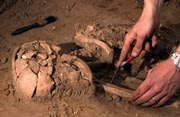 |
| Preservation of ancient bones that help tell humanity’s story is improving thanks to science and seashells. Credit: Stocktrek Images/Thinkstock |
Abstract:
Recreating the story of humanity's past by studying ancient bones can hit a snag when they deteriorate, but scientists are now reporting an advance inspired by seashells that can better preserve valuable remains. Their findings, which appear in the ACS journal Langmuir, could have wide-ranging implications for both archeology and paleontology.
Seashells inspire new way to preserve bones for archeologists, paleontologists
Washington, DC | Posted on January 22nd, 2014Luigi Dei and colleagues explain that a process similar to osteoporosis causes bones discovered at historically significant sites to become brittle and fragile — and in the process, lose clues to the culture they were once part of. Preserving them has proved challenging. Current techniques to harden and strengthen bones use vinyl and acrylic polymers. They act as a sort of glue, filling in cracks and holding fragments together, but they are not ideal. In an effort to stanch the loss of information due to damage, Dei's team set out to find a better way to preserve old bones.
The researchers turned to seashells for inspiration. Using skeletal fragments from the Late Middle Ages, they grew aragonite, a kind of lime that some sea animals produce to shore up their shells, on the bones in a controlled way. The treatment hardened the surfaces of the bones, as well as the pores inside them, making the ancient remains 50 to 70 percent sturdier. "These results could have immediate impact for preserving archeological and paleontological bone remains," the scientists conclude.
The authors acknowledge funding from Consorzio Interuniversitario per lo Sviluppo dei Sistemi a Grande Interfase (CSGI), Florence, Italy; the University of Florence; the TEMART Project funded by the European Fund for Regional Development; the Tuscany region; and the S.I.C.A.M.O.R. PAR-FAS Project Tuscany Region.
####
About American Chemical Society
The American Chemical Society is a nonprofit organization chartered by the U.S. Congress. With more than 163,000 members, ACS is the world’s largest scientific society and a global leader in providing access to chemistry-related research through its multiple databases, peer-reviewed journals and scientific conferences. Its main offices are in Washington, D.C., and Columbus, Ohio.
For more information, please click here
Contacts:
Luigi Dei, Ph.D.
Department of Chemistry “Ugo Schiff” and CSGI Consortium
University of Florence
via della Lastruccia 3
50019 Sesto Fiorentino (FI)
Italy
General Inquiries:
Michael Bernstein
202-872-6042
Science Inquiries:
Katie Cottingham, Ph.D.
301-775-8455
Copyright © American Chemical Society
If you have a comment, please Contact us.Issuers of news releases, not 7th Wave, Inc. or Nanotechnology Now, are solely responsible for the accuracy of the content.
Bookmark:


| Related Links |
| Related News Press |
News and information
 Quantum computer improves AI predictions April 17th, 2026
Flexible sensor gains sensitivity under pressure April 17th, 2026
A reusable chip for particulate matter sensing April 17th, 2026
Detecting vibrational quantum beating in the predissociation dynamics of SF6 using time-resolved photoelectron spectroscopy April 17th, 2026
Govt.-Legislation/Regulation/Funding/Policy
Quantum computer improves AI predictions April 17th, 2026
Metasurfaces smooth light to boost magnetic sensing precision January 30th, 2026
New imaging approach transforms study of bacterial biofilms August 8th, 2025
Discoveries
Quantum computer improves AI predictions April 17th, 2026
Flexible sensor gains sensitivity under pressure April 17th, 2026
A reusable chip for particulate matter sensing April 17th, 2026
Detecting vibrational quantum beating in the predissociation dynamics of SF6 using time-resolved photoelectron spectroscopy April 17th, 2026
Announcements
A fundamentally new therapeutic approach to cystic fibrosis: Nanobody repairs cellular defect April 17th, 2026
UC Irvine physicists discover method to reverse ‘quantum scrambling’ : The work addresses the problem of information loss in quantum computing system April 17th, 2026
Alliances/Trade associations/Partnerships/Distributorships
Chicago Quantum Exchange welcomes six new partners highlighting quantum technology solutions, from Chicago and beyond September 23rd, 2022
University of Illinois Chicago joins Brookhaven Lab's Quantum Center June 10th, 2022
 |
||
 |
||
| The latest news from around the world, FREE | ||
 |
||
|
|
||
| Premium Products | ||
 |
||
|
Only the news you want to read!
Learn More |
||
 |
||
|
Full-service, expert consulting
Learn More |
||
|
|
||