Home > Press > Copper promises cheaper, sturdier fuel cells: Copper nanowires offer an efficient, inexpensive approach to solar energy harvesting
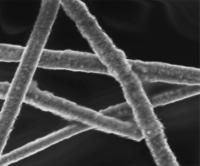 |
| The copper nanowires, seen here with a nickel coating, can split water molecules under the power of sunlight.
Credit: Zuofeng Chen |
Abstract:
Copper adorns the Statue of Liberty, makes sturdy, affordable wiring, and helps our bodies absorb iron. Now, researchers at Duke University would like to use copper to transform sunlight and water into a chemical fuel.
Copper promises cheaper, sturdier fuel cells: Copper nanowires offer an efficient, inexpensive approach to solar energy harvesting
Durham, NC | Posted on November 22nd, 2013Converting solar energy into storable fuel remains one of the greatest challenges of modern chemistry. One of the ways chemists have tried to capture the power of the sun is through water splitting, in which the atoms of H2O are broken apart so the hydrogen may be collected and used as fuel. Plants do this naturally through photosynthesis, and for half a century, scientists have tried to recreate that process by tinkering with chemical catalysts jumpstarted by sunlight.
Indium tin oxide (ITO) is one material they've commonly tried to use. Researchers prefer it for its transparency -- which allows sunlight to pass through and trigger the water-splitting reactions -- and its ability to conduct electricity. But ITO is far from an ideal material.
"Indium is not very abundant," said Ben Wiley, assistant professor of chemistry at Duke University. "It is similar in abundance to silver in the earth's crust." As a result, solar fuel cells using ITO will likely remain expensive and uncompetitive with conventional energy sources like coal and natural gas, he said.
Wiley's lab has created something they hope can replace ITO: copper nanowires fused in a see-through film. The team -- including two postdoctoral researchers, a graduate student, and a former graduate student from Duke -- published their new approach last month in the chemistry journal Angewandte Chemie.
Copper is 1000 times more plentiful and 100 times less expensive than indium. Copper nanowire catalysts also cost less to produce than their ITO counterparts because they can be "printed" on pieces of glass or plastic in a liquid ink form, using a machine that functions much like a printing press. ITO production, by contrast, requires large, sequential chambers of pumps and vacuums that deposit a thin layer of indium atoms at a far slower rate.
The copper nanowire films consist of networks of microscopic metal rods, the properties and applications of which Wiley's lab has studied for years. The nanowires provide a high surface area for catalyzing chemistry, and Wiley's team experimented with coating them in either cobalt or nickel -- metals that serve as the actual chemical catalyst. Even with a coat of cobalt or nickel, the nanowire films allow nearly seven times more sunlight to pass through than ITO. The films are also flexible, leading Wiley to imagine the completed fuel cells one day being attached to backpacks or cars.
In the meantime, engineering and chemistry challenges remain. The nanowire films carry out only one half of the water-splitting equation, a process called water oxidation. The other half of the reaction involves using the electrons obtained from water oxidation to reduce water to hydrogen. Wiley's team expects to publish their work on this process in the coming year.
"A lot of groups are working on putting together complete devices to generate fuels from sunlight," he said, but "the efficiencies and costs of these systems have to be improved for them to get to commercial [production]."
Wiley noted that solar energy production is just one application of the copper nanowire films they study. The nanowires also show promise for use in flexible touch screens, organic LED (or OLED) lights and smart glass.
###
This research was funded by the National Science Foundation Research Triangle Materials Research Science and Engineering Center (DMR-1121107), a National Science Foundation Faculty Early Career Development award (DMR-1253534) and a National Science Foundation graduate research fellowship.
CITATION: "Optically Transparent Water Oxidation Catalysts Based on Copper Nanowires," Zuofeng Chen, Aaron Rathmell, Shengrong Ye, Adria Wilson, Ben Wiley. Angewandte Chemie, October 18, 2013. 10.1002/ange.201306585.
####
For more information, please click here
Contacts:
Erin Weeks
919-681-8057
Copyright © Duke University
If you have a comment, please Contact us.Issuers of news releases, not 7th Wave, Inc. or Nanotechnology Now, are solely responsible for the accuracy of the content.
Bookmark:


| Related News Press |
News and information
 Quantum computer improves AI predictions April 17th, 2026
Flexible sensor gains sensitivity under pressure April 17th, 2026
A reusable chip for particulate matter sensing April 17th, 2026
Detecting vibrational quantum beating in the predissociation dynamics of SF6 using time-resolved photoelectron spectroscopy April 17th, 2026
Chemistry
Projecting light to dispense liquids: A new route to ultra-precise microdroplets January 30th, 2026
From sensors to smart systems: the rise of AI-driven photonic noses January 30th, 2026
"Nanoreactor" cage uses visible light for catalytic and ultra-selective cross-cycloadditions October 3rd, 2025
Cambridge chemists discover simple way to build bigger molecules – one carbon at a time June 6th, 2025
Thin films
Tiny nanosheets, big leap: A new sensor detects ethanol at ultra-low levels January 30th, 2026
Govt.-Legislation/Regulation/Funding/Policy
Quantum computer improves AI predictions April 17th, 2026
Metasurfaces smooth light to boost magnetic sensing precision January 30th, 2026
New imaging approach transforms study of bacterial biofilms August 8th, 2025
Discoveries
Quantum computer improves AI predictions April 17th, 2026
Flexible sensor gains sensitivity under pressure April 17th, 2026
A reusable chip for particulate matter sensing April 17th, 2026
Detecting vibrational quantum beating in the predissociation dynamics of SF6 using time-resolved photoelectron spectroscopy April 17th, 2026
Announcements
A fundamentally new therapeutic approach to cystic fibrosis: Nanobody repairs cellular defect April 17th, 2026
UC Irvine physicists discover method to reverse ‘quantum scrambling’ : The work addresses the problem of information loss in quantum computing system April 17th, 2026
Interviews/Book Reviews/Essays/Reports/Podcasts/Journals/White papers/Posters
A fundamentally new therapeutic approach to cystic fibrosis: Nanobody repairs cellular defect April 17th, 2026
UC Irvine physicists discover method to reverse ‘quantum scrambling’ : The work addresses the problem of information loss in quantum computing system April 17th, 2026
Energy
Sensors innovations for smart lithium-based batteries: advancements, opportunities, and potential challenges August 8th, 2025
Simple algorithm paired with standard imaging tool could predict failure in lithium metal batteries August 8th, 2025
Automotive/Transportation
Decoding hydrogen‑bond network of electrolyte for cryogenic durable aqueous zinc‑ion batteries January 30th, 2026
Sensors innovations for smart lithium-based batteries: advancements, opportunities, and potential challenges August 8th, 2025
Simple algorithm paired with standard imaging tool could predict failure in lithium metal batteries August 8th, 2025
Fuel Cells
Deciphering local microstrain-induced optimization of asymmetric Fe single atomic sites for efficient oxygen reduction August 8th, 2025
Current and Future Developments in Nanomaterials and Carbon Nanotubes: Applications of Nanomaterials in Energy Storage and Electronics October 28th, 2022
Solar/Photovoltaic
Spinel-type sulfide semiconductors to operate the next-generation LEDs and solar cells For solar-cell absorbers and green-LED source October 3rd, 2025
KAIST researchers introduce new and improved, next-generation perovskite solar cell November 8th, 2024
Groundbreaking precision in single-molecule optoelectronics August 16th, 2024
Development of zinc oxide nanopagoda array photoelectrode: photoelectrochemical water-splitting hydrogen production January 12th, 2024
 |
||
 |
||
| The latest news from around the world, FREE | ||
 |
||
|
|
||
| Premium Products | ||
 |
||
|
Only the news you want to read!
Learn More |
||
 |
||
|
Full-service, expert consulting
Learn More |
||
|
|
||