Home > Press > “Waviness” Explains Why Carbon Nanotube Forests Have Low Stiffness
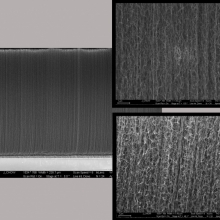 |
| This montage includes images of carbon nanotube forests. New research explains why the CNT forests have less stiffness than expected. Images courtesy of Justin Chow |
Abstract:
A new study has found that "waviness" in forests of vertically-aligned carbon nanotubes dramatically reduces their stiffness, answering a long-standing question surrounding the tiny structures. Instead of being a detriment, the waviness may make the nanotube arrays more compliant and therefore useful as thermal interface material for conducting heat away from future high-powered integrated circuits.
“Waviness” Explains Why Carbon Nanotube Forests Have Low Stiffness
Atlanta, GA | Posted on October 1st, 2013Measurements of nanotube stiffness, which is influenced by a property known as modulus, had suggested that forests of vertically-aligned nanotubes should have a much higher stiffness than what scientists were actually measuring. The reduced effective modulus had been blamed on uneven growth density, and on buckling of the nanotubes under compression.
However, based on experiments, scanning electron microscope (SEM) imaging and mathematical modeling, the new study found that kinked sections of nanotubes may be the primary mechanism reducing the modulus.
"We believe that the mechanism making these nanotubes more compliant is a tiny kinkiness in their structure," said Suresh Sitaraman, a professor in the Woodruff School of Mechanical Engineering at the Georgia Institute of Technology. "Although they appear to be perfectly straight, under high magnification we found waviness in the carbon nanotubes that we believe accounts for the difference in what is measured versus what would be expected."
The research, which was supported by the Defense Advanced Research Projects Agency (DARPA), was published online August 31, 2013, in the journal Carbon. It will appear later in the journal's print issue.
Carbon nanotubes provide many attractive properties, including high electrical and thermal conductivity, and high strength. Individual carbon nanotubes have a modulus ranging from 100 gigapascals to 1.5 terapascals. Arrays of vertically-aligned carbon nanotubes with a low density would be expected to a have an effective modulus of at least five to 150 gigapascals, Sitaraman said, but scientists have typically measured values that are four orders or magnitude less - between one and 10 megapascals.
To understand what might be causing this variation, Sitaraman and Ph.D. students Nicholas Ginga and Wei Chen studied forests of carbon nanotubes grown atop a silicon substrate, then covered the tips of the structures with another layer of silicon. They then used sensitive test apparatus - a nanoindenter - to compress samples of the nanotubes and measure their stiffness. Alternately, they also placed samples of the silicon-nanotube sandwiches under tensile stress - pulling them apart instead of compressing them.
What they found was that the effective modulus remained low - as much as 10,000 times less than expected - regardless of whether the nanotube sandwiches were compressed or pulled apart. That suggests growth issues, or buckling, could not fully account for the differences observed.
To look for potential explanations, the researchers examined the carbon nanotubes using scanning electron microscopes located in Georgia Tech's Institute for Electronics and Nanotechnology facilities. At magnification of 10,000 times, they saw the waviness in sections of the nanotubes.
"We found very tiny kinks in the carbon nanotubes," said Sitaraman. "Although they appeared to be perfectly straight, there was waviness in them. The more waviness we saw, the lower their stiffness was."
They also noted that under compression, the nanotubes contact one another, influencing nanotube behavior. These observations were modeled mathematically to help explain what was being seen across the different conditions studied.
"We took into account the contact between the carbon nanotubes," said Chen. "This allowed us to investigate the extreme conditions under which the deformation of nanotubes is constrained by the presence of neighboring nanotubes in the forest."
Though the loss of modulus might seem like a problem, it actually may be helpful in thermal management applications, Sitaraman said. The compliance of the nanotubes allows them to connect to a silicon integrated circuit on one side, and be bonded to a copper heat spreader on the other side. The flexibility of the nanotubes allows them to move as the top and bottom structures expand and contract at different rates due to temperature changes.
"The beauty of the carbon nanotubes is that they act like springs between the silicon chip and the copper heat spreader," said Sitaraman. "They can conduct lots of heat because of good thermal properties, and at the same time, they are supple and compliant."
Carbon nanotubes have extraordinarily high thermal conductivity, as much as ten times that of copper, making them ideal for drawing heat away from the chips.
"The demand for heat removal from chips is continuing to increase," said Ginga. "Industry has been looking for new materials and new techniques to add to their toolbox for heat transfer. Different approaches will be needed for different devices, and this provides the industry with a new way to address the challenge."
####
For more information, please click here
Contacts:
Research News
Georgia Institute of Technology
177 North Avenue
Atlanta, Georgia 30332-0181 USA
John Toon
404-894-6986
or
Brett Israel
404-385-1933
Copyright © Georgia Institute of Technology
If you have a comment, please Contact us.Issuers of news releases, not 7th Wave, Inc. or Nanotechnology Now, are solely responsible for the accuracy of the content.
Bookmark:


| Related News Press |
News and information
 Quantum computer improves AI predictions April 17th, 2026
Flexible sensor gains sensitivity under pressure April 17th, 2026
A reusable chip for particulate matter sensing April 17th, 2026
Detecting vibrational quantum beating in the predissociation dynamics of SF6 using time-resolved photoelectron spectroscopy April 17th, 2026
Chip Technology
A reusable chip for particulate matter sensing April 17th, 2026
Metasurfaces smooth light to boost magnetic sensing precision January 30th, 2026
Nanotubes/Buckyballs/Fullerenes/Nanorods/Nanostrings/Nanosheets
Tiny nanosheets, big leap: A new sensor detects ethanol at ultra-low levels January 30th, 2026
Enhancing power factor of p- and n-type single-walled carbon nanotubes April 25th, 2025
Chainmail-like material could be the future of armor: First 2D mechanically interlocked polymer exhibits exceptional flexibility and strength January 17th, 2025
Innovative biomimetic superhydrophobic coating combines repair and buffering properties for superior anti-erosion December 13th, 2024
Nanoelectronics
Lab to industry: InSe wafer-scale breakthrough for future electronics August 8th, 2025
Interdisciplinary: Rice team tackles the future of semiconductors Multiferroics could be the key to ultralow-energy computing October 6th, 2023
Key element for a scalable quantum computer: Physicists from Forschungszentrum Jülich and RWTH Aachen University demonstrate electron transport on a quantum chip September 23rd, 2022
Reduced power consumption in semiconductor devices September 23rd, 2022
Discoveries
Quantum computer improves AI predictions April 17th, 2026
Flexible sensor gains sensitivity under pressure April 17th, 2026
A reusable chip for particulate matter sensing April 17th, 2026
Detecting vibrational quantum beating in the predissociation dynamics of SF6 using time-resolved photoelectron spectroscopy April 17th, 2026
Announcements
A fundamentally new therapeutic approach to cystic fibrosis: Nanobody repairs cellular defect April 17th, 2026
UC Irvine physicists discover method to reverse ‘quantum scrambling’ : The work addresses the problem of information loss in quantum computing system April 17th, 2026
Interviews/Book Reviews/Essays/Reports/Podcasts/Journals/White papers/Posters
A fundamentally new therapeutic approach to cystic fibrosis: Nanobody repairs cellular defect April 17th, 2026
UC Irvine physicists discover method to reverse ‘quantum scrambling’ : The work addresses the problem of information loss in quantum computing system April 17th, 2026
 |
||
 |
||
| The latest news from around the world, FREE | ||
 |
||
|
|
||
| Premium Products | ||
 |
||
|
Only the news you want to read!
Learn More |
||
 |
||
|
Full-service, expert consulting
Learn More |
||
|
|
||