Home > Press > Los Alamos catalyst could jumpstart e-cars, green energy: The new material has the highest oxygen reduction reaction (ORR) activity in alkaline media of any non-precious metal catalyst developed to date
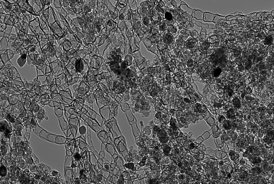 |
| A high-resolution microscopic image of a new type of nanostructured-carbon-based catalyst developed at Los Alamos National Laboratory that could pave the way for reliable, economical next-generation batteries and alkaline fuel cells. Photo credit: Los Alamos National Laboratory |
Abstract:
Los Alamos National Laboratory scientists have designed a new type of nanostructured-carbon-based catalyst that could pave the way for reliable, economical next-generation batteries and alkaline fuel cells, providing for practical use of wind- and solar-powered electricity, as well as enhanced hybrid electric vehicles.
Los Alamos catalyst could jumpstart e-cars, green energy: The new material has the highest oxygen reduction reaction (ORR) activity in alkaline media of any non-precious metal catalyst developed to date
Los Alamos, NM | Posted on June 4th, 2013In a paper appearing recently in Nature Communications, Los Alamos researchers Hoon T. Chung, Piotr Zelenay and Jong H. Won, the latter now at the Korea Basic Science Institute, describe a new type of nitrogen-doped carbon-nanotube catalyst. The new material has the highest oxygen reduction reaction (ORR) activity in alkaline media of any non-precious metal catalyst developed to date. This activity is critical for efficient storage of electrical energy.
The new catalyst doesn't use precious metals such as platinum, which is more expensive per ounce than gold, yet it performs under certain conditions as effectively as many well-known and prohibitively expensive precious-metal catalysts developed for battery and fuel-cell use. Moreover, although the catalyst is based on nitrogen-containing carbon nanotubes, it does not require the tedious, toxic and costly processing that is usually required when converting such materials for catalytic use.
"These findings could help forge a path between nanostructured-carbon-based materials and alkaline fuel cells, metal-air batteries and certain electrolyzers," said Zelenay. "A lithium-air secondary battery, potentially the most-promising metal-air battery known, has an energy storage potential that is 10 times greater than a state-of-the-art lithium-ion battery. Consequently, the new catalyst makes possible the creation of economical lithium-air batteries that could power electric vehicles, or provide efficient, reliable energy storage for intermittent sources of green energy, such as windmills or solar panels."
The scientists developed an ingenious method for synthesizing the new catalyst using readily available chemicals that allow preparation of the material in a single step. They also demonstrated that the synthesis method can be scaled up to larger volumes and could also be used to prepare other carbon-nanotube-based materials.
Project funding for the Los Alamos research came from the U.S. Department of Energy's Energy Efficiency and Renewable Energy (EERE) Office as well as from Los Alamos National Laboratory's Technology Maturation Fund and Laboratory-Directed Research and Development program.
####
About Los Alamos National Laboratory
Los Alamos National Laboratory, a multidisciplinary research institution engaged in strategic science on behalf of national security, is operated by Los Alamos National Security, LLC, a team composed of Bechtel National, the University of California, The Babcock & Wilcox Company, and URS Corporation for the Department of Energy’s National Nuclear Security Administration.
Los Alamos enhances national security by ensuring the safety and reliability of the U.S. nuclear stockpile, developing technologies to reduce threats from weapons of mass destruction, and solving problems related to energy, environment, infrastructure, health, and global security concerns.
For more information, please click here
Contacts:
James E. Rickman
505-665-9203
Copyright © Los Alamos National Laboratory
If you have a comment, please Contact us.Issuers of news releases, not 7th Wave, Inc. or Nanotechnology Now, are solely responsible for the accuracy of the content.
Bookmark:


| Related Links |
 The paper describing the breakthrough can be found here:
| Related News Press |
News and information
Quantum computer improves AI predictions April 17th, 2026
Flexible sensor gains sensitivity under pressure April 17th, 2026
A reusable chip for particulate matter sensing April 17th, 2026
Detecting vibrational quantum beating in the predissociation dynamics of SF6 using time-resolved photoelectron spectroscopy April 17th, 2026
Laboratories
Researchers develop molecular qubits that communicate at telecom frequencies October 3rd, 2025
A battery’s hopping ions remember where they’ve been: Seen in atomic detail, the seemingly smooth flow of ions through a battery’s electrolyte is surprisingly complicated February 16th, 2024
Govt.-Legislation/Regulation/Funding/Policy
Quantum computer improves AI predictions April 17th, 2026
Metasurfaces smooth light to boost magnetic sensing precision January 30th, 2026
New imaging approach transforms study of bacterial biofilms August 8th, 2025
Nanotubes/Buckyballs/Fullerenes/Nanorods/Nanostrings/Nanosheets
Tiny nanosheets, big leap: A new sensor detects ethanol at ultra-low levels January 30th, 2026
Enhancing power factor of p- and n-type single-walled carbon nanotubes April 25th, 2025
Chainmail-like material could be the future of armor: First 2D mechanically interlocked polymer exhibits exceptional flexibility and strength January 17th, 2025
Innovative biomimetic superhydrophobic coating combines repair and buffering properties for superior anti-erosion December 13th, 2024
Discoveries
Quantum computer improves AI predictions April 17th, 2026
Flexible sensor gains sensitivity under pressure April 17th, 2026
A reusable chip for particulate matter sensing April 17th, 2026
Detecting vibrational quantum beating in the predissociation dynamics of SF6 using time-resolved photoelectron spectroscopy April 17th, 2026
Announcements
A fundamentally new therapeutic approach to cystic fibrosis: Nanobody repairs cellular defect April 17th, 2026
UC Irvine physicists discover method to reverse ‘quantum scrambling’ : The work addresses the problem of information loss in quantum computing system April 17th, 2026
Interviews/Book Reviews/Essays/Reports/Podcasts/Journals/White papers/Posters
A fundamentally new therapeutic approach to cystic fibrosis: Nanobody repairs cellular defect April 17th, 2026
UC Irvine physicists discover method to reverse ‘quantum scrambling’ : The work addresses the problem of information loss in quantum computing system April 17th, 2026
Energy
Sensors innovations for smart lithium-based batteries: advancements, opportunities, and potential challenges August 8th, 2025
Simple algorithm paired with standard imaging tool could predict failure in lithium metal batteries August 8th, 2025
Automotive/Transportation
Decoding hydrogen‑bond network of electrolyte for cryogenic durable aqueous zinc‑ion batteries January 30th, 2026
Sensors innovations for smart lithium-based batteries: advancements, opportunities, and potential challenges August 8th, 2025
Simple algorithm paired with standard imaging tool could predict failure in lithium metal batteries August 8th, 2025
Battery Technology/Capacitors/Generators/Piezoelectrics/Thermoelectrics/Energy storage
Decoding hydrogen‑bond network of electrolyte for cryogenic durable aqueous zinc‑ion batteries January 30th, 2026
COF scaffold membrane with gate‑lane nanostructure for efficient Li+/Mg2+ separation January 30th, 2026
MXene nanomaterials enter a new dimension Multilayer nanomaterial: MXene flakes created at Drexel University show new promise as 1D scrolls January 30th, 2026
Fuel Cells
Deciphering local microstrain-induced optimization of asymmetric Fe single atomic sites for efficient oxygen reduction August 8th, 2025
Current and Future Developments in Nanomaterials and Carbon Nanotubes: Applications of Nanomaterials in Energy Storage and Electronics October 28th, 2022
Solar/Photovoltaic
Spinel-type sulfide semiconductors to operate the next-generation LEDs and solar cells For solar-cell absorbers and green-LED source October 3rd, 2025
KAIST researchers introduce new and improved, next-generation perovskite solar cell November 8th, 2024
Groundbreaking precision in single-molecule optoelectronics August 16th, 2024
Development of zinc oxide nanopagoda array photoelectrode: photoelectrochemical water-splitting hydrogen production January 12th, 2024
 |
||
 |
||
| The latest news from around the world, FREE | ||
 |
||
|
|
||
| Premium Products | ||
 |
||
|
Only the news you want to read!
Learn More |
||
 |
||
|
Full-service, expert consulting
Learn More |
||
|
|
||