Home > Press > Freedom of assembly
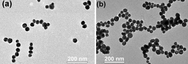 |
| Gold nanoparticles self-assemble into long chains when bombarded with electrons. |
Abstract:
In a new study performed at the Center for Nanoscale Materials at the U.S. Department of Energy's (DOE) Argonne National Laboratory, researchers have for the first time seen the self-assembly of nanoparticle chains in situ, that is, in place as it occurs in real-time.
Freedom of assembly
Lemont, IL | Posted on April 20th, 2013The scientists exposed a tiny liquid "cell" or pouch that contained gold nanoparticles covered with a positively charged coating to an intense beam of electrons generated with a transmission electron microscope. Some of the electrons that penetrated the outside of the cell became trapped in the fluid medium in the cell. These "hydrated" electrons attracted the positively charged nanoparticles, which in time reduced the intensity of charge of the positive coating.
As the hydrated electrons reduced the coating's positive charge, the nanoparticles no longer repelled each other as strongly. Instead, their newfound relative attraction led the nanoparticles to "jump around" and eventually stick together in long chains. This self-assembly of nanoparticle chains had been detected before in different studies, but this technique allowed researchers, for the first time, to observe the phenomenon as it occurred.
"The moment-to-moment behavior of nanoparticles is something that's not yet entirely understood by the scientific community," said Argonne nanoscientist Yuzi Liu, the study's lead author. "The potential of nanoparticles in all sorts of different applications and devices - from tiny machines to harvesters of new sources of energy - requires us to bring all of our resources to bear to look at how they function on the most basic physical levels."
Self-assembly is particularly interesting to scientists because it could lead to new materials that could be used to develop new, energy-relevant technologies. "When we look at self-assembly, we're looking to use nature as a springboard into man-made materials," said Argonne nanoscientist Tijana Rajh, who directed the group that carried out the study.
Because the particles under study were so tiny - just a few dozen nanometers in diameter - an optical microscope would not have been able to resolve, or see, individual nanoparticles. By using the liquid cell in the transmission electron microscope at the Center for Nanoscale Materials, Liu and his colleagues could create short movies showing the quick movement of the nanoparticles as their coatings contacted the hydrated electrons.
The study, titled In Situ Visualization of Self-Assembly of Charged Gold Nanoparticles, was published online in the Journal of the American Chemical Society. Funding for the research was provided by the U.S. Department of Energy's Office of Science.
####
About Argonne National Laboratory
Argonne National Laboratory seeks solutions to pressing national problems in science and technology. The nation's first national laboratory, Argonne conducts leading-edge basic and applied scientific research in virtually every scientific discipline. Argonne researchers work closely with researchers from hundreds of companies, universities, and federal, state and municipal agencies to help them solve their specific problems, advance America's scientific leadership and prepare the nation for a better future. With employees from more than 60 nations, Argonne is managed by UChicago Argonne, LLC for the U.S. Department of Energy's Office of Science.
The Center for Nanoscale Materials at Argonne National Laboratory is one of the five DOE Nanoscale Science Research Centers (NSRCs), premier national user facilities for interdisciplinary research at the nanoscale, supported by the DOE Office of Science. Together the NSRCs comprise a suite of complementary facilities that provide researchers with state-of-the-art capabilities to fabricate, process, characterize and model nanoscale materials, and constitute the largest infrastructure investment of the National Nanotechnology Initiative. The NSRCs are located at DOE’s Argonne, Brookhaven, Lawrence Berkeley, Oak Ridge, Sandia and Los Alamos National Laboratories.
For more information, please click here
Contacts:
Jared Sagoff
630-252-5549
Copyright © Argonne National Laboratory
If you have a comment, please Contact us.Issuers of news releases, not 7th Wave, Inc. or Nanotechnology Now, are solely responsible for the accuracy of the content.
Bookmark:


| Related Links |
| Related News Press |
News and information
 Quantum computer improves AI predictions April 17th, 2026
Flexible sensor gains sensitivity under pressure April 17th, 2026
A reusable chip for particulate matter sensing April 17th, 2026
Detecting vibrational quantum beating in the predissociation dynamics of SF6 using time-resolved photoelectron spectroscopy April 17th, 2026
Imaging
Simple algorithm paired with standard imaging tool could predict failure in lithium metal batteries August 8th, 2025
First real-time observation of two-dimensional melting process: Researchers at Mainz University unveil new insights into magnetic vortex structures August 8th, 2025
New imaging approach transforms study of bacterial biofilms August 8th, 2025
Laboratories
Researchers develop molecular qubits that communicate at telecom frequencies October 3rd, 2025
Videos/Movies
ICFO researchers overcome long-standing bottleneck in single photon detection with twisted 2D materials August 8th, 2025
Govt.-Legislation/Regulation/Funding/Policy
Quantum computer improves AI predictions April 17th, 2026
Metasurfaces smooth light to boost magnetic sensing precision January 30th, 2026
New imaging approach transforms study of bacterial biofilms August 8th, 2025
Self Assembly
Diamond glitter: A play of colors with artificial DNA crystals May 17th, 2024
Liquid crystal templated chiral nanomaterials October 14th, 2022
Nanoclusters self-organize into centimeter-scale hierarchical assemblies April 22nd, 2022
Atom by atom: building precise smaller nanoparticles with templates March 4th, 2022
Discoveries
Quantum computer improves AI predictions April 17th, 2026
Flexible sensor gains sensitivity under pressure April 17th, 2026
A reusable chip for particulate matter sensing April 17th, 2026
Detecting vibrational quantum beating in the predissociation dynamics of SF6 using time-resolved photoelectron spectroscopy April 17th, 2026
Announcements
A fundamentally new therapeutic approach to cystic fibrosis: Nanobody repairs cellular defect April 17th, 2026
UC Irvine physicists discover method to reverse ‘quantum scrambling’ : The work addresses the problem of information loss in quantum computing system April 17th, 2026
Interviews/Book Reviews/Essays/Reports/Podcasts/Journals/White papers/Posters
A fundamentally new therapeutic approach to cystic fibrosis: Nanobody repairs cellular defect April 17th, 2026
UC Irvine physicists discover method to reverse ‘quantum scrambling’ : The work addresses the problem of information loss in quantum computing system April 17th, 2026
Tools
Metasurfaces smooth light to boost magnetic sensing precision January 30th, 2026
From sensors to smart systems: the rise of AI-driven photonic noses January 30th, 2026
Japan launches fully domestically produced quantum computer: Expo visitors to experience quantum computing firsthand August 8th, 2025
 |
||
 |
||
| The latest news from around the world, FREE | ||
 |
||
|
|
||
| Premium Products | ||
 |
||
|
Only the news you want to read!
Learn More |
||
 |
||
|
Full-service, expert consulting
Learn More |
||
|
|
||