Home > Press > Potential REP Lab-on-a-Chip System for Medicine and Research
 |
Abstract:
Researchers have demonstrated a new technology that combines a laser and electric fields to create tiny centrifuge-like whirlpools to separate particles and microbes by size, a potential lab-on-a-chip system for medicine and research.
Potential REP Lab-on-a-Chip System for Medicine and Research
Germany | Posted on January 17th, 2013The theory behind the technology, called rapid electrokinetic patterning - or REP - has been described in technical papers published between 2008 and 2011. Now the researchers have used the method for the first time to collect microscopic bacteria and fungi, said Steven T. Wereley, a Purdue University professor of mechanical engineering.
The technology could bring innovative sensors and analytical devices for lab-on-a-chip applications, or miniature instruments that perform measurements normally requiring large laboratory equipment. REP is a potential new tool for applications including medical diagnostics; testing food, water and contaminated soil; isolating DNA for gene sequencing; crime-scene forensics; and pharmaceutical manufacturing.
"The new results demonstrate that REP can be used to sort biological particles but also that the technique is a powerful tool for development of a high-performance on-chip bioassay system," Wereley said.
A research paper about the technology was featured on the cover of the Dec. 7 issue of the journal Lab on a Chip. Mechanical engineering doctoral student Jae-Sung Kwon, working extensively with Sandeep Ravindranath, a doctoral student in agricultural and biological engineering, was lead author of the paper.
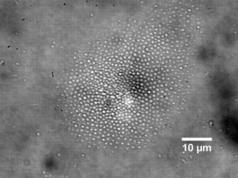
The technology works by using a highly focused infrared laser to heat a fluid in a microchannel containing particles or bacteria. An electric field is applied, combining with the laser's heating action to circulate the fluid in a "microfluidic vortex," whirling mini-maelstroms one-tenth the width of a human hair that work like a centrifuge to isolate specific types of particles based on size.
Particles of different sizes can be isolated by changing the electrical frequency, and the vortex moves wherever the laser is pointed, representing a method for positioning specific types of particles for detection and analysis.
The paper was written by Kwon; Ravindranath; Aloke Kumar, a researcher at the Oak Ridge National Laboratory; Joseph Irudayaraj, a Purdue professor of agricultural and biological engineering and deputy director of the Bindley Bioscience Center; and Wereley.
Much of the research has been based at the Birck Nanotechnology Center at Purdue's Discovery Park, in collaboration with Irudayaraj's group in the Bindley Bioscience Center.
The researchers used REP to collect three types of microorganisms: a bacterium called Shewanella oneidensis MR-1; Saccharomyces cerevisiae, a single-cell spherical fungus; and Staphylococcus aureus, a spherical bacterium. The new findings demonstrate the tool's ability to perform size-based separation of microorganisms, Wereley said.
"By properly choosing the electrical frequency we can separate blood components, such as platelets," Wereley said. "Say you want to collect Shewanella bacteria, so you use a certain electrical frequency and collect them. Then the next day you want to collect platelets from blood. That's going to be a different frequency. We foresee the ability to dynamically select what you will collect, which you could not do that with conventional tools."
The overall research field is called "optoelectrical microfluidics." More research is needed before the technology is ready for commercialization.
"It won't be on the market in a year," Wereley said. "We are still in the research end of this. We are sort of at the stage of looking for the killer app for this technology."
REP may be used as a tool for nanomanufacturing because it shows promise for the assembly of suspended particles, called colloids. The ability to construct objects with colloids makes it possible to create structures with particular mechanical and thermal characteristics to manufacture electronic devices and tiny mechanical parts.
Purdue researchers are pursuing the technology for pharmaceutical manufacturing, Wereley said, because a number of drugs are manufactured from solid particles suspended in liquid. The particles have to be collected and separated from the liquid. This process is now done using filters and centrifuges.
REP also might be used to diagnose the presence of viruses, as well, although it has not yet been used to separate viruses from a sample, Wereley said.
Unlike conventional tools, REP requires only tiny samples, making it potentially practical for medical diagnostics and laboratory analysis.
####
For more information, please click here
Copyright © Wiley-VCH Materials Science Journals
If you have a comment, please Contact us.Issuers of news releases, not 7th Wave, Inc. or Nanotechnology Now, are solely responsible for the accuracy of the content.
Bookmark:


| Related Links |
 PDFLink to the original paper:
| Related News Press |
News and information
Quantum computer improves AI predictions April 17th, 2026
Flexible sensor gains sensitivity under pressure April 17th, 2026
A reusable chip for particulate matter sensing April 17th, 2026
Detecting vibrational quantum beating in the predissociation dynamics of SF6 using time-resolved photoelectron spectroscopy April 17th, 2026
Microfluidics/Nanofluidics
Projecting light to dispense liquids: A new route to ultra-precise microdroplets January 30th, 2026
Implantable device shrinks pancreatic tumors: Taming pancreatic cancer with intratumoral immunotherapy April 14th, 2023
Researchers design new inks for 3D-printable wearable bioelectronics: Potential uses include printing electronic tattoos for medical tracking applications August 19th, 2022
Lab-on-a-chip
Micro-scale opto-thermo-mechanical actuation in the dry adhesive regime Peer-Reviewed Publication September 24th, 2021
Silicon-graphene hybrid plasmonic waveguide photodetectors beyond 1.55 μm March 13th, 2020
Nanomedicine
A fundamentally new therapeutic approach to cystic fibrosis: Nanobody repairs cellular defect April 17th, 2026
New molecular technology targets tumors and simultaneously silences two ‘undruggable’ cancer genes August 8th, 2025
New imaging approach transforms study of bacterial biofilms August 8th, 2025
Electrifying results shed light on graphene foam as a potential material for lab grown cartilage June 6th, 2025
Discoveries
Quantum computer improves AI predictions April 17th, 2026
Flexible sensor gains sensitivity under pressure April 17th, 2026
A reusable chip for particulate matter sensing April 17th, 2026
Detecting vibrational quantum beating in the predissociation dynamics of SF6 using time-resolved photoelectron spectroscopy April 17th, 2026
Announcements
A fundamentally new therapeutic approach to cystic fibrosis: Nanobody repairs cellular defect April 17th, 2026
UC Irvine physicists discover method to reverse ‘quantum scrambling’ : The work addresses the problem of information loss in quantum computing system April 17th, 2026
Nanobiotechnology
A fundamentally new therapeutic approach to cystic fibrosis: Nanobody repairs cellular defect April 17th, 2026
New molecular technology targets tumors and simultaneously silences two ‘undruggable’ cancer genes August 8th, 2025
New imaging approach transforms study of bacterial biofilms August 8th, 2025
Electrifying results shed light on graphene foam as a potential material for lab grown cartilage June 6th, 2025
Photonics/Optics/Lasers
Metasurfaces smooth light to boost magnetic sensing precision January 30th, 2026
From sensors to smart systems: the rise of AI-driven photonic noses January 30th, 2026
 |
||
 |
||
| The latest news from around the world, FREE | ||
 |
||
|
|
||
| Premium Products | ||
 |
||
|
Only the news you want to read!
Learn More |
||
 |
||
|
Full-service, expert consulting
Learn More |
||
|
|
||