Home > Press > New biosensor monitors water quality
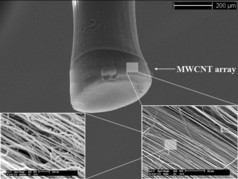 |
| A fabricated electrode with a grown MWCNT array (CNT post fabricated at the UC Nanoworld Lab). |
Abstract:
Cyanobacterial harmful algal blooms frequently occur in drinking water sources around the world due to eutrophication as a result of antrophogenic activities. Their presence in water is a potential threat because some species of cyanobacteria can produce and release potent toxic compounds (cyanotoxins), such as hepatotoxins, neurotoxins, and dermatotoxins.
New biosensor monitors water quality
Germany | Posted on January 9th, 2013Among hepatotoxins, microcystins (MCs) are the most frequently reported cyanotoxins and MC-LR is the most commonly occurring congener of MCs worldwide as well as in the USA. The World Health Organization (WHO) has proposed a provisional concentration limit of MC-LR in drinking water of 1 μg L-1. Therefore, there is a need for techniques to monitor MC-LR in various sources of water.
Recently, Prof. Dionysiou's group at the University of Cincinnati (UC) in the USA and his collaborators (UC and USEPA, Cincinnati, USA; and NCSR Demokritos, Athens, Greece) developed a multi-walled carbon nanotube (MWCNT)-based electrochemical biosensor to monitor MC-LR in sources of drinking water supplies.
They reported the formation of oxygen-containing functional groups on the MWCNT surface following electrochemical functionalization in alkaline solution. The performance of the MWCNT array biosensor demonstrated a marked increase of the electron-transfer resistance upon antibody conjugation. The biosensor's electron-transfer resistance showed a linear dependence on the MC-LR concentration ranging from 0.05 to 20 μg L-1. The sensing performance of the biosensor at low MC-LR concentration allows monitoring of this cyanotoxin well below the drinking water provisional concentration limit of 1 μg L-1.
####
For more information, please click here
Copyright © Wiley-VCH Materials Science Journals
If you have a comment, please Contact us.Issuers of news releases, not 7th Wave, Inc. or Nanotechnology Now, are solely responsible for the accuracy of the content.
Bookmark:


| Related Links |
 Link to the original paper on Wiley Online Library:
| Related News Press |
News and information
Quantum computer improves AI predictions April 17th, 2026
Flexible sensor gains sensitivity under pressure April 17th, 2026
A reusable chip for particulate matter sensing April 17th, 2026
Detecting vibrational quantum beating in the predissociation dynamics of SF6 using time-resolved photoelectron spectroscopy April 17th, 2026
Nanotubes/Buckyballs/Fullerenes/Nanorods/Nanostrings/Nanosheets
Tiny nanosheets, big leap: A new sensor detects ethanol at ultra-low levels January 30th, 2026
Enhancing power factor of p- and n-type single-walled carbon nanotubes April 25th, 2025
Chainmail-like material could be the future of armor: First 2D mechanically interlocked polymer exhibits exceptional flexibility and strength January 17th, 2025
Innovative biomimetic superhydrophobic coating combines repair and buffering properties for superior anti-erosion December 13th, 2024
Discoveries
Quantum computer improves AI predictions April 17th, 2026
Flexible sensor gains sensitivity under pressure April 17th, 2026
A reusable chip for particulate matter sensing April 17th, 2026
Detecting vibrational quantum beating in the predissociation dynamics of SF6 using time-resolved photoelectron spectroscopy April 17th, 2026
Announcements
A fundamentally new therapeutic approach to cystic fibrosis: Nanobody repairs cellular defect April 17th, 2026
UC Irvine physicists discover method to reverse ‘quantum scrambling’ : The work addresses the problem of information loss in quantum computing system April 17th, 2026
Water
Taking salt out of the water equation October 7th, 2022
 |
||
 |
||
| The latest news from around the world, FREE | ||
 |
||
|
|
||
| Premium Products | ||
 |
||
|
Only the news you want to read!
Learn More |
||
 |
||
|
Full-service, expert consulting
Learn More |
||
|
|
||