Home > Press > ‘Strain tuning’ reveals promise in nanoscale manufacturing
 |
Abstract:
Researchers at the Department of Energy's Oak Ridge National Laboratory have reported progress in fabricating advanced materials at the nanoscale.
‘Strain tuning’ reveals promise in nanoscale manufacturing
Germany | Posted on November 22nd, 2012The spontaneous self-assembly of nanostructures composed of multiple elements paves the way toward materials that could improve a range of energy efficient technologies and data storage devices.
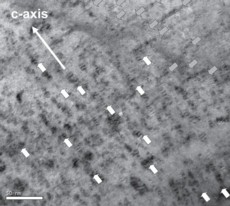
ORNL Materials Science and Technology Division researcher Amit Goyal led the effort, combining theoretical and experimental studies to understand and control the self-assembly of insulating barium zirconium oxide nanodots and nanorods within barium-copper-oxide superconducting films.
"We found that a strain field that develops around the embedded nanodots and nanorods is a key driving force in the self-assembly," said Goyal, a UT-Battelle Corporate Fellow. "By tuning the strain field, the nanodefects self-assembled within the superconducting film and included defects aligned in both vertical and horizontal directions."
The controlled assembly within the superconducting material resulted in greatly improved properties, Goyal said, including a marked reduction in the material's anisotropy, or directional dependence, desired for many large-scale, high-temperature superconductivity applications.
The strain-tuning the team demonstrated has implications in the nanoscale fabrication of controlled, self-assembled nanostructures of multiple elements, with properties suitable for a range of electrical and electronic applications, including multiferroics, magnetoelectrics, thermoelectrics, photovoltaics, ultra-high density information storage and high-temperature superconductors.
"Such nanocomposite films with different overall composition, concentration, feature size and spatial ordering can produce a number of novel and unprecedented properties that are not exhibited in individual materials or phases comprising the composite films," Goyal said.
####
For more information, please click here
Copyright © Wiley-VCH Materials Science Journals
If you have a comment, please Contact us.Issuers of news releases, not 7th Wave, Inc. or Nanotechnology Now, are solely responsible for the accuracy of the content.
Bookmark:


| Related Links |
 Link to the original paper on Wiley Online Library:
| Related News Press |
News and information
Quantum computer improves AI predictions April 17th, 2026
Flexible sensor gains sensitivity under pressure April 17th, 2026
A reusable chip for particulate matter sensing April 17th, 2026
Detecting vibrational quantum beating in the predissociation dynamics of SF6 using time-resolved photoelectron spectroscopy April 17th, 2026
Superconductivity
MXene nanomaterials enter a new dimension Multilayer nanomaterial: MXene flakes created at Drexel University show new promise as 1D scrolls January 30th, 2026
Lattice-driven charge density wave fluctuations far above the transition temperature in Kagome superconductor April 25th, 2025
Laboratories
Researchers develop molecular qubits that communicate at telecom frequencies October 3rd, 2025
Govt.-Legislation/Regulation/Funding/Policy
Quantum computer improves AI predictions April 17th, 2026
Metasurfaces smooth light to boost magnetic sensing precision January 30th, 2026
New imaging approach transforms study of bacterial biofilms August 8th, 2025
Chip Technology
A reusable chip for particulate matter sensing April 17th, 2026
Metasurfaces smooth light to boost magnetic sensing precision January 30th, 2026
Memory Technology
Researchers tackle the memory bottleneck stalling quantum computing October 3rd, 2025
First real-time observation of two-dimensional melting process: Researchers at Mainz University unveil new insights into magnetic vortex structures August 8th, 2025
Utilizing palladium for addressing contact issues of buried oxide thin film transistors April 5th, 2024
Self Assembly
Diamond glitter: A play of colors with artificial DNA crystals May 17th, 2024
Liquid crystal templated chiral nanomaterials October 14th, 2022
Nanoclusters self-organize into centimeter-scale hierarchical assemblies April 22nd, 2022
Atom by atom: building precise smaller nanoparticles with templates March 4th, 2022
Discoveries
Quantum computer improves AI predictions April 17th, 2026
Flexible sensor gains sensitivity under pressure April 17th, 2026
A reusable chip for particulate matter sensing April 17th, 2026
Detecting vibrational quantum beating in the predissociation dynamics of SF6 using time-resolved photoelectron spectroscopy April 17th, 2026
Announcements
A fundamentally new therapeutic approach to cystic fibrosis: Nanobody repairs cellular defect April 17th, 2026
UC Irvine physicists discover method to reverse ‘quantum scrambling’ : The work addresses the problem of information loss in quantum computing system April 17th, 2026
Energy
Sensors innovations for smart lithium-based batteries: advancements, opportunities, and potential challenges August 8th, 2025
Simple algorithm paired with standard imaging tool could predict failure in lithium metal batteries August 8th, 2025
Solar/Photovoltaic
Spinel-type sulfide semiconductors to operate the next-generation LEDs and solar cells For solar-cell absorbers and green-LED source October 3rd, 2025
KAIST researchers introduce new and improved, next-generation perovskite solar cell November 8th, 2024
Groundbreaking precision in single-molecule optoelectronics August 16th, 2024
Development of zinc oxide nanopagoda array photoelectrode: photoelectrochemical water-splitting hydrogen production January 12th, 2024
 |
||
 |
||
| The latest news from around the world, FREE | ||
 |
||
|
|
||
| Premium Products | ||
 |
||
|
Only the news you want to read!
Learn More |
||
 |
||
|
Full-service, expert consulting
Learn More |
||
|
|
||