Home > Press > Graphene earns its stripes: New nanoscale electronic state discovered on graphene sheets
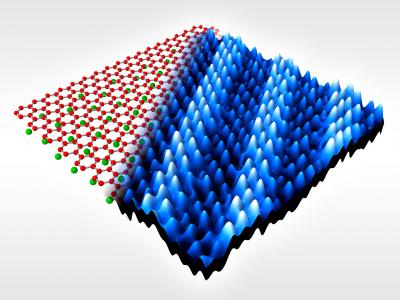 |
| These are electronic stripes, called "charge density waves," on the surface of a graphitic superconductor.
Credit: K. A. Rahnejat |
Abstract:
Researchers from the London Centre for Nanotechnology (LCN) have discovered electronic stripes, called 'charge density waves', on the surface of the graphene sheets that make up a graphitic superconductor. This is the first time these stripes have been seen on graphene, and the finding is likely to have profound implications for the exploitation of this recently discovered material, which scientists believe will play a key role in the future of nanotechnology. The discovery is reported in Nature Communications, 29th November.
Graphene earns its stripes: New nanoscale electronic state discovered on graphene sheets
London, UK | Posted on November 29th, 2011Graphene is a material made up of a single sheet of carbon atoms just one atom thick, and is found in the marks made by a graphite pencil. Graphene has remarkable physical properties and therefore has great technological potential, for example, in transparent electrodes for flat screen TVs, in fast energy-efficient transistors, and in ultra-strong composite materials. Scientists are now devoting huge efforts to understand and control the properties of this material.
The LCN team donated extra electrons to a graphene surface by sliding calcium metal atoms underneath it. One would normally expect these additional electrons to spread out evenly on the graphene surface, just as oil spreads out on water. But by using an instrument known as a scanning tunneling microscope, which can image individual atoms, the researchers have found that the extra electrons arrange themselves spontaneously into nanometer-scale stripes. This unexpected behavior demonstrates that the electrons can have a life of their own which is not connected directly to the underlying atoms. The results inspire many new directions for both science and technology. For example, they suggest a new method for manipulating and encoding information, where binary zeros and ones correspond to stripes running from north to south and running from east to west respectively.
This work is part of an ongoing multi-disciplinary research effort into graphene at the LCN and follows on from the original discovery of superconductivity in the graphite superconductor CaC6 by Weller at al. published in Nature Physics, doi:10.1038/nphys0010.
Professor Jan Zaanen of Leiden University and winner of the prestigious Spinoza prize for, among other things, his role as proponent of the stripe concept for atomically thin materials, commented: "This discovery is another important step towards demonstrating the ubiquity of stripes, and the fact that they appear in the world's simplest host - the two-dimensional network of carbon atoms that is graphene - means that more great science and applications are not far behind."
Notes to Editors:
The paper
'Charge density waves in the graphene sheets of the superconductor CaC6' appears in Nature Communications on 29th November 2001. DOI: 10.1038/ncomms1574
####
About University College London
The London Centre for Nanotechnology, is a UK-based, multidisciplinary research centre forming the bridge between the physical and biomedical sciences. It was conceived from the outset with a management structure allowing for a clear focus on scientific excellence, exploitation and commercialisation. It brings together two world leaders in nanotechnology, namely University College London and Imperial College London, in a unique operating model that accesses the combined skills of multiple departments, including medicine, chemistry, physics, electronic and electrical engineering, biochemical engineering, materials and earth sciences, and two leading technology transfer offices. Website: www.london-nano.com
For more information, please click here
Contacts:
Joanna Rooke
44-207-679-9950
Copyright © University College London
If you have a comment, please Contact us.Issuers of news releases, not 7th Wave, Inc. or Nanotechnology Now, are solely responsible for the accuracy of the content.
Bookmark:


| Related News Press |
News and information
 Quantum computer improves AI predictions April 17th, 2026
Flexible sensor gains sensitivity under pressure April 17th, 2026
A reusable chip for particulate matter sensing April 17th, 2026
Detecting vibrational quantum beating in the predissociation dynamics of SF6 using time-resolved photoelectron spectroscopy April 17th, 2026
Graphene/ Graphite
Electrifying results shed light on graphene foam as a potential material for lab grown cartilage June 6th, 2025
Breakthrough in proton barrier films using pore-free graphene oxide: Kumamoto University researchers achieve new milestone in advanced coating technologies September 13th, 2024
Chip Technology
A reusable chip for particulate matter sensing April 17th, 2026
Metasurfaces smooth light to boost magnetic sensing precision January 30th, 2026
Memory Technology
Researchers tackle the memory bottleneck stalling quantum computing October 3rd, 2025
First real-time observation of two-dimensional melting process: Researchers at Mainz University unveil new insights into magnetic vortex structures August 8th, 2025
Utilizing palladium for addressing contact issues of buried oxide thin film transistors April 5th, 2024
Discoveries
Quantum computer improves AI predictions April 17th, 2026
Flexible sensor gains sensitivity under pressure April 17th, 2026
A reusable chip for particulate matter sensing April 17th, 2026
Detecting vibrational quantum beating in the predissociation dynamics of SF6 using time-resolved photoelectron spectroscopy April 17th, 2026
Announcements
A fundamentally new therapeutic approach to cystic fibrosis: Nanobody repairs cellular defect April 17th, 2026
UC Irvine physicists discover method to reverse ‘quantum scrambling’ : The work addresses the problem of information loss in quantum computing system April 17th, 2026
 |
||
 |
||
| The latest news from around the world, FREE | ||
 |
||
|
|
||
| Premium Products | ||
 |
||
|
Only the news you want to read!
Learn More |
||
 |
||
|
Full-service, expert consulting
Learn More |
||
|
|
||