Home > Press > Carbon nanotube structures changed by 'attack' from within, researchers discover
 |
Abstract:
A team of researchers involving scientists from The University of Nottingham has shown for the first time that chemical reactions at the nano-level which change the structure of carbon nanotubes can be sparked by an ‘attack' from within.
Carbon nanotube structures changed by 'attack' from within, researchers discover
Nottingham, UK | Posted on August 16th, 2011The discovery challenges previous scientific thinking that the internal surface of the hollow nanostructures is chemically unreactive, largely restricting their use to that of an inert container or a ‘nano-reactor' inside which other chemical reactions can take place.
Their research, published in the journal Nature Chemistry, shows that carbon nanotubes that have had their structures changed are exciting new materials that could be useful in the development of new technologies for gas storage devices, chemical sensors and parts of electronic devices such as transistors.
Dr Andrei Khlobystov, of the University's School of Chemistry, who led the work at Nottingham, said: "It has universally been accepted for some time now that the internal surface of carbon nanotubes — or the concave side — is chemically unreactive, and indeed we have been successfully using carbon nanotubes as nano-reactors.
"However, in the course of this new research we made the serendipitous discovery that in the presence of catalytically active transition metals inside the nanotube cavity, the nanotube itself can be involved in unexpected chemical reactions."
Carbon nanotubes are remarkable nanostructures with a typical diameter of 1-2 nanometres, which is 80,000 times smaller than the thickness of a human hair. Dr Khlobystov and his research associates were recently involved in the discovery — published in Nature Materials — that nanotubes can be used as a catalyst for the production of nanoribbon, atomically thin strips of carbon created from carbon and sulphur atoms. These nanoribbons could potentially be used as new materials for the next generation of computers and data storage devices that are faster, smaller and more powerful.
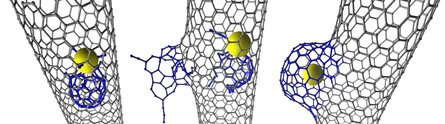
In this latest research, the scientists found that an individual atom of Rhenium metal (Re) sets off a chemical reaction leading to the transformation of the inner wall of the nanotube. Initially, the attack by the Rhenium creates a small defect in the nanotube wall which then gradually develops into a nano-sized protrusion by ‘eating' additional carbon atoms.
The protrusion then rapidly increases in size and seals itself off, forming a unique carbon structure dubbed a NanoBud, so called because the protrusion on the carbon nanotube resembles a bud on a stem.
Previously, NanoBuds were believed to be formed outside the nanotube through reactions on the outer surface with carbon molecules called fullerenes.
The new study demonstrates for the first time that they can be formed from within, provided that a transition metal atom with suitable catalytic activity is present within the nanotube.
In collaboration with the Electron Microscopy of Materials Science group at Ulm University in Germany, the scientists have even been able to capture ‘on camera' the chemical reaction of the transition metal atom with the nanotube in real time at the atomic level using the latest Aberration-Corrected High Resolution Transmission Electron Microscopy (AC-HRTEM). Their videos show nanotubes with a diameter of around 1.5 nanometers, while the NanoBuds are just 1 nanometer across.
####
For more information, please click here
Contacts:
Dr Andrei Khlobystov
Emma Thorne
Media Relations Manager
Email:
Phone: +44 (0)115 951 5793
Location: King's Meadow Campus
Copyright © University of Nottingham
If you have a comment, please Contact us.Issuers of news releases, not 7th Wave, Inc. or Nanotechnology Now, are solely responsible for the accuracy of the content.
Bookmark:


| Related News Press |
News and information
 Quantum computer improves AI predictions April 17th, 2026
Flexible sensor gains sensitivity under pressure April 17th, 2026
A reusable chip for particulate matter sensing April 17th, 2026
Detecting vibrational quantum beating in the predissociation dynamics of SF6 using time-resolved photoelectron spectroscopy April 17th, 2026
Chemistry
Projecting light to dispense liquids: A new route to ultra-precise microdroplets January 30th, 2026
From sensors to smart systems: the rise of AI-driven photonic noses January 30th, 2026
"Nanoreactor" cage uses visible light for catalytic and ultra-selective cross-cycloadditions October 3rd, 2025
Cambridge chemists discover simple way to build bigger molecules – one carbon at a time June 6th, 2025
Chip Technology
A reusable chip for particulate matter sensing April 17th, 2026
Metasurfaces smooth light to boost magnetic sensing precision January 30th, 2026
Nanotubes/Buckyballs/Fullerenes/Nanorods/Nanostrings/Nanosheets
Tiny nanosheets, big leap: A new sensor detects ethanol at ultra-low levels January 30th, 2026
Enhancing power factor of p- and n-type single-walled carbon nanotubes April 25th, 2025
Chainmail-like material could be the future of armor: First 2D mechanically interlocked polymer exhibits exceptional flexibility and strength January 17th, 2025
Innovative biomimetic superhydrophobic coating combines repair and buffering properties for superior anti-erosion December 13th, 2024
Sensors
Flexible sensor gains sensitivity under pressure April 17th, 2026
Tiny nanosheets, big leap: A new sensor detects ethanol at ultra-low levels January 30th, 2026
From sensors to smart systems: the rise of AI-driven photonic noses January 30th, 2026
Sensors innovations for smart lithium-based batteries: advancements, opportunities, and potential challenges August 8th, 2025
Discoveries
Quantum computer improves AI predictions April 17th, 2026
Flexible sensor gains sensitivity under pressure April 17th, 2026
A reusable chip for particulate matter sensing April 17th, 2026
Detecting vibrational quantum beating in the predissociation dynamics of SF6 using time-resolved photoelectron spectroscopy April 17th, 2026
Announcements
A fundamentally new therapeutic approach to cystic fibrosis: Nanobody repairs cellular defect April 17th, 2026
UC Irvine physicists discover method to reverse ‘quantum scrambling’ : The work addresses the problem of information loss in quantum computing system April 17th, 2026
Tools
Metasurfaces smooth light to boost magnetic sensing precision January 30th, 2026
From sensors to smart systems: the rise of AI-driven photonic noses January 30th, 2026
Japan launches fully domestically produced quantum computer: Expo visitors to experience quantum computing firsthand August 8th, 2025
 |
||
 |
||
| The latest news from around the world, FREE | ||
 |
||
|
|
||
| Premium Products | ||
 |
||
|
Only the news you want to read!
Learn More |
||
 |
||
|
Full-service, expert consulting
Learn More |
||
|
|
||