Home > Press > NIU scientists discover simple, green and cost-effective way to produce high yields of highly touted graphene
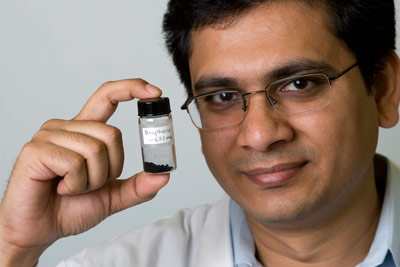 |
| Amartya Chakrabarti holds up a sample of graphene produced via the dry-ice method. |
Abstract:
Scientists at Northern Illinois University say they have discovered a simple method for producing high yields of graphene, a highly touted carbon nanostructure that some believe could replace silicon as the technological fabric of the future.
NIU scientists discover simple, green and cost-effective way to produce high yields of highly touted graphene
DeKalb, IL | Posted on June 20th, 2011The focus of intense scientific research in recent years, graphene is a two-dimensional material, comprised of a single layer of carbon atoms arranged in a hexagonal lattice. It is the strongest material ever measured and has other remarkable qualities, including high electron mobility, a property that elevates its potential for use in high-speed nano-scale devices of the future.
In a June communication to the Journal of Materials Chemistry, the NIU researchers report on a new method that converts carbon dioxide directly into few-layer graphene (less than 10 atoms in thickness) by burning pure magnesium metal in dry ice.
"It is scientifically proven that burning magnesium metal in carbon dioxide produces carbon, but the formation of this carbon with few-layer graphene as the major product has neither been identified nor proven as such until our current report," said Narayan Hosmane, a professor of chemistry and biochemistry who leads the NIU research group.
"The synthetic process can be used to potentially produce few-layer graphene in large quantities," he said. "Up until now, graphene has been synthesized by various methods utilizing hazardous chemicals and tedious techniques. This new method is simple, green and cost-effective."
Hosmane said his research group initially set out to produce single-wall carbon nanotubes. "Instead, we isolated few-layer graphene," he said. "It surprised us all."
"It's a very simple technique that's been done by scientists before," added Amartya Chakrabarti, first author of the communication to the Journal of Materials Chemistry and an NIU post-doctoral research associate in chemistry and biochemistry. "But nobody actually closely examined the structure of the carbon that had been produced."
Other members of the research group publishing in the Journal of Materials Chemistry include former NIU physics postdoctoral research associate Jun Lu, NIU undergraduate student Jennifer Skrabutenas, NIU Chemistry and Biochemistry Professor Tao Xu, NIU Physics Professor Zhili Xiao and John A. Maguire, a chemistry professor at Southern Methodist University.
The work was supported by grants from the National Science Foundation, Petroleum Research Fund administered by the American Chemical Society, the Department of Energy and Robert A. Welch Foundation.
####
For more information, please click here
Contacts:
Tom Parisi
NIU
Media Relations & Internal Communications
815-753-3635
Copyright © Northern Illinois University
If you have a comment, please Contact us.Issuers of news releases, not 7th Wave, Inc. or Nanotechnology Now, are solely responsible for the accuracy of the content.
Bookmark:


| Related Links |
 The Journal of Materials Chemistry communication can be downloaded at:
| Related News Press |
News and information
Quantum computer improves AI predictions April 17th, 2026
Flexible sensor gains sensitivity under pressure April 17th, 2026
A reusable chip for particulate matter sensing April 17th, 2026
Detecting vibrational quantum beating in the predissociation dynamics of SF6 using time-resolved photoelectron spectroscopy April 17th, 2026
Graphene/ Graphite
Electrifying results shed light on graphene foam as a potential material for lab grown cartilage June 6th, 2025
Breakthrough in proton barrier films using pore-free graphene oxide: Kumamoto University researchers achieve new milestone in advanced coating technologies September 13th, 2024
Govt.-Legislation/Regulation/Funding/Policy
Quantum computer improves AI predictions April 17th, 2026
Metasurfaces smooth light to boost magnetic sensing precision January 30th, 2026
New imaging approach transforms study of bacterial biofilms August 8th, 2025
Possible Futures
A fundamentally new therapeutic approach to cystic fibrosis: Nanobody repairs cellular defect April 17th, 2026
UC Irvine physicists discover method to reverse ‘quantum scrambling’ : The work addresses the problem of information loss in quantum computing system April 17th, 2026
Chip Technology
A reusable chip for particulate matter sensing April 17th, 2026
Metasurfaces smooth light to boost magnetic sensing precision January 30th, 2026
Discoveries
Quantum computer improves AI predictions April 17th, 2026
Flexible sensor gains sensitivity under pressure April 17th, 2026
A reusable chip for particulate matter sensing April 17th, 2026
Detecting vibrational quantum beating in the predissociation dynamics of SF6 using time-resolved photoelectron spectroscopy April 17th, 2026
Announcements
A fundamentally new therapeutic approach to cystic fibrosis: Nanobody repairs cellular defect April 17th, 2026
UC Irvine physicists discover method to reverse ‘quantum scrambling’ : The work addresses the problem of information loss in quantum computing system April 17th, 2026
Grants/Sponsored Research/Awards/Scholarships/Gifts/Contests/Honors/Records
Quantum computer improves AI predictions April 17th, 2026
Detecting vibrational quantum beating in the predissociation dynamics of SF6 using time-resolved photoelectron spectroscopy April 17th, 2026
Metasurfaces smooth light to boost magnetic sensing precision January 30th, 2026
 |
||
 |
||
| The latest news from around the world, FREE | ||
 |
||
|
|
||
| Premium Products | ||
 |
||
|
Only the news you want to read!
Learn More |
||
 |
||
|
Full-service, expert consulting
Learn More |
||
|
|
||