Home > Press > NIMS Signed MOU with The Inter University Accelerator Centre of India
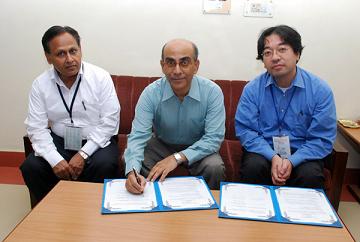 |
| From left: Dr. Devesh Kumar Avasthi (IUAC, Group Leader of Materials Science & Radiation Biology), Dr. Amit Roy (IUAC, Director), and Dr. Hiroshi Amekura (NIMS, Senior Researcher). |
Abstract:
The Inter University Accelerator Centre (IUAC), New Delhi, India, and the Quantum Beam Center, NIMS, signed a Memorandum of Understanding (MOU) on collaborative research for "the Fabrication and modification of nano-materials by ion beams".
NIMS Signed MOU with The Inter University Accelerator Centre of India
Japan | Posted on November 8th, 2010The IUAC has a 50 meter tall tower made of heavy concrete, which houses a Pelletron-type tandem accelerator. The accelerator generates high energy beam up to 200 MeV of heavy ions such as gold, silver, etc. This kind of the swift heavy ions seldom collide with the atoms in solids, and rather induce high-density electronic excitation in nanometric cylindrical regions along the ion trajectories.
In the collaborative research, we focus on irradiation effects of the swift heavy ions on morphology and physical properties of nano-structures, such as metal and oxide nanoparticles embedded in insulators. We hope that this collaboration will open a door to the new paradigm which could be called "High-energy nanotechnology".
####
For more information, please click here
Copyright © National Institute for Materials Science
If you have a comment, please Contact us.Issuers of news releases, not 7th Wave, Inc. or Nanotechnology Now, are solely responsible for the accuracy of the content.
Bookmark:


| Related News Press |
News and information
 Quantum computer improves AI predictions April 17th, 2026
Flexible sensor gains sensitivity under pressure April 17th, 2026
A reusable chip for particulate matter sensing April 17th, 2026
Detecting vibrational quantum beating in the predissociation dynamics of SF6 using time-resolved photoelectron spectroscopy April 17th, 2026
Academic/Education
Rice University launches Rice Synthetic Biology Institute to improve lives January 12th, 2024
Multi-institution, $4.6 million NSF grant to fund nanotechnology training September 9th, 2022
Announcements
A fundamentally new therapeutic approach to cystic fibrosis: Nanobody repairs cellular defect April 17th, 2026
UC Irvine physicists discover method to reverse ‘quantum scrambling’ : The work addresses the problem of information loss in quantum computing system April 17th, 2026
Tools
Metasurfaces smooth light to boost magnetic sensing precision January 30th, 2026
From sensors to smart systems: the rise of AI-driven photonic noses January 30th, 2026
Japan launches fully domestically produced quantum computer: Expo visitors to experience quantum computing firsthand August 8th, 2025
Alliances/Trade associations/Partnerships/Distributorships
Chicago Quantum Exchange welcomes six new partners highlighting quantum technology solutions, from Chicago and beyond September 23rd, 2022
University of Illinois Chicago joins Brookhaven Lab's Quantum Center June 10th, 2022
 |
||
 |
||
| The latest news from around the world, FREE | ||
 |
||
|
|
||
| Premium Products | ||
 |
||
|
Only the news you want to read!
Learn More |
||
 |
||
|
Full-service, expert consulting
Learn More |
||
|
|
||