Home > Press > Student’s Discovery Advances Nanotech Research
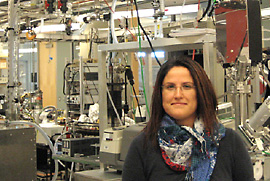 |
| Materials science graduate student Muge Acik has been working with graphene, a single sheet of carbon that exhibits unique electronic and mechanical properties. |
Abstract:
Enhanced, Ultra-Thin Sheets of Carbon Hold Promise in Sensor Applications
Student’s Discovery Advances Nanotech Research
Richardson, TX | Posted on October 7th, 2010A UT Dallas graduate student's surprising research results could ultimately lead to high-performance nanoelectronics applications such as electron emitters, thermal-infrared night-vision sensors and solar absorbers for harvesting sunlight.
Materials science graduate student Muge Acik has been working with graphene, a single sheet of carbon that exhibits unique electronic and mechanical properties, making it a candidate to eventually replace silicon in applications like ultrafast transistors.
Making real-world devices from graphene, however, depends upon controlling the edges of graphene sheets, which often dictate the material's electronic properties. Simply adding oxygen atoms at the edges may turn graphene into an insulator.
Performing her experimental work on graphene oxide (GO) in Dr. Yves Chabal's Laboratory for Surface and Nanostructure Modification, Acik discovered a new infrared absorption mechanism when GO is annealed to about 850°C to remove most oxygen. The result was a very special arrangement of oxygen atoms at the edges. This stable configuration fosters the electronic conduction or emission necessary for device operation and for electron emitters.
Moreover, "this new phenomenon opens the door to tailoring giant infrared absorption at different spectral positions by modifying the nature of the edge termination," she and her co-investigators concluded. And that opens the door to employing graphene in a number of nanoelectronic applications in which infrared absorption is important, such as night-vision sensors and sunlight-harvesting solar absorbers.
"This work is a good example where the contribution from theory has been critical, as provided by Dr. G. Lee, a postdoctoral fellow working under the supervision of Dr. Kyeongjae ‘KJ' Cho," said Chabal, head of materials science and engineering and holder of the Texas Instruments Distinguished University Chair in Nanoelectronics. "The theory provided a detailed understanding of this new phenomenon that would have remained puzzling on its own."
Cho added that "this experimental finding is consistent with an earlier theoretical prediction of the metallic state of graphene edge oxide published in Physical Review in 2009."
The team's results recently appeared in the journal Nature Materials in an article titled "Unusual Infrared Absorption Mechanism in Thermally Reduced Graphene Oxide."
This absorption is a new phenomenon that's unique to graphene, according to Chabal in an article that appeared in nanotechweb.org, noting that the potential applications are very exciting.
"The effect cannot be explained by simple infrared absorption mechanisms and can only happen if free, mobile electrons are induced in reduced graphene oxide - something that has never been observed before," the article concluded.
The research was funded by the Semiconductor Research Corp.'s Nanotechnology Research Initiative and by Texas Instruments. The work was done in collaboration with Cecilia Mattevi and Manish Chhowalla at Rutgers University. A synopsis of the Nature Materials article is featured under Nano Focus here.
####
For more information, please click here
Contacts:
Media Contact: David Moore, UT Dallas, (972) 883-4183,
Office of Media Relations, UT Dallas, (972) 883-2155,
Copyright © University of Texas at Dallas
If you have a comment, please Contact us.Issuers of news releases, not 7th Wave, Inc. or Nanotechnology Now, are solely responsible for the accuracy of the content.
Bookmark:


| Related News Press |
News and information
 Quantum computer improves AI predictions April 17th, 2026
Flexible sensor gains sensitivity under pressure April 17th, 2026
A reusable chip for particulate matter sensing April 17th, 2026
Detecting vibrational quantum beating in the predissociation dynamics of SF6 using time-resolved photoelectron spectroscopy April 17th, 2026
Possible Futures
A fundamentally new therapeutic approach to cystic fibrosis: Nanobody repairs cellular defect April 17th, 2026
UC Irvine physicists discover method to reverse ‘quantum scrambling’ : The work addresses the problem of information loss in quantum computing system April 17th, 2026
Academic/Education
Rice University launches Rice Synthetic Biology Institute to improve lives January 12th, 2024
Multi-institution, $4.6 million NSF grant to fund nanotechnology training September 9th, 2022
Chip Technology
A reusable chip for particulate matter sensing April 17th, 2026
Metasurfaces smooth light to boost magnetic sensing precision January 30th, 2026
Sensors
Flexible sensor gains sensitivity under pressure April 17th, 2026
Tiny nanosheets, big leap: A new sensor detects ethanol at ultra-low levels January 30th, 2026
From sensors to smart systems: the rise of AI-driven photonic noses January 30th, 2026
Sensors innovations for smart lithium-based batteries: advancements, opportunities, and potential challenges August 8th, 2025
Nanoelectronics
Lab to industry: InSe wafer-scale breakthrough for future electronics August 8th, 2025
Interdisciplinary: Rice team tackles the future of semiconductors Multiferroics could be the key to ultralow-energy computing October 6th, 2023
Key element for a scalable quantum computer: Physicists from Forschungszentrum Jülich and RWTH Aachen University demonstrate electron transport on a quantum chip September 23rd, 2022
Reduced power consumption in semiconductor devices September 23rd, 2022
Discoveries
Quantum computer improves AI predictions April 17th, 2026
Flexible sensor gains sensitivity under pressure April 17th, 2026
A reusable chip for particulate matter sensing April 17th, 2026
Detecting vibrational quantum beating in the predissociation dynamics of SF6 using time-resolved photoelectron spectroscopy April 17th, 2026
Announcements
A fundamentally new therapeutic approach to cystic fibrosis: Nanobody repairs cellular defect April 17th, 2026
UC Irvine physicists discover method to reverse ‘quantum scrambling’ : The work addresses the problem of information loss in quantum computing system April 17th, 2026
Energy
Sensors innovations for smart lithium-based batteries: advancements, opportunities, and potential challenges August 8th, 2025
Simple algorithm paired with standard imaging tool could predict failure in lithium metal batteries August 8th, 2025
Solar/Photovoltaic
Spinel-type sulfide semiconductors to operate the next-generation LEDs and solar cells For solar-cell absorbers and green-LED source October 3rd, 2025
KAIST researchers introduce new and improved, next-generation perovskite solar cell November 8th, 2024
Groundbreaking precision in single-molecule optoelectronics August 16th, 2024
Development of zinc oxide nanopagoda array photoelectrode: photoelectrochemical water-splitting hydrogen production January 12th, 2024
 |
||
 |
||
| The latest news from around the world, FREE | ||
 |
||
|
|
||
| Premium Products | ||
 |
||
|
Only the news you want to read!
Learn More |
||
 |
||
|
Full-service, expert consulting
Learn More |
||
|
|
||