Home > Press > TCD Nanoscientist Receives Major European Research Grant to Support Development of Next Generation Materials
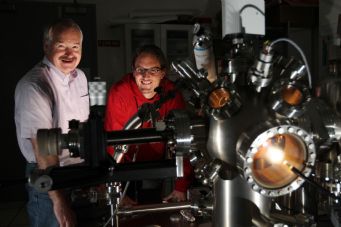 |
| Principal Investigator at CRANN, the TCD and UCC based nanoscience research institute, and Professor in the School of Physics, Trinity College Dublin Jonathan Coleman been awarded a prestigious European Research Commission (ERC) Starter Grant of €1.5 million |
Abstract:
Professor Jonathan Coleman, Professor of Physics, Trinity College Dublin has been awarded a prestigious European Research Council (ERC) Starter Grant of €1.5 million. He is one of Irelands' leading nanoscientists and is a Principal Investigator at CRANN, the TCD and UCC based nanoscience research institute.
TCD Nanoscientist Receives Major European Research Grant to Support Development of Next Generation Materials
Dublin, Ireland | Posted on August 8th, 2010The awards are given to only 300 top scientists across Europe, less than 10% of those who apply. The awards recognise scientists who are working on research with major potential so that they will have the funding and encouragement to develop cutting edge science.
Professor John Donegan, Head of the School of Physics commented, "Johnny Coleman is a scientist of great international repute. His publication record is extraordinary and he is a gifted communicator. The School is rightly proud of his achieving the ERC award and we fully expect great new science will arise from this research".
Professor John Boland, Director of CRANN said, "These awards are only made to Europe's top scientists and it is great recognition of the work being done by Professor Coleman and his team to develop next-generation materials. Ireland has built up its expertise in the area of nanoscience which is globally recognised, as evidenced by the increasing number of international research grants we are attracting. Ireland is beginning to take a globally recognised leadership position in Nanoscience and scientists of the calibre of Professor Coleman are critical to building our reputation."
The research grant is based on Professor Coleman's work with graphene and his team's novel method of being able to split graphite (millions of graphene sheets stuck tightly together) down into individual layers of graphene, which could be used to make stronger and lighter materials. They could be incorporated into products that uses plastic, making composites which are stronger, lighter and more environmentally friendly e.g. aircraft parts, car parts, sport and household goods.
Two of the materials that Professor Coleman is currently researching are Bismuth Telluride and Molybdenum Disulfide. Bismuth Telluride is used to generate energy from waste heat, for example from car engines or in nuclear plants. Professor Coleman's method of separating graphene using a liquid process could be applied to bismuth telluride, which could then be coated onto thin films and attached to the side of a car to capture the lost heat energy and convert it into usable electrical energy.
Molybolenum disulfide is currently being evaluated for use in batteries. However production of this is currently time consuming and complicated. Using the methods developed by Professor Coleman's group, one would be able to produce and apply the films in a simpler and faster way, allowing industrialisation of the process.
####
For more information, please click here
Contacts:
Central Switchboard
+353 1 896 1000
Copyright © Trinity College Dublin
If you have a comment, please Contact us.Issuers of news releases, not 7th Wave, Inc. or Nanotechnology Now, are solely responsible for the accuracy of the content.
Bookmark:


| Related News Press |
News and information
 Quantum computer improves AI predictions April 17th, 2026
Flexible sensor gains sensitivity under pressure April 17th, 2026
A reusable chip for particulate matter sensing April 17th, 2026
Detecting vibrational quantum beating in the predissociation dynamics of SF6 using time-resolved photoelectron spectroscopy April 17th, 2026
Possible Futures
A fundamentally new therapeutic approach to cystic fibrosis: Nanobody repairs cellular defect April 17th, 2026
UC Irvine physicists discover method to reverse ‘quantum scrambling’ : The work addresses the problem of information loss in quantum computing system April 17th, 2026
Academic/Education
Rice University launches Rice Synthetic Biology Institute to improve lives January 12th, 2024
Multi-institution, $4.6 million NSF grant to fund nanotechnology training September 9th, 2022
Nanotubes/Buckyballs/Fullerenes/Nanorods/Nanostrings/Nanosheets
Tiny nanosheets, big leap: A new sensor detects ethanol at ultra-low levels January 30th, 2026
Enhancing power factor of p- and n-type single-walled carbon nanotubes April 25th, 2025
Chainmail-like material could be the future of armor: First 2D mechanically interlocked polymer exhibits exceptional flexibility and strength January 17th, 2025
Innovative biomimetic superhydrophobic coating combines repair and buffering properties for superior anti-erosion December 13th, 2024
Announcements
A fundamentally new therapeutic approach to cystic fibrosis: Nanobody repairs cellular defect April 17th, 2026
UC Irvine physicists discover method to reverse ‘quantum scrambling’ : The work addresses the problem of information loss in quantum computing system April 17th, 2026
Energy
Sensors innovations for smart lithium-based batteries: advancements, opportunities, and potential challenges August 8th, 2025
Simple algorithm paired with standard imaging tool could predict failure in lithium metal batteries August 8th, 2025
Automotive/Transportation
Decoding hydrogen‑bond network of electrolyte for cryogenic durable aqueous zinc‑ion batteries January 30th, 2026
Sensors innovations for smart lithium-based batteries: advancements, opportunities, and potential challenges August 8th, 2025
Simple algorithm paired with standard imaging tool could predict failure in lithium metal batteries August 8th, 2025
Battery Technology/Capacitors/Generators/Piezoelectrics/Thermoelectrics/Energy storage
Decoding hydrogen‑bond network of electrolyte for cryogenic durable aqueous zinc‑ion batteries January 30th, 2026
COF scaffold membrane with gate‑lane nanostructure for efficient Li+/Mg2+ separation January 30th, 2026
MXene nanomaterials enter a new dimension Multilayer nanomaterial: MXene flakes created at Drexel University show new promise as 1D scrolls January 30th, 2026
Grants/Sponsored Research/Awards/Scholarships/Gifts/Contests/Honors/Records
Quantum computer improves AI predictions April 17th, 2026
Detecting vibrational quantum beating in the predissociation dynamics of SF6 using time-resolved photoelectron spectroscopy April 17th, 2026
Metasurfaces smooth light to boost magnetic sensing precision January 30th, 2026
 |
||
 |
||
| The latest news from around the world, FREE | ||
 |
||
|
|
||
| Premium Products | ||
 |
||
|
Only the news you want to read!
Learn More |
||
 |
||
|
Full-service, expert consulting
Learn More |
||
|
|
||