Home > Press > NSF CAREER Award funds research on plastics that conduct electricity
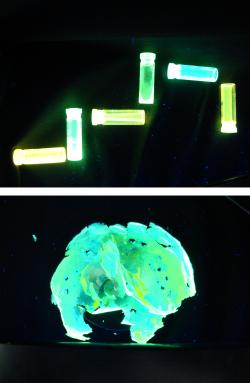 |
| These are some organized plastic materials under ultraviolet light. Because the materials absorb and brightly emit different colors of light, they are good candidates for displays and solar cells. photo by: Clemson University |
Abstract:
Clemson chemistry assistant professor Rhett Smith will receive $598,000 in a National Science Foundation CAREER Award to study a new class of materials that conduct electrical currents and can be used in thin, lightweight and flexible plastic electronic devices.
NSF CAREER Award funds research on plastics that conduct electricity
Clemson, SC | Posted on August 10th, 2009"Some of the most exciting applications that are targeted are ultrathin, flexible displays like television and computer screens or displays in hand-held electronics," said Smith. "Another exciting application that could have an even bigger impact on society is thin-film solar cells to harvest energy from the sun as a renewable, potentially cheaper alternative to petroleum and coal-based energy resources."
Smith's research aims to reveal fundamental insight into how molecular-level organization of the material creates the plastic and dictates how it performs and how material combinations interact and conduct electrical currents.
The Faculty Early Career Development (CAREER) Program offers the National Science Foundation's most prestigious awards in support of the early career-development activities of teacher-scholars who most effectively integrate research and education within the context of the missions of their organizations. Smith's goal is to include a service-learning program, outreach and the development of polymer-science courses to increase awareness and participation in physical sciences. He also wants to mimic graduate-school research at the undergraduate level.
Smith received a bachelor's degree in 2000 from the University of Toledo and his Ph.D. in 2004 from Case Western Reserve University. He did his postdoctoral fellowship at the Massachusetts Institute of Technology before joining Clemson in 2006. His research focus includes the synthesis and applications of organic and inorganic materials for plastic electronic technologies.
####
About Clemson University
Clemson University offers countless opportunities for students, faculty and community members to participate in decades of tradition, improve quality of life for their surrounding communities and pursue academic challenges. Ranked as the 22nd best national public university by U.S.News and World Report, Clemson is a vibrant student-centered community that thrives on leadership, collaboration and a winning spirit — in academics, athletics and life.
To become one of the country’s top-tier research universities, Clemson University has combined the scientific and technological horsepower of a major research university with the academic and social environment of a small college. Just as founder Thomas Green Clemson intertwined his life with the state’s economic and educational development, this University’s students and faculty impact lives daily with their research and service.
For more information, please click here
Contacts:
Rhett Smith
864-656-6112
Susan Polowczuk
Media Relations
864-656-2063
Copyright © Clemson University
If you have a comment, please Contact us.Issuers of news releases, not 7th Wave, Inc. or Nanotechnology Now, are solely responsible for the accuracy of the content.
Bookmark:


| Related News Press |
News and information
 Quantum computer improves AI predictions April 17th, 2026
Flexible sensor gains sensitivity under pressure April 17th, 2026
A reusable chip for particulate matter sensing April 17th, 2026
Detecting vibrational quantum beating in the predissociation dynamics of SF6 using time-resolved photoelectron spectroscopy April 17th, 2026
Thin films
Tiny nanosheets, big leap: A new sensor detects ethanol at ultra-low levels January 30th, 2026
Display technology/LEDs/SS Lighting/OLEDs
Spinel-type sulfide semiconductors to operate the next-generation LEDs and solar cells For solar-cell absorbers and green-LED source October 3rd, 2025
Efficient and stable hybrid perovskite-organic light-emitting diodes with external quantum efficiency exceeding 40 per cent July 5th, 2024
Govt.-Legislation/Regulation/Funding/Policy
Quantum computer improves AI predictions April 17th, 2026
Metasurfaces smooth light to boost magnetic sensing precision January 30th, 2026
New imaging approach transforms study of bacterial biofilms August 8th, 2025
Chip Technology
A reusable chip for particulate matter sensing April 17th, 2026
Metasurfaces smooth light to boost magnetic sensing precision January 30th, 2026
Nanoelectronics
Lab to industry: InSe wafer-scale breakthrough for future electronics August 8th, 2025
Interdisciplinary: Rice team tackles the future of semiconductors Multiferroics could be the key to ultralow-energy computing October 6th, 2023
Key element for a scalable quantum computer: Physicists from Forschungszentrum Jülich and RWTH Aachen University demonstrate electron transport on a quantum chip September 23rd, 2022
Reduced power consumption in semiconductor devices September 23rd, 2022
Announcements
A fundamentally new therapeutic approach to cystic fibrosis: Nanobody repairs cellular defect April 17th, 2026
UC Irvine physicists discover method to reverse ‘quantum scrambling’ : The work addresses the problem of information loss in quantum computing system April 17th, 2026
Environment
A reusable chip for particulate matter sensing April 17th, 2026
Researchers unveil a groundbreaking clay-based solution to capture carbon dioxide and combat climate change June 6th, 2025
Energy
Sensors innovations for smart lithium-based batteries: advancements, opportunities, and potential challenges August 8th, 2025
Simple algorithm paired with standard imaging tool could predict failure in lithium metal batteries August 8th, 2025
Solar/Photovoltaic
Spinel-type sulfide semiconductors to operate the next-generation LEDs and solar cells For solar-cell absorbers and green-LED source October 3rd, 2025
KAIST researchers introduce new and improved, next-generation perovskite solar cell November 8th, 2024
Groundbreaking precision in single-molecule optoelectronics August 16th, 2024
Development of zinc oxide nanopagoda array photoelectrode: photoelectrochemical water-splitting hydrogen production January 12th, 2024
 |
||
 |
||
| The latest news from around the world, FREE | ||
 |
||
|
|
||
| Premium Products | ||
 |
||
|
Only the news you want to read!
Learn More |
||
 |
||
|
Full-service, expert consulting
Learn More |
||
|
|
||