Home > Press > Stretchable micro-supercapacitors to self-power wearable devices
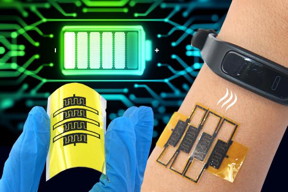 |
| A team of international researchers, led by Huanyu "Larry" Cheng, Dorothy Quiggle Career Development Professor in Penn State's Department of Engineering Science and Mechanics, has developed a self-powered, stretchable system that will be used in wearable health-monitoring and diagnostic devices. CREDIT Penn State College of Engineering |
Abstract:
A stretchable system that can harvest energy from human breathing and motion for use in wearable health-monitoring devices may be possible, according to an international team of researchers, led by Huanyu "Larry" Cheng, Dorothy Quiggle Career Development Professor in Penn State's Department of Engineering Science and Mechanics.
Stretchable micro-supercapacitors to self-power wearable devices
University Park, PA | Posted on December 11th, 2020The research team, with members from Penn State and Minjiang University and Nanjing University, both in China, recently published its results in Nano Energy.
According to Cheng, current versions of batteries and supercapacitors powering wearable and stretchable health-monitoring and diagnostic devices have many shortcomings, including low energy density and limited stretchability.
"This is something quite different than what we have worked on before, but it is a vital part of the equation," Cheng said, noting that his research group and collaborators tend to focus on developing the sensors in wearable devices. "While working on gas sensors and other wearable devices, we always need to combine these devices with a battery for powering. Using micro-supercapacitors gives us the ability to self-power the sensor without the need for a battery."
An alternative to batteries, micro-supercapacitors are energy storage devices that can complement or replace lithium-ion batteries in wearable devices. Micro-supercapacitors have a small footprint, high power density, and the ability to charge and discharge quickly. However, according to Cheng, when fabricated for wearable devices, conventional micro-supercapacitors have a "sandwich-like" stacked geometry that displays poor flexibility, long ion diffusion distances and a complex integration process when combined with wearable electronics.
This led Cheng and his team to explore alternative device architectures and integration processes to advance the use of micro-supercapacitors in wearable devices. They found that arranging micro-supercapacitor cells in a serpentine, island-bridge layout allows the configuration to stretch and bend at the bridges, while reducing deformation of the micro-supercapacitors -- the islands. When combined, the structure becomes what the researchers refer to as "micro-supercapacitors arrays."
"By using an island-bridge design when connecting cells, the micro-supercapacitor arrays displayed increased stretchability and allowed for adjustable voltage outputs," Cheng said. "This allows the system to be reversibly stretched up to 100%."
By using non-layered, ultrathin zinc-phosphorus nanosheets and 3D laser-induced graphene foam -- a highly porous, self-heating nanomaterial -- to construct the island-bridge design of the cells, Cheng and his team saw drastic improvements in electric conductivity and the number of absorbed charged ions. This proved that these micro-supercapacitor arrays can charge and discharge efficiently and store the energy needed to power a wearable device.
The researchers also integrated the system with a triboelectric nanogenerator, an emerging technology that converts mechanical movement to electrical energy. This combination created a self-powered system.
"When we have this wireless charging module that's based on the triboelectric nanogenerator, we can harvest energy based on motion, such as bending your elbow or breathing and speaking," Cheng said. "We are able to use these everyday human motions to charge the micro-supercapacitors."
By combining this integrated system with a graphene-based strain sensor, the energy-storing micro-supercapacitor arrays -- charged by the triboelectric nanogenerators -- are able to power the sensor, Cheng said, showing the potential for this system to power wearable, stretchable devices.
###
Other researchers on this project were Cheng Zeng, assistant professor; Zhixiang Peng, research assistant; Chao Xing, associate professor; Huaming Chen, associate professor; Chunlei Huang, assistant professor, and Jun Wang, professor, all at Minjiang University; Bingwen Zhang, assistant professor at the Fujian Provincial Key Laboratory of Functional Marine Sensing Materials at Minjiang University; and Shaolong Tang, professor of physics, Nanjing University.
The National Natural Science Foundation of China; the Educational Commission of Fujian Province for Youths; the U.S. National Science Foundation; the National Heart, Lung, and Blood Institute of the U.S. National Institutes of Health supported this work.
####
For more information, please click here
Contacts:
A'ndrea Elyse Messer
814-865-5689
@penn_state
Copyright © Penn State
If you have a comment, please Contact us.Issuers of news releases, not 7th Wave, Inc. or Nanotechnology Now, are solely responsible for the accuracy of the content.
Bookmark:


| Related Links |
| Related News Press |
News and information
 Quantum computer improves AI predictions April 17th, 2026
Flexible sensor gains sensitivity under pressure April 17th, 2026
A reusable chip for particulate matter sensing April 17th, 2026
Detecting vibrational quantum beating in the predissociation dynamics of SF6 using time-resolved photoelectron spectroscopy April 17th, 2026
Flexible Electronics
Flexible sensor gains sensitivity under pressure April 17th, 2026
Flexible electronics integrated with paper-thin structure for use in space January 17th, 2025
Wearable electronics
Breakthrough brings body-heat powered wearable devices closer to reality December 13th, 2024
Govt.-Legislation/Regulation/Funding/Policy
Quantum computer improves AI predictions April 17th, 2026
Metasurfaces smooth light to boost magnetic sensing precision January 30th, 2026
New imaging approach transforms study of bacterial biofilms August 8th, 2025
Possible Futures
A fundamentally new therapeutic approach to cystic fibrosis: Nanobody repairs cellular defect April 17th, 2026
UC Irvine physicists discover method to reverse ‘quantum scrambling’ : The work addresses the problem of information loss in quantum computing system April 17th, 2026
Nanomedicine
A fundamentally new therapeutic approach to cystic fibrosis: Nanobody repairs cellular defect April 17th, 2026
New molecular technology targets tumors and simultaneously silences two ‘undruggable’ cancer genes August 8th, 2025
New imaging approach transforms study of bacterial biofilms August 8th, 2025
Electrifying results shed light on graphene foam as a potential material for lab grown cartilage June 6th, 2025
Sensors
Flexible sensor gains sensitivity under pressure April 17th, 2026
Tiny nanosheets, big leap: A new sensor detects ethanol at ultra-low levels January 30th, 2026
From sensors to smart systems: the rise of AI-driven photonic noses January 30th, 2026
Sensors innovations for smart lithium-based batteries: advancements, opportunities, and potential challenges August 8th, 2025
Discoveries
Quantum computer improves AI predictions April 17th, 2026
Flexible sensor gains sensitivity under pressure April 17th, 2026
A reusable chip for particulate matter sensing April 17th, 2026
Detecting vibrational quantum beating in the predissociation dynamics of SF6 using time-resolved photoelectron spectroscopy April 17th, 2026
Announcements
A fundamentally new therapeutic approach to cystic fibrosis: Nanobody repairs cellular defect April 17th, 2026
UC Irvine physicists discover method to reverse ‘quantum scrambling’ : The work addresses the problem of information loss in quantum computing system April 17th, 2026
Interviews/Book Reviews/Essays/Reports/Podcasts/Journals/White papers/Posters
A fundamentally new therapeutic approach to cystic fibrosis: Nanobody repairs cellular defect April 17th, 2026
UC Irvine physicists discover method to reverse ‘quantum scrambling’ : The work addresses the problem of information loss in quantum computing system April 17th, 2026
Battery Technology/Capacitors/Generators/Piezoelectrics/Thermoelectrics/Energy storage
Decoding hydrogen‑bond network of electrolyte for cryogenic durable aqueous zinc‑ion batteries January 30th, 2026
COF scaffold membrane with gate‑lane nanostructure for efficient Li+/Mg2+ separation January 30th, 2026
MXene nanomaterials enter a new dimension Multilayer nanomaterial: MXene flakes created at Drexel University show new promise as 1D scrolls January 30th, 2026
Grants/Sponsored Research/Awards/Scholarships/Gifts/Contests/Honors/Records
Quantum computer improves AI predictions April 17th, 2026
Detecting vibrational quantum beating in the predissociation dynamics of SF6 using time-resolved photoelectron spectroscopy April 17th, 2026
Metasurfaces smooth light to boost magnetic sensing precision January 30th, 2026
Research partnerships
Lab to industry: InSe wafer-scale breakthrough for future electronics August 8th, 2025
HKU physicists uncover hidden order in the quantum world through deconfined quantum critical points April 25th, 2025
 |
||
 |
||
| The latest news from around the world, FREE | ||
 |
||
|
|
||
| Premium Products | ||
 |
||
|
Only the news you want to read!
Learn More |
||
 |
||
|
Full-service, expert consulting
Learn More |
||
|
|
||