Home > Press > Nanoreactor strategy generates superior supported bimetallic catalysts
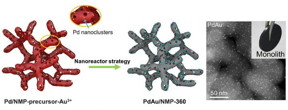 |
| Synthesis of supported PdAu BNPs (monolith) using nanoreactor strategy CREDIT TIAN Zhengbin |
Abstract:
Supported bimetallic catalysts are an important class of catalysts in heterogeneous catalysis. They can be applied in various fields, such as electrocatalysis, biomass conversion, and hydrogen production.
Nanoreactor strategy generates superior supported bimetallic catalysts
Beijing, China | Posted on July 31st, 2020However, traditional impregnation and immobilization methods for synthesizing supported bimetallic nanoparticles (BNPs) are often uncontrollable, thus creating BNPs with non-uniform particle size, low alloy degree and inhomogeneous distribution on the supports. The result is poor catalytic performance and low metal utilization.
To improve the performance and efficiency of the supported BNPs, Prof. WANG Guanghui and Prof. JIANG Heqing from the Qingdao Institute of Bioenergy and Bioprocess Technology (QIBEBT) of the Chinese Academy of Sciences (CAS), in collaboration with Prof. LIU Jian from the Dalian Institute of Chemical Physics (DICP) of CAS, recently proposed a nanoreactor strategy for scalable synthesis of the supported ultrafine BNPs.
This strategy introduces high-quality seeds (Pd nanoclusters) and Au ions into the nitrogen-doped mesoporous polymer (NMP). The NMP is used as a nanoreactor for the seeded growth of PdAu BNPs in solid state during thermal reduction.
"The synthesized Pd1Au1/4 BNPs are very uniform in diameter with an error of 0.5 nm, and are homogeneously dispersed in the NMP support," said Prof. WANG.
The Pd1Au1/4/NMP sample showed enhanced catalytic performance in formic acid (FA) dehydrogenation compared with the monometallic analogues Pd/NMP and Au/NMP.
"The enhanced activity can be attributed to the electronic interaction between Pd and Au in the Pd1Au1/4 BNPs. In addition, the electronic interaction could be adjusted by changing the composition of PdAu BNPs during synthesis," said Prof. JIANG.
Moreover, the PdAu/NMP product can be molded into a monolith by a pellet press under mild pressure (1.0 bar) without any binders, due to its coral-like structure. The monolith contains abundant macropores which can be of benefit for mass transfer in a liquid reaction.
Notably, the monolith of Pd1Au1/4/NMP still exhibits considerable activity in FA dehydrogenation with a TOF value of 3684 h-1 at 333 K, and can be recycled five times without mass loss and changes in activity.
Many other supported Pd-based BNPs (diameters ranging from 2-3 nm) have also been synthesized using this method, including PdRu, PdCo, PdNi, PdZn, PdAg and PdCu BNPs.
This proposed nanoreactor strategy provides an effective route for synthesizing various supported bimetallic catalysts. These catalysts are promising for applications in green and sustainable catalytic processes.
###
This study was published in Materials Today on July 30. It was supported by the National Natural Science Foundation of China, QIBEBT and the DNL Cooperation Fund, CAS.
####
For more information, please click here
Contacts:
CHENG Jing
Copyright © Chinese Academy of Sciences
If you have a comment, please Contact us.Issuers of news releases, not 7th Wave, Inc. or Nanotechnology Now, are solely responsible for the accuracy of the content.
Bookmark:


| Related Links |
| Related News Press |
News and information
 Quantum computer improves AI predictions April 17th, 2026
Flexible sensor gains sensitivity under pressure April 17th, 2026
A reusable chip for particulate matter sensing April 17th, 2026
Detecting vibrational quantum beating in the predissociation dynamics of SF6 using time-resolved photoelectron spectroscopy April 17th, 2026
Chemistry
Projecting light to dispense liquids: A new route to ultra-precise microdroplets January 30th, 2026
From sensors to smart systems: the rise of AI-driven photonic noses January 30th, 2026
"Nanoreactor" cage uses visible light for catalytic and ultra-selective cross-cycloadditions October 3rd, 2025
Cambridge chemists discover simple way to build bigger molecules – one carbon at a time June 6th, 2025
Govt.-Legislation/Regulation/Funding/Policy
Quantum computer improves AI predictions April 17th, 2026
Metasurfaces smooth light to boost magnetic sensing precision January 30th, 2026
New imaging approach transforms study of bacterial biofilms August 8th, 2025
Possible Futures
A fundamentally new therapeutic approach to cystic fibrosis: Nanobody repairs cellular defect April 17th, 2026
UC Irvine physicists discover method to reverse ‘quantum scrambling’ : The work addresses the problem of information loss in quantum computing system April 17th, 2026
Discoveries
Quantum computer improves AI predictions April 17th, 2026
Flexible sensor gains sensitivity under pressure April 17th, 2026
A reusable chip for particulate matter sensing April 17th, 2026
Detecting vibrational quantum beating in the predissociation dynamics of SF6 using time-resolved photoelectron spectroscopy April 17th, 2026
Announcements
A fundamentally new therapeutic approach to cystic fibrosis: Nanobody repairs cellular defect April 17th, 2026
UC Irvine physicists discover method to reverse ‘quantum scrambling’ : The work addresses the problem of information loss in quantum computing system April 17th, 2026
Interviews/Book Reviews/Essays/Reports/Podcasts/Journals/White papers/Posters
A fundamentally new therapeutic approach to cystic fibrosis: Nanobody repairs cellular defect April 17th, 2026
UC Irvine physicists discover method to reverse ‘quantum scrambling’ : The work addresses the problem of information loss in quantum computing system April 17th, 2026
 |
||
 |
||
| The latest news from around the world, FREE | ||
 |
||
|
|
||
| Premium Products | ||
 |
||
|
Only the news you want to read!
Learn More |
||
 |
||
|
Full-service, expert consulting
Learn More |
||
|
|
||