Home > Press > Solid-state intramolecular motions in continuous fibers for fluorescent humidity sensor
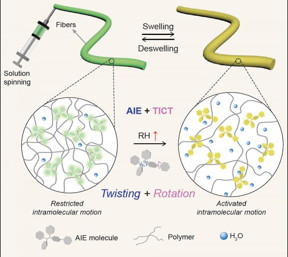 |
| Schematic illustration of fluorescence variation of AIE/polymer fiber sensor when exposed to water molecules. CREDIT ©Science China Press |
Abstract:
Taking advantages of intramolecular motion of D-A based aggregation-induced emission (AIE) molecular rotors and one-dimensional (1D) polymer fibers, highly sensitive optical fiber sensors that respond to ambient humidity rapidly and reversibly with observable chromatic fluorescence change are developed. Moisture environments induce the swelling of the polymer fibers, activating intramolecular motions of AIE molecules to result in red-shifted fluorescence and linear response to ambient relative humidity (RH). In this case, polymer fiber provides a process-friendly architecture and a physically tunable medium for the embedded AIE molecules to manipulate their fluorescence response characteristics.
Solid-state intramolecular motions in continuous fibers for fluorescent humidity sensor
Beijing, China | Posted on July 16th, 2020Intramolecular motions of AIE molecules driven by ambient humidity. D-A based AIE molecules contain three segments: an electron-donating tetraphenylethene (TPE) group, an electron-accepting pyridinium salt unit, and a spacer unit of single (TPE-P)/double (TPE-EP) bond. The highly twisted TPE group with four phenyl rings ensures the intramolecular twisted-motion in the solid state, while intramolecular rotation of D-A subgroups based on the twisted intramolecular charge-transfer (TICT) effect achieves local polarity sensing. Combining AIE and TICT effects that manipulated by the intramolecular motions, a sensitive humidity sensor is developed by embedding AIE molecules into a water-captured polymer.
Dry spinning AIE/polymer microfiber sensor. Dry-spinning technology is utilized to fabricate AIE/polymer microfibers, and polyvinylpyrrolidone (PVP) is chosen as a material support. AIE/PVP micro-fibrous film shows chromatic fluorescence response and linear response to ambient humidity, serving as sensitive woven fabrics for spatial-temporal humidity mapping. Assembly of microfibers and UV silicone tube could be integrated to develop fiber-shaped flexible device, which can act as a built-in sensor for easy identification of RH and also be able to serve as color-tunable lighting for smart displays.
Electro-spinning AIE/polymer nanofiber sensor. Polyacrylic acid (PAA) nanofibers from electro-spinning characterized with large surface area, high porosity, and fine flexibility, are used as a physical medium for AIE molecules to achieve instant humidity response sensitivity. The nanofibrous nonwoven membranes show ultrafast response and recovery (< 1 s) to a neglectable amount of water, which can be applied as axial positioning interface for future integrated wearable systems.
The mechanism of intramolecular motion of AIE molecules has been demonstrated for developing highly sensitive AIE/polymer fiber sensor. The fluorescence response performance is amplified by refining the fiber structure and changing the chemical structure of polymers. Additionally, fibrous sensors can be used to build various architectures, facilitating multifunctionality in terms of spatial humidity mapping, high device-integration capability, and touchless positioning. The strategy of combining AIE and 1D fiber structure will not only provide a new route for humidity sensor, but also serve as artificial nerves to sense wide environmental stimuli.
###
This research received funding from the Fundamental Research Funds for the Central Universities, the National Natural Science Foundation of China, the Science and Technology Commission of Shanghai Municipality, the National Key Research and Development Program of China, the Program for Changjiang Scholars and Innovative Research Team in University, and International Joint Laboratory for Advanced Fiber and Low-Dimension Materials.
####
About Science China Press
The National Science Review is the first comprehensive scholarly journal released in English in China that is aimed at linking the country's rapidly advancing community of scientists with the global frontiers of science and technology. The journal also aims to shine a worldwide spotlight on scientific research advances across China.
For more information, please click here
Contacts:
Yanhua Cheng
Copyright © Science China Press
If you have a comment, please Contact us.Issuers of news releases, not 7th Wave, Inc. or Nanotechnology Now, are solely responsible for the accuracy of the content.
Bookmark:


| Related Links |
| Related News Press |
News and information
 Quantum computer improves AI predictions April 17th, 2026
Flexible sensor gains sensitivity under pressure April 17th, 2026
A reusable chip for particulate matter sensing April 17th, 2026
Detecting vibrational quantum beating in the predissociation dynamics of SF6 using time-resolved photoelectron spectroscopy April 17th, 2026
Flexible Electronics
Flexible sensor gains sensitivity under pressure April 17th, 2026
Govt.-Legislation/Regulation/Funding/Policy
Quantum computer improves AI predictions April 17th, 2026
Metasurfaces smooth light to boost magnetic sensing precision January 30th, 2026
New imaging approach transforms study of bacterial biofilms August 8th, 2025
Possible Futures
A fundamentally new therapeutic approach to cystic fibrosis: Nanobody repairs cellular defect April 17th, 2026
UC Irvine physicists discover method to reverse ‘quantum scrambling’ : The work addresses the problem of information loss in quantum computing system April 17th, 2026
Sensors
Flexible sensor gains sensitivity under pressure April 17th, 2026
Tiny nanosheets, big leap: A new sensor detects ethanol at ultra-low levels January 30th, 2026
From sensors to smart systems: the rise of AI-driven photonic noses January 30th, 2026
Sensors innovations for smart lithium-based batteries: advancements, opportunities, and potential challenges August 8th, 2025
Discoveries
Quantum computer improves AI predictions April 17th, 2026
Flexible sensor gains sensitivity under pressure April 17th, 2026
A reusable chip for particulate matter sensing April 17th, 2026
Detecting vibrational quantum beating in the predissociation dynamics of SF6 using time-resolved photoelectron spectroscopy April 17th, 2026
Announcements
A fundamentally new therapeutic approach to cystic fibrosis: Nanobody repairs cellular defect April 17th, 2026
UC Irvine physicists discover method to reverse ‘quantum scrambling’ : The work addresses the problem of information loss in quantum computing system April 17th, 2026
Interviews/Book Reviews/Essays/Reports/Podcasts/Journals/White papers/Posters
A fundamentally new therapeutic approach to cystic fibrosis: Nanobody repairs cellular defect April 17th, 2026
UC Irvine physicists discover method to reverse ‘quantum scrambling’ : The work addresses the problem of information loss in quantum computing system April 17th, 2026
 |
||
 |
||
| The latest news from around the world, FREE | ||
 |
||
|
|
||
| Premium Products | ||
 |
||
|
Only the news you want to read!
Learn More |
||
 |
||
|
Full-service, expert consulting
Learn More |
||
|
|
||