Home > Press > Toward safer disposal of printed circuit boards
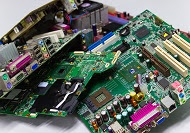 |
| Researchers have developed a new, safer method to dispose of printed circuit boards. Credit: junpiiiiiiiiiii/Shutterstock.com |
Abstract:
Printed circuit boards are vital components of modern electronics. However, once they have served their purpose, they are often burned or buried in landfills, polluting the air, soil and water. Most concerning are the brominated flame retardants added to printed circuit boards to keep them from catching fire. Now, researchers reporting in ACS Sustainable Chemistry & Engineering have developed a ball-milling method to break down these potentially harmful compounds, enabling safer disposal.
Toward safer disposal of printed circuit boards
Washington, DC | Posted on January 16th, 2020Composed of 30% metallic and 70% nonmetallic particles, printed circuit boards support and connect all of the electrical components of a device. Metallic components can be recovered from crushed circuit boards by magnetic and high-voltage electrostatic separations, leaving behind nonmetallic particles including resins, reinforcing materials, brominated flame retardants and other additives. Scientists have linked compounds in brominated flame retardants to endocrine disorders and fetal tissue damage. Therefore, Jujun Ruan and colleagues wanted to develop a method to remove the flame retardants from waste printed circuit boards so that they wouldn’t contaminate the environment.
The researchers crushed printed circuit boards and removed the metallic components by magnetic and high-voltage electrostatic separations, as is typically done. Then, they put the nonmetallic particles into a ball mill – a rotating machine that uses small agate balls to grind up materials. They also added iron powder, which prior studies had shown was helpful for removing halogens, such as bromine, from organic compounds. After ball-milling, the bromine content on the surface of the particles had decreased by 50%, and phenolic resin compounds had decomposed. The researchers determined that during the ball-milling process, iron transferred electrons to flame retardant compounds, causing carbon-bromine bonds to stretch and break.
The authors acknowledge funding from the 111 Project, the Natural Science Foundation of Guangdong Province, China and the Pearl River Star of Science and Technology.
####
About American Chemical Society
The American Chemical Society (ACS) is a nonprofit organization chartered by the U.S. Congress. ACS’ mission is to advance the broader chemistry enterprise and its practitioners for the benefit of Earth and its people. The Society is a global leader in providing access to chemistry-related information and research through its multiple research solutions, peer-reviewed journals, scientific conferences, eBooks and weekly news periodical Chemical & Engineering News. ACS journals are among the most cited, most trusted and most read within the scientific literature; however, ACS itself does not conduct chemical research. As a specialist in scientific information solutions (including SciFinder® and STN®), its CAS division powers global research, discovery and innovation. ACS’ main offices are in Washington, D.C., and Columbus, Ohio.
For more information, please click here
Contacts:
Jujun Ruan, Ph.D.
School of Environmental Science and Engineering
Sun Yat-sen University
Guangzhou, 510275, China
Phone: +86-20-84113620
Email:
ACS Newsroom
Katie Cottingham
301-775-8455
Copyright © American Chemical Society
If you have a comment, please Contact us.Issuers of news releases, not 7th Wave, Inc. or Nanotechnology Now, are solely responsible for the accuracy of the content.
Bookmark:


| Related Links |
| Related News Press |
News and information
 Quantum computer improves AI predictions April 17th, 2026
Flexible sensor gains sensitivity under pressure April 17th, 2026
A reusable chip for particulate matter sensing April 17th, 2026
Detecting vibrational quantum beating in the predissociation dynamics of SF6 using time-resolved photoelectron spectroscopy April 17th, 2026
Chemistry
Projecting light to dispense liquids: A new route to ultra-precise microdroplets January 30th, 2026
From sensors to smart systems: the rise of AI-driven photonic noses January 30th, 2026
"Nanoreactor" cage uses visible light for catalytic and ultra-selective cross-cycloadditions October 3rd, 2025
Cambridge chemists discover simple way to build bigger molecules – one carbon at a time June 6th, 2025
Govt.-Legislation/Regulation/Funding/Policy
Quantum computer improves AI predictions April 17th, 2026
Metasurfaces smooth light to boost magnetic sensing precision January 30th, 2026
New imaging approach transforms study of bacterial biofilms August 8th, 2025
Possible Futures
A fundamentally new therapeutic approach to cystic fibrosis: Nanobody repairs cellular defect April 17th, 2026
UC Irvine physicists discover method to reverse ‘quantum scrambling’ : The work addresses the problem of information loss in quantum computing system April 17th, 2026
Chip Technology
A reusable chip for particulate matter sensing April 17th, 2026
Metasurfaces smooth light to boost magnetic sensing precision January 30th, 2026
Discoveries
Quantum computer improves AI predictions April 17th, 2026
Flexible sensor gains sensitivity under pressure April 17th, 2026
A reusable chip for particulate matter sensing April 17th, 2026
Detecting vibrational quantum beating in the predissociation dynamics of SF6 using time-resolved photoelectron spectroscopy April 17th, 2026
Announcements
A fundamentally new therapeutic approach to cystic fibrosis: Nanobody repairs cellular defect April 17th, 2026
UC Irvine physicists discover method to reverse ‘quantum scrambling’ : The work addresses the problem of information loss in quantum computing system April 17th, 2026
Interviews/Book Reviews/Essays/Reports/Podcasts/Journals/White papers/Posters
A fundamentally new therapeutic approach to cystic fibrosis: Nanobody repairs cellular defect April 17th, 2026
UC Irvine physicists discover method to reverse ‘quantum scrambling’ : The work addresses the problem of information loss in quantum computing system April 17th, 2026
Environment
A reusable chip for particulate matter sensing April 17th, 2026
Researchers unveil a groundbreaking clay-based solution to capture carbon dioxide and combat climate change June 6th, 2025
Research partnerships
Lab to industry: InSe wafer-scale breakthrough for future electronics August 8th, 2025
HKU physicists uncover hidden order in the quantum world through deconfined quantum critical points April 25th, 2025
 |
||
 |
||
| The latest news from around the world, FREE | ||
 |
||
|
|
||
| Premium Products | ||
 |
||
|
Only the news you want to read!
Learn More |
||
 |
||
|
Full-service, expert consulting
Learn More |
||
|
|
||