Home > Press > Color superlensing to assist in surpassing diffraction barrier: A paper by Kazan Federal University's Sergey Kharintsev appeared in Optics Letters
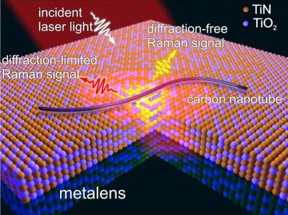 |
| Schematic of the working principle of a disordered TiN?TiO2 metalens. CREDIT Kazan Federal University |
Abstract:
The research was supported by a Russian Science Foundation's grant under the title "Synthesis and research of a new class of nanocomposite ceramics with degenerate dielectric permeability for opto-plasmonic applications."
Color superlensing to assist in surpassing diffraction barrier: A paper by Kazan Federal University's Sergey Kharintsev appeared in Optics Letters
Kazan, Russian Federation | Posted on January 3rd, 2020A metalens described in the article is a thin composite metal-dielectric film placed on a dielectric substrate; the width is several dozen nanometers.
"The light has a wave nature, so there is a diffraction limit which confines the resolution of traditional optical microscopy," explains Kharintsev. "Our metalens is an optical device capable of surpassing that diffraction limit. Such a solution paves way for using optical technologies in nanoscale integral circuits and sensors."
The ultra-high resolution is based on an unusual behavior of the metalens in optical and infrared ranges.
"The material part of the dielectric constant oscillates near zero. This property can be used to enhance stimulated Raman scattering of light in a spatially limited medium illuminated by low-intensity continuous laser light. For most materials found in nature, nonlinear effects are weak, and to observe them it is necessary to increase the length of the medium (for example, using optical fibers) and / or to increase the laser pump power (using high-power pulsed lasers).
"We used a 50 nm thick titanium oxy nitride (TiON) film as a disordered nonlinear medium. The film was synthesized by magnetron sputtering and subsequent oxidation in air. As a result of a two-stage procedure, metal (TiN) and dielectric (TiO2) nanoparticles were formed in the film. An increase in the amplitude of the Stokes wave in a TiN / TiO2 film occurs due to the enhancement of the cubic susceptibility because of localized plasmon resonance and a small refractive index of the effective medium. Such metal-insulator nanocomposite films having several epsilon-near-zero frequencies in the visible and infrared ramges have found application in creating broadband metal technologies providing resolution beyond the limits of light diffraction," adds the author.
Kazan University employees have succeeded in visualizing 40 nm multiwall carbon nanotubes scattered along the surface of the metalens created by them, and the resolution was below 100 nm.
"Nanocomposite epsilon-near-zero film works as a surface-enhanced Raman scattering substrate, and it helps not only enhance the scattered signal, but also achieve beyond-diffraction resolutions. Metalenses and ENZ films can be used to create broadband absorbers for solar panels," concludes Dr. Kharintsev.
####
For more information, please click here
Contacts:
Yury Nurmeev
@KazanUni
Copyright © Kazan Federal University
If you have a comment, please Contact us.Issuers of news releases, not 7th Wave, Inc. or Nanotechnology Now, are solely responsible for the accuracy of the content.
Bookmark:


| Related Links |
| Related News Press |
News and information
 Quantum computer improves AI predictions April 17th, 2026
Flexible sensor gains sensitivity under pressure April 17th, 2026
A reusable chip for particulate matter sensing April 17th, 2026
Detecting vibrational quantum beating in the predissociation dynamics of SF6 using time-resolved photoelectron spectroscopy April 17th, 2026
Imaging
Simple algorithm paired with standard imaging tool could predict failure in lithium metal batteries August 8th, 2025
First real-time observation of two-dimensional melting process: Researchers at Mainz University unveil new insights into magnetic vortex structures August 8th, 2025
Thin films
Tiny nanosheets, big leap: A new sensor detects ethanol at ultra-low levels January 30th, 2026
Nanotubes/Buckyballs/Fullerenes/Nanorods/Nanostrings/Nanosheets
Tiny nanosheets, big leap: A new sensor detects ethanol at ultra-low levels January 30th, 2026
Enhancing power factor of p- and n-type single-walled carbon nanotubes April 25th, 2025
Chainmail-like material could be the future of armor: First 2D mechanically interlocked polymer exhibits exceptional flexibility and strength January 17th, 2025
Innovative biomimetic superhydrophobic coating combines repair and buffering properties for superior anti-erosion December 13th, 2024
Discoveries
Quantum computer improves AI predictions April 17th, 2026
Flexible sensor gains sensitivity under pressure April 17th, 2026
A reusable chip for particulate matter sensing April 17th, 2026
Detecting vibrational quantum beating in the predissociation dynamics of SF6 using time-resolved photoelectron spectroscopy April 17th, 2026
Announcements
A fundamentally new therapeutic approach to cystic fibrosis: Nanobody repairs cellular defect April 17th, 2026
UC Irvine physicists discover method to reverse ‘quantum scrambling’ : The work addresses the problem of information loss in quantum computing system April 17th, 2026
Interviews/Book Reviews/Essays/Reports/Podcasts/Journals/White papers/Posters
A fundamentally new therapeutic approach to cystic fibrosis: Nanobody repairs cellular defect April 17th, 2026
UC Irvine physicists discover method to reverse ‘quantum scrambling’ : The work addresses the problem of information loss in quantum computing system April 17th, 2026
Tools
Metasurfaces smooth light to boost magnetic sensing precision January 30th, 2026
From sensors to smart systems: the rise of AI-driven photonic noses January 30th, 2026
Japan launches fully domestically produced quantum computer: Expo visitors to experience quantum computing firsthand August 8th, 2025
Energy
Sensors innovations for smart lithium-based batteries: advancements, opportunities, and potential challenges August 8th, 2025
Simple algorithm paired with standard imaging tool could predict failure in lithium metal batteries August 8th, 2025
Solar/Photovoltaic
Spinel-type sulfide semiconductors to operate the next-generation LEDs and solar cells For solar-cell absorbers and green-LED source October 3rd, 2025
KAIST researchers introduce new and improved, next-generation perovskite solar cell November 8th, 2024
Groundbreaking precision in single-molecule optoelectronics August 16th, 2024
Development of zinc oxide nanopagoda array photoelectrode: photoelectrochemical water-splitting hydrogen production January 12th, 2024
 |
||
 |
||
| The latest news from around the world, FREE | ||
 |
||
|
|
||
| Premium Products | ||
 |
||
|
Only the news you want to read!
Learn More |
||
 |
||
|
Full-service, expert consulting
Learn More |
||
|
|
||