Home > Press > Researchers to develop a theory of transients in graphene: The research considers behavior of graphene in the moment of its transition from the state of thermal equilibrium and the process of returning to this state
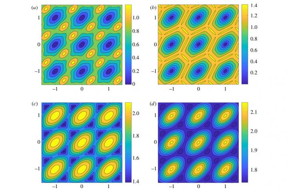 |
| Scientists to develop a theory of transients in graphene. CREDIT Peter the Great St.Petersburg Polytechnic University |
Abstract:
The article "Equilibration of energies in a two-dimensional harmonic graphene lattice" published in the oldest scientific journal in the world Philosophical Transactions of the Royal Society considers the behavior of graphene in the moment of its transition from the state of thermal equilibrium and the process of returning to this state. The scientific report is conducted by Vitaly Kuzkin, the deputy director of Higher School of Theoretical mechanics and Research Educational Centre "Gazpromneft-Polytech" of Peter the Great St.Petersburg Polytechnic University (SPbPU) in collaboration with Igor Berinskii from the School of Mechanical Engineering, Tel Aviv University (Israel) in the field of materials science, solid mechanics and dynamics of mechanical systems.
Researchers to develop a theory of transients in graphene: The research considers behavior of graphene in the moment of its transition from the state of thermal equilibrium and the process of returning to this state
St. Petersburg, Russia | Posted on December 27th, 2019"Our research group develops a theory that describes the transition to thermal equilibrium in crystals which are initially in a nonequilibrium state. It can be caused, for example, by high-speed laser exposure or the passage of shock waves. In this paper, we applied this theory to graphene", notes Vitaly Kuzkin. Usually, transients occur rather quickly and have a high frequency, but graphene turned out to be unique here - some transients in graphene have very low frequencies. "
The research results are important for investigation of heat transport and other nonequilibrium thermodynamic processes in graphene.
"Graphene is a very promising material. It has many useful properties like strength, stiffness, high heat and electrical conductivity. It can be used in flexible electronics, wearable devices, and in creation of composite materials," - explains Vitaly Kuzkin.
###
Publication in Philosophical Transactions of the Royal Society, which printed by Royal Society of London, is considered prestigious. This is the oldest scientific journal with long, rich history that continuously published since 1665.
####
For more information, please click here
Contacts:
Raisa Bestugina
7-812-591-6675
@pgpuspb
Copyright © Peter the Great Saint-Petersburg Polytechnic University
If you have a comment, please Contact us.Issuers of news releases, not 7th Wave, Inc. or Nanotechnology Now, are solely responsible for the accuracy of the content.
Bookmark:


| Related Links |
| Related News Press |
News and information
 Quantum computer improves AI predictions April 17th, 2026
Flexible sensor gains sensitivity under pressure April 17th, 2026
A reusable chip for particulate matter sensing April 17th, 2026
Detecting vibrational quantum beating in the predissociation dynamics of SF6 using time-resolved photoelectron spectroscopy April 17th, 2026
Flexible Electronics
Flexible sensor gains sensitivity under pressure April 17th, 2026
Flexible electronics integrated with paper-thin structure for use in space January 17th, 2025
Graphene/ Graphite
Electrifying results shed light on graphene foam as a potential material for lab grown cartilage June 6th, 2025
Wearable electronics
Breakthrough brings body-heat powered wearable devices closer to reality December 13th, 2024
Possible Futures
A fundamentally new therapeutic approach to cystic fibrosis: Nanobody repairs cellular defect April 17th, 2026
UC Irvine physicists discover method to reverse ‘quantum scrambling’ : The work addresses the problem of information loss in quantum computing system April 17th, 2026
Discoveries
Quantum computer improves AI predictions April 17th, 2026
Flexible sensor gains sensitivity under pressure April 17th, 2026
A reusable chip for particulate matter sensing April 17th, 2026
Detecting vibrational quantum beating in the predissociation dynamics of SF6 using time-resolved photoelectron spectroscopy April 17th, 2026
Announcements
A fundamentally new therapeutic approach to cystic fibrosis: Nanobody repairs cellular defect April 17th, 2026
UC Irvine physicists discover method to reverse ‘quantum scrambling’ : The work addresses the problem of information loss in quantum computing system April 17th, 2026
Interviews/Book Reviews/Essays/Reports/Podcasts/Journals/White papers/Posters
A fundamentally new therapeutic approach to cystic fibrosis: Nanobody repairs cellular defect April 17th, 2026
UC Irvine physicists discover method to reverse ‘quantum scrambling’ : The work addresses the problem of information loss in quantum computing system April 17th, 2026
 |
||
 |
||
| The latest news from around the world, FREE | ||
 |
||
|
|
||
| Premium Products | ||
 |
||
|
Only the news you want to read!
Learn More |
||
 |
||
|
Full-service, expert consulting
Learn More |
||
|
|
||