Home > Press > Scientists create thin films with tantalizing electronic properties: As predicted by theorists, experiments show that barium zirconium sulfide thin films hold great promise for solar cells, LEDs
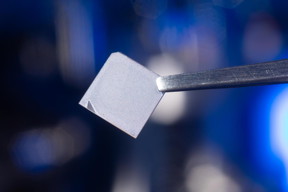 |
| A barium zirconium sulfide thin film created by the research team. CREDIT Credit: Douglas Levere / University at Buffalo |
Abstract:
Scientists have created thin films made from barium zirconium sulfide (BaZrS3) and confirmed that the materials have alluring electronic and optical properties predicted by theorists.
Scientists create thin films with tantalizing electronic properties: As predicted by theorists, experiments show that barium zirconium sulfide thin films hold great promise for solar cells, LEDs
Buffalo, NY | Posted on December 27th, 2019The films combine exceptionally strong light absorption with good charge transport -- two qualities that make them ideal for applications such as photovoltaics and light-emitting diodes (LEDs).
In solar panels, for example, experimental results suggest that BaZrS3 films would be much more efficient at converting sunlight into electricity than traditional silicon-based materials with identical thicknesses, says lead researcher Hao Zeng, PhD, professor of physics in the University at Buffalo College of Arts and Sciences. This could lower solar energy costs, especially because the new films performed admirably even when they had imperfections. (Manufacturing nearly flawless materials is typically more expensive, Zeng explains.)
"For many decades, there have been only a handful of semiconductor materials that have been used, with silicon being the dominant material," Zeng says. "Our thin films open the door to a new direction in semiconductor research. There's a chance to explore the potential of a whole new class of materials."
The study was published in November in the journal Nano Energy.
UB physics PhD students Xiucheng Wei and Haolei Hui were the first authors. The project -- funded by a U.S. Department of Energy (DOE) SunShot award and National Science Foundation (NSF) Sustainable Chemistry, Engineering and Materials award -- included contributions from researchers at UB; Taiyuan Normal University, Southern University of Science & Technology, Xi'an Jiaotong University and the Chinese Academy of Sciences, all in China; Los Alamos National Laboratory; and Rensselaer Polytechnic Institute.
Experiments inspired by theoretical predictions
BaZrS3 belongs to a category of materials known as chalcogenide perovskites, which are nontoxic, earth-abundant compounds. In recent years, theorists have calculated that various chalcogenide perovskites should exhibit useful electronic and optical properties, and these predictions have captured the interest and imagination of experimentalists like Zeng.
BaZrS3 is not a totally new material. Zeng looked into the history of the compound, and found information dating back to the 1950s.
"It has existed for more than half a century," he says. "Among earlier research, a company in Niagara Falls produced it in powder form. I think people paid little attention to it."
But thin films -- not powder -- are needed for applications such as photovoltaics and LEDs, so that's what Zeng's team set out to create.
The researchers crafted their BaZrS3 films by using a laser to heat up and vaporize barium zirconium oxide. The vapor was deposited on a sapphire surface, forming a film, and then converted into the final material through a chemical reaction called sulfurization.
"Semiconductor research has traditionally been highly focused on conventional materials," Hui says. "This is an opportunity to explore something new. Chalcogenide perovskites share some similarities to the widely researched halide perovskites, but do not suffer from the toxicity and instability of the latter materials."
"Now that we have a thin film made from BaZrS3, we can study its fundamental properties and how it might be used in solar panels, LEDs, optical sensors and other applications," Wei says.
###
In addition to the NSF and DOE SunShot program, the research received support from the National Natural Science Foundation of China and the U.S. National Nuclear Security Administration's Laboratory Directed Research & Development program.
####
For more information, please click here
Contacts:
Charlotte Hsu
716-645-4655
@UBNewsSource
Copyright © University at Buffalo
If you have a comment, please Contact us.Issuers of news releases, not 7th Wave, Inc. or Nanotechnology Now, are solely responsible for the accuracy of the content.
Bookmark:


| Related Links |
| Related News Press |
News and information
 Quantum computer improves AI predictions April 17th, 2026
Flexible sensor gains sensitivity under pressure April 17th, 2026
A reusable chip for particulate matter sensing April 17th, 2026
Detecting vibrational quantum beating in the predissociation dynamics of SF6 using time-resolved photoelectron spectroscopy April 17th, 2026
Thin films
Tiny nanosheets, big leap: A new sensor detects ethanol at ultra-low levels January 30th, 2026
Display technology/LEDs/SS Lighting/OLEDs
Spinel-type sulfide semiconductors to operate the next-generation LEDs and solar cells For solar-cell absorbers and green-LED source October 3rd, 2025
Efficient and stable hybrid perovskite-organic light-emitting diodes with external quantum efficiency exceeding 40 per cent July 5th, 2024
Govt.-Legislation/Regulation/Funding/Policy
Quantum computer improves AI predictions April 17th, 2026
Metasurfaces smooth light to boost magnetic sensing precision January 30th, 2026
New imaging approach transforms study of bacterial biofilms August 8th, 2025
Possible Futures
A fundamentally new therapeutic approach to cystic fibrosis: Nanobody repairs cellular defect April 17th, 2026
UC Irvine physicists discover method to reverse ‘quantum scrambling’ : The work addresses the problem of information loss in quantum computing system April 17th, 2026
Discoveries
Quantum computer improves AI predictions April 17th, 2026
Flexible sensor gains sensitivity under pressure April 17th, 2026
A reusable chip for particulate matter sensing April 17th, 2026
Detecting vibrational quantum beating in the predissociation dynamics of SF6 using time-resolved photoelectron spectroscopy April 17th, 2026
Announcements
A fundamentally new therapeutic approach to cystic fibrosis: Nanobody repairs cellular defect April 17th, 2026
UC Irvine physicists discover method to reverse ‘quantum scrambling’ : The work addresses the problem of information loss in quantum computing system April 17th, 2026
Interviews/Book Reviews/Essays/Reports/Podcasts/Journals/White papers/Posters
A fundamentally new therapeutic approach to cystic fibrosis: Nanobody repairs cellular defect April 17th, 2026
UC Irvine physicists discover method to reverse ‘quantum scrambling’ : The work addresses the problem of information loss in quantum computing system April 17th, 2026
Grants/Sponsored Research/Awards/Scholarships/Gifts/Contests/Honors/Records
Quantum computer improves AI predictions April 17th, 2026
Detecting vibrational quantum beating in the predissociation dynamics of SF6 using time-resolved photoelectron spectroscopy April 17th, 2026
Metasurfaces smooth light to boost magnetic sensing precision January 30th, 2026
Solar/Photovoltaic
Spinel-type sulfide semiconductors to operate the next-generation LEDs and solar cells For solar-cell absorbers and green-LED source October 3rd, 2025
KAIST researchers introduce new and improved, next-generation perovskite solar cell November 8th, 2024
Groundbreaking precision in single-molecule optoelectronics August 16th, 2024
Development of zinc oxide nanopagoda array photoelectrode: photoelectrochemical water-splitting hydrogen production January 12th, 2024
 |
||
 |
||
| The latest news from around the world, FREE | ||
 |
||
|
|
||
| Premium Products | ||
 |
||
|
Only the news you want to read!
Learn More |
||
 |
||
|
Full-service, expert consulting
Learn More |
||
|
|
||