Home > Press > New polymer material may help batteries become self-healing, recyclable
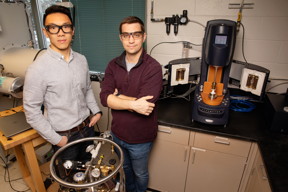 |
| Materials science and engineering professor Christopher Evans, right, and graduate student Brian Jing have developed a solid battery electrolyte that is both self-healing and recyclable. Photo by L. Brian Stauffer |
Abstract:
Lithium-ion batteries are notorious for developing internal electrical shorts that can ignite a battery’s liquid electrolytes, leading to explosions and fires. Engineers at the University of Illinois have developed a solid polymer-based electrolyte that can self-heal after damage – and the material can also be recycled without the use of harsh chemicals or high temperatures.
New polymer material may help batteries become self-healing, recyclable
Champaign, IL | Posted on December 23rd, 2019The new study, which could help manufacturers produce recyclable, self-healing commercial batteries, is published in the Journal of the American Chemical Society.
As lithium-ion batteries go through multiple cycles of charge and discharge, they develop tiny, branchlike structures of solid lithium called dendrites, the researchers said. These structures reduce battery life, cause hotspots and electrical shorts, and sometimes grow large enough to puncture the internal parts of the battery, causing explosive chemical reactions between the electrodes and electrolyte liquids.
There has been a push by chemists and engineers to replace the liquid electrolytes in lithium-ion batteries with solid materials such as ceramics or polymers, the researchers said. However, many of these materials are rigid and brittle resulting in poor electrolyte-to-electrode contact and reduced conductivity.
“Solid ion-conducting polymers are one option for developing nonliquid electrolytes,” said Brian Jing, a materials science and engineering graduate student and study co-author. “But the high-temperature conditions inside a battery can melt most polymers, again resulting in dendrites and failure.”
Past studies have produced solid electrolytes by using a network of polymer strands that are cross-linked to form a rubbery lithium conductor. This method delays the growth of dendrites; however, these materials are complex and cannot be recovered or healed after damage, Jing said.
To address this issue, the researchers developed a network polymer electrolyte in which the cross-link point can undergo exchange reactions and swap polymer strands. In contrast to linear polymers, these networks actually get stiffer upon heating, which can potentially minimize the dendrite problem, the researchers said. Additionally, they can be easily broken down and resolidified into a networked structure after damage, making them recyclable, and they restore conductivity after being damaged because they are self-healing.
“This new network polymer also shows the remarkable property that both conductivity and stiffness increase with heating, which is not seen in conventional polymer electrolytes,” Jing said.
“Most polymers require strong acids and high temperatures to break down,” said materials science and engineering professor and lead author Christopher Evans. “Our material dissolves in water at room temperature, making it a very energy-efficient and environmentally friendly process.”
The team probed the conductivity of the new material and found its potential as an effective battery electrolyte to be promising, the researchers said, but acknowledge that more work is required before it could be used in batteries that are comparable to what is in use today.
“I think this work presents an interesting platform for others to test,” Evans said. “We used a very specific chemistry and a very specific dynamic bond in our polymer, but we think this platform can be reconfigured to be used with many other chemistries to tweak the conductivity and mechanical properties.”
Evans and Jing also are affiliated with the Beckman Institute for Advanced Science and Technology at the U. of I.
The Energy Biosciences Institute, through the EBI-Shell Program, supported this study.
####
For more information, please click here
Contacts:
LOIS YOKSOULIAN
217-244-2788
Christopher Evans
217-300-9949
Copyright © University of Illinois at Urbana-Champaign
If you have a comment, please Contact us.Issuers of news releases, not 7th Wave, Inc. or Nanotechnology Now, are solely responsible for the accuracy of the content.
Bookmark:


| Related Links |
| Related News Press |
News and information
 Quantum computer improves AI predictions April 17th, 2026
Flexible sensor gains sensitivity under pressure April 17th, 2026
A reusable chip for particulate matter sensing April 17th, 2026
Detecting vibrational quantum beating in the predissociation dynamics of SF6 using time-resolved photoelectron spectroscopy April 17th, 2026
Chemistry
Projecting light to dispense liquids: A new route to ultra-precise microdroplets January 30th, 2026
From sensors to smart systems: the rise of AI-driven photonic noses January 30th, 2026
"Nanoreactor" cage uses visible light for catalytic and ultra-selective cross-cycloadditions October 3rd, 2025
Cambridge chemists discover simple way to build bigger molecules – one carbon at a time June 6th, 2025
Possible Futures
A fundamentally new therapeutic approach to cystic fibrosis: Nanobody repairs cellular defect April 17th, 2026
UC Irvine physicists discover method to reverse ‘quantum scrambling’ : The work addresses the problem of information loss in quantum computing system April 17th, 2026
Discoveries
Quantum computer improves AI predictions April 17th, 2026
Flexible sensor gains sensitivity under pressure April 17th, 2026
A reusable chip for particulate matter sensing April 17th, 2026
Detecting vibrational quantum beating in the predissociation dynamics of SF6 using time-resolved photoelectron spectroscopy April 17th, 2026
Materials/Metamaterials/Magnetoresistance
First real-time observation of two-dimensional melting process: Researchers at Mainz University unveil new insights into magnetic vortex structures August 8th, 2025
Researchers unveil a groundbreaking clay-based solution to capture carbon dioxide and combat climate change June 6th, 2025
A 1960s idea inspires NBI researchers to study hitherto inaccessible quantum states June 6th, 2025
Institute for Nanoscience hosts annual proposal planning meeting May 16th, 2025
Announcements
A fundamentally new therapeutic approach to cystic fibrosis: Nanobody repairs cellular defect April 17th, 2026
UC Irvine physicists discover method to reverse ‘quantum scrambling’ : The work addresses the problem of information loss in quantum computing system April 17th, 2026
Interviews/Book Reviews/Essays/Reports/Podcasts/Journals/White papers/Posters
A fundamentally new therapeutic approach to cystic fibrosis: Nanobody repairs cellular defect April 17th, 2026
UC Irvine physicists discover method to reverse ‘quantum scrambling’ : The work addresses the problem of information loss in quantum computing system April 17th, 2026
Automotive/Transportation
Decoding hydrogen‑bond network of electrolyte for cryogenic durable aqueous zinc‑ion batteries January 30th, 2026
Sensors innovations for smart lithium-based batteries: advancements, opportunities, and potential challenges August 8th, 2025
Simple algorithm paired with standard imaging tool could predict failure in lithium metal batteries August 8th, 2025
Battery Technology/Capacitors/Generators/Piezoelectrics/Thermoelectrics/Energy storage
Decoding hydrogen‑bond network of electrolyte for cryogenic durable aqueous zinc‑ion batteries January 30th, 2026
COF scaffold membrane with gate‑lane nanostructure for efficient Li+/Mg2+ separation January 30th, 2026
MXene nanomaterials enter a new dimension Multilayer nanomaterial: MXene flakes created at Drexel University show new promise as 1D scrolls January 30th, 2026
 |
||
 |
||
| The latest news from around the world, FREE | ||
 |
||
|
|
||
| Premium Products | ||
 |
||
|
Only the news you want to read!
Learn More |
||
 |
||
|
Full-service, expert consulting
Learn More |
||
|
|
||