Home > Press > Building next gen smart materials with the power of sound
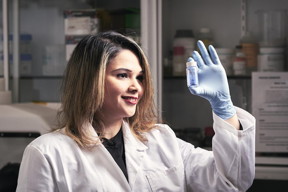 |
| Dr. Heba Ahmed holding a MOF created with high-frequency sound waves. CREDIT RMIT University |
Abstract:
Researchers have used sound waves to precisely manipulate atoms and molecules, accelerating the sustainable production of breakthrough smart materials.
Building next gen smart materials with the power of sound
Melbourne, Australia | Posted on May 28th, 2019Metal-organic frameworks, or MOFs, are incredibly versatile and super porous nanomaterials that can be used to store, separate, release or protect almost anything.
Predicted to be the defining material of the 21st century, MOFs are ideal for sensing and trapping substances at minute concentrations, to purify water or air, and can also hold large amounts of energy, for making better batteries and energy storage devices.
Scientists have designed more than 88,000 precisely-customised MOFs - with applications ranging from agriculture to pharmaceuticals - but the traditional process for creating them is environmentally unsustainable and can take several hours or even days.
Now researchers from RMIT University in Melbourne, Australia, have demonstrated a clean, green technique that can produce a customised MOF in minutes.
Dr Heba Ahmed, lead author of the study published in Nature Communications, said the efficient and scaleable method harnessed the precision power of high-frequency sound waves.
"MOFs have boundless potential, but we need cleaner and faster synthesis techniques to take full advantage of all their possible benefits," Ahmed, a postdoctoral researcher in RMIT's Micro/Nanophysics Research Laboratory, said.
"Our acoustically-driven approach avoids the environmental harms of traditional methods and produces ready-to-use MOFs quickly and sustainably.
"The technique not only eliminates one of the most time-consuming steps in making MOFs, it leaves no trace and can be easily scaled up for efficient mass production."
Sound device: how to make a MOF
Metal-organic frameworks are crystalline powders full of tiny, molecular-sized holes.
They have a unique structure - metals joined to each other by organic linkers - and are so porous that if you took a gram of a MOF and spread out its internal surface area, you would cover an area larger than a football pitch.
Some have predicted MOFs could be as important to the 21st century as plastics were to the 20th.
During the standard production process, solvents and other contaminants become trapped in the MOF's holes.
To flush them out, scientists use a combination of vacuum and high temperatures or harmful chemical solvents in a process called "activation".
In their novel technique, RMIT researchers used a microchip to produce high-frequency sound waves.
Co-author and acoustic expert Dr Amgad Rezk said these sound waves, which are not audible to humans, can be used for precision micro- and nano-manufacturing.
"At the nano-scale, sound waves are powerful tools for the meticulous ordering and manoeuvring of atoms and molecules," Rezk said.
The "ingredients" of a MOF - a metal precursor and a binding organic molecule - were exposed to the sound waves produced by the microchip.
Using the sound waves to arrange and link these elements together, the researchers were able to create a highly ordered and porous network, while simultaneously "activating" the MOF by pushing out the solvents from the holes.
Lead investigator, Distinguished Professor Leslie Yeo, said the new method produces MOFs with empty holes and a high surface area, eliminating the need for post-synthesis "activation".
"Existing techniques usually take a long time from synthesis to activation but our approach not only produces MOFs within a few minutes, they are already activated and ready for direct application," said Yeo, a Professor of Chemical Engineering and Director of the Micro/Nanophysics Research Laboratory at RMIT.
The researchers successfully tested the approach on copper and iron-based MOFs, with the technique able to be expanded to other MOFs and scaled out for efficient green production of these smart materials.
####
For more information, please click here
Contacts:
Gosia Kaszubska
61-417-510-735
Copyright © RMIT University
If you have a comment, please Contact us.Issuers of news releases, not 7th Wave, Inc. or Nanotechnology Now, are solely responsible for the accuracy of the content.
Bookmark:


| Related Links |
| Related News Press |
News and information
 Quantum computer improves AI predictions April 17th, 2026
Flexible sensor gains sensitivity under pressure April 17th, 2026
A reusable chip for particulate matter sensing April 17th, 2026
Detecting vibrational quantum beating in the predissociation dynamics of SF6 using time-resolved photoelectron spectroscopy April 17th, 2026
Possible Futures
A fundamentally new therapeutic approach to cystic fibrosis: Nanobody repairs cellular defect April 17th, 2026
UC Irvine physicists discover method to reverse ‘quantum scrambling’ : The work addresses the problem of information loss in quantum computing system April 17th, 2026
Materials/Metamaterials/Magnetoresistance
First real-time observation of two-dimensional melting process: Researchers at Mainz University unveil new insights into magnetic vortex structures August 8th, 2025
Researchers unveil a groundbreaking clay-based solution to capture carbon dioxide and combat climate change June 6th, 2025
A 1960s idea inspires NBI researchers to study hitherto inaccessible quantum states June 6th, 2025
Institute for Nanoscience hosts annual proposal planning meeting May 16th, 2025
Announcements
A fundamentally new therapeutic approach to cystic fibrosis: Nanobody repairs cellular defect April 17th, 2026
UC Irvine physicists discover method to reverse ‘quantum scrambling’ : The work addresses the problem of information loss in quantum computing system April 17th, 2026
Interviews/Book Reviews/Essays/Reports/Podcasts/Journals/White papers/Posters
A fundamentally new therapeutic approach to cystic fibrosis: Nanobody repairs cellular defect April 17th, 2026
UC Irvine physicists discover method to reverse ‘quantum scrambling’ : The work addresses the problem of information loss in quantum computing system April 17th, 2026
Industrial
Tiny nanosheets, big leap: A new sensor detects ethanol at ultra-low levels January 30th, 2026
Quantum interference in molecule-surface collisions February 28th, 2025
Boron nitride nanotube fibers get real: Rice lab creates first heat-tolerant, stable fibers from wet-spinning process June 24th, 2022
Battery Technology/Capacitors/Generators/Piezoelectrics/Thermoelectrics/Energy storage
Decoding hydrogen‑bond network of electrolyte for cryogenic durable aqueous zinc‑ion batteries January 30th, 2026
COF scaffold membrane with gate‑lane nanostructure for efficient Li+/Mg2+ separation January 30th, 2026
MXene nanomaterials enter a new dimension Multilayer nanomaterial: MXene flakes created at Drexel University show new promise as 1D scrolls January 30th, 2026
 |
||
 |
||
| The latest news from around the world, FREE | ||
 |
||
|
|
||
| Premium Products | ||
 |
||
|
Only the news you want to read!
Learn More |
||
 |
||
|
Full-service, expert consulting
Learn More |
||
|
|
||