Home > Press > Tuneable reverse photochromes in the solid state
 |
Abstract:
A new technique allows the design of solid materials that are coloured in the dark. ICN2 researchers from the Nanostructured Functional Materials Group, led by Dr Daniel Ruiz, have developed it in collaboration with the Department of Chemistry of the UAB. Their results, published in ACS Applied Materials & Interfaces with Dr Claudio Roscini as its last author, can have applications in rewritable displays or optical data storage systems.
Tuneable reverse photochromes in the solid state
Barcelona, Spain | Posted on April 3rd, 2019Photochromes are dyes that change their colour depending on the light they receive. When light is switched off they can either remain in their photoinduced state (P-type photochromes) or turn back to their original state (T-type photochromes). The last ones may colour when irradiated, bleaching when light is moved away (direct photochromism) or discolour under irradiation, getting back their colour in the dark (reverse photochromism).
During the last decades, both the industrial and the academic sectors have shown growing interest toward organic photochromes for the preparation of colour-tuneable functional materials. Ophthalmic lenses and smart windows are examples of current applications based on direct photochromism. However, functional solid devices based on reverse T-type photochromes are very scarce and only started to be reported recently (e.g., in multicoloured light-responsive rewritable devices).
Different strategies have been explored to obtain reverse photochromism with organic substances called spiro compounds. Nevertheless, the materials produced so far do not provide flexible tuneability of their photochromic responses. That is, their colour and the speed at which the change is produced cannot be adjusted. Also, chemical reactions are needed to modify the structure of the photochrome so that it produces the required effect.
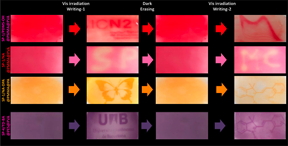
A new, straightforward, reactions-free and universal strategy to obtain solid materials with highly tuneable reverse photochromism has been recently developed from a collaboration between the ICN2 and the Department of Chemistry of the UAB, and published in ACS Applied Materials & Interfaces. The last author of the article and leader of the research is Dr Claudio Roscini, who supervised the work of the PhD student Àlex Julià, both from the ICN2 Nanostructured Functional Materials Group, led by Dr Daniel Ruiz. The author from the Chemistry Department of the UAB is Dr Jordi Hernando. These researchers employed commercially available organic compounds from the family of spiropyran, which can be stabilized to different states with different colours and colouration rates by simply varying the nature of the surrounding media (functional phase-change-material).
Moreover, they transferred this behaviour to solid matrices by preparing polymer capsules loaded with spiropyran solutions of functional phase-change-material (which provides the initial colour of the dye) and eventually dispersing them in the final material of interest. As a result, polymer films with up to three different photochromic responses regarding colours and switching rates could be generated from the same commercial dye. This represents an unprecedented tuneability of the photochromic properties in the solid state.
Considering that more colours could be obtained by combining capsules of different types, which might also display other behaviours, such as thermochromism (changing colours with temperature), functional materials could be prepared from spiropyran dyes exhibiting multicolour and multistimuli responses.
####
For more information, please click here
Contacts:
Àlex Argemí
Phone: +34937372607
Fax: 08193
Copyright © ICN2
If you have a comment, please Contact us.Issuers of news releases, not 7th Wave, Inc. or Nanotechnology Now, are solely responsible for the accuracy of the content.
Bookmark:


| Related Links |
| Related News Press |
News and information
 Quantum computer improves AI predictions April 17th, 2026
Flexible sensor gains sensitivity under pressure April 17th, 2026
A reusable chip for particulate matter sensing April 17th, 2026
Detecting vibrational quantum beating in the predissociation dynamics of SF6 using time-resolved photoelectron spectroscopy April 17th, 2026
Possible Futures
A fundamentally new therapeutic approach to cystic fibrosis: Nanobody repairs cellular defect April 17th, 2026
UC Irvine physicists discover method to reverse ‘quantum scrambling’ : The work addresses the problem of information loss in quantum computing system April 17th, 2026
Discoveries
Quantum computer improves AI predictions April 17th, 2026
Flexible sensor gains sensitivity under pressure April 17th, 2026
A reusable chip for particulate matter sensing April 17th, 2026
Detecting vibrational quantum beating in the predissociation dynamics of SF6 using time-resolved photoelectron spectroscopy April 17th, 2026
Materials/Metamaterials/Magnetoresistance
First real-time observation of two-dimensional melting process: Researchers at Mainz University unveil new insights into magnetic vortex structures August 8th, 2025
Researchers unveil a groundbreaking clay-based solution to capture carbon dioxide and combat climate change June 6th, 2025
A 1960s idea inspires NBI researchers to study hitherto inaccessible quantum states June 6th, 2025
Institute for Nanoscience hosts annual proposal planning meeting May 16th, 2025
Announcements
A fundamentally new therapeutic approach to cystic fibrosis: Nanobody repairs cellular defect April 17th, 2026
UC Irvine physicists discover method to reverse ‘quantum scrambling’ : The work addresses the problem of information loss in quantum computing system April 17th, 2026
Interviews/Book Reviews/Essays/Reports/Podcasts/Journals/White papers/Posters
A fundamentally new therapeutic approach to cystic fibrosis: Nanobody repairs cellular defect April 17th, 2026
UC Irvine physicists discover method to reverse ‘quantum scrambling’ : The work addresses the problem of information loss in quantum computing system April 17th, 2026
Printing/Lithography/Inkjet/Inks/Bio-printing/Dyes
Presenting: Ultrasound-based printing of 3D materials—potentially inside the body December 8th, 2023
Simple ballpoint pen can write custom LEDs August 11th, 2023
Disposable electronics on a simple sheet of paper October 7th, 2022
 |
||
 |
||
| The latest news from around the world, FREE | ||
 |
||
|
|
||
| Premium Products | ||
 |
||
|
Only the news you want to read!
Learn More |
||
 |
||
|
Full-service, expert consulting
Learn More |
||
|
|
||