Home > Press > ‘GO dough’ makes graphene easy to shape and mold: New form of graphene oxide is fun to play with — and solves manufacturing challenges
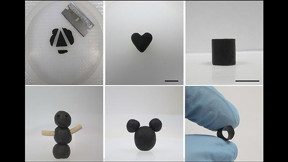 |
| Highly processable and versatile, GO dough can be readily reshaped by cutting, pinching, molding and carving. |
Abstract:
GO dough can be shaped and reshaped into free-standing, 3D structures
Product is a safer version of graphene oxide powders and much lighter than dispersions
Can be readily transformed into high-quality dispersions, dense foams and hard solids
‘GO dough’ makes graphene easy to shape and mold: New form of graphene oxide is fun to play with — and solves manufacturing challenges
Evanston, IL | Posted on January 25th, 2019A Northwestern University team is reshaping the world of graphene.
The team has turned graphene oxide (GO) into a soft, moldable and kneadable play dough that can be shaped and reshaped into free-standing, three-dimensional structures.
Called “GO dough,” the product might be fun to play with it, but it’s more than a toy. The malleable material solves several long-standing — and sometimes explosive — problems in the graphene manufacturing industry.
“Currently graphene oxide is stored as dry solids or powders, which are prone to combustion,” said Jiaxing Huang, who led the study. “Or they have to be turned into dilute dispersions, which multiply the material’s mass by hundreds or thousands.”
Huang recounted his most recent shipment of 5 kilograms of graphene oxide, which was dispersed in 500 liters of liquid. “It had to be delivered in a truck,” he said. “The same amount of graphene oxide in dough form would weigh about 10 kilograms, and I could carry it myself.”
The research was published today (Jan. 24) in the journal Nature Communications. Huang is a professor of materials science and engineering in Northwestern’s McCormick School of Engineering.
Graphene oxide, which is a product of graphite oxidation, is often used to make graphene, a single-atom-layer thick sheet of carbon that is remarkably strong, lightweight and has potential for applications in electronics and energy storage.
Just add water
Huang’s team made GO dough by adding an ultra-high concentration of graphene oxide to water. If the team had used binding additives, they would have had to further process the material to remove these additives in order to return graphene oxide to its pure form.
“Adding binders such as plastics could turn anything into a dough state,” Huang said. “But these additives often significantly alter the material’s properties.”
After being shaped into structures, the dough can be converted into dense solids that are electrically conductive, chemically stable and mechanically hard. Or, more water can be added to the dough to transform it into a high-quality GO dispersion on demand. The dough can also be processed further to make bulk graphene oxide and graphene materials of different forms with tunable microstructures. Huang hopes that GO dough’s ease of use could help graphene meet its much-anticipated potential as a super material.
“My dream is to turn graphene-based sheets into a widely accessible, readily usable engineering material, just like plastic, glass and steel,” Huang said. “I hope GO dough can help inspire new uses of graphene-based materials, just like how play dough can inspire young children’s imagination and creativity.”
This work was mainly supported by the Office of Naval Research (ONR N000141612838).
####
For more information, please click here
Contacts:
Amanda Morris
847-467-6790
Copyright © Northwestern University
If you have a comment, please Contact us.Issuers of news releases, not 7th Wave, Inc. or Nanotechnology Now, are solely responsible for the accuracy of the content.
Bookmark:


| Related Links |
| Related News Press |
News and information
 Quantum computer improves AI predictions April 17th, 2026
Flexible sensor gains sensitivity under pressure April 17th, 2026
A reusable chip for particulate matter sensing April 17th, 2026
Detecting vibrational quantum beating in the predissociation dynamics of SF6 using time-resolved photoelectron spectroscopy April 17th, 2026
Graphene/ Graphite
Electrifying results shed light on graphene foam as a potential material for lab grown cartilage June 6th, 2025
Breakthrough in proton barrier films using pore-free graphene oxide: Kumamoto University researchers achieve new milestone in advanced coating technologies September 13th, 2024
Govt.-Legislation/Regulation/Funding/Policy
Quantum computer improves AI predictions April 17th, 2026
Metasurfaces smooth light to boost magnetic sensing precision January 30th, 2026
New imaging approach transforms study of bacterial biofilms August 8th, 2025
Possible Futures
A fundamentally new therapeutic approach to cystic fibrosis: Nanobody repairs cellular defect April 17th, 2026
UC Irvine physicists discover method to reverse ‘quantum scrambling’ : The work addresses the problem of information loss in quantum computing system April 17th, 2026
Discoveries
Quantum computer improves AI predictions April 17th, 2026
Flexible sensor gains sensitivity under pressure April 17th, 2026
A reusable chip for particulate matter sensing April 17th, 2026
Detecting vibrational quantum beating in the predissociation dynamics of SF6 using time-resolved photoelectron spectroscopy April 17th, 2026
Materials/Metamaterials/Magnetoresistance
First real-time observation of two-dimensional melting process: Researchers at Mainz University unveil new insights into magnetic vortex structures August 8th, 2025
Researchers unveil a groundbreaking clay-based solution to capture carbon dioxide and combat climate change June 6th, 2025
A 1960s idea inspires NBI researchers to study hitherto inaccessible quantum states June 6th, 2025
Institute for Nanoscience hosts annual proposal planning meeting May 16th, 2025
Announcements
A fundamentally new therapeutic approach to cystic fibrosis: Nanobody repairs cellular defect April 17th, 2026
UC Irvine physicists discover method to reverse ‘quantum scrambling’ : The work addresses the problem of information loss in quantum computing system April 17th, 2026
Interviews/Book Reviews/Essays/Reports/Podcasts/Journals/White papers/Posters
A fundamentally new therapeutic approach to cystic fibrosis: Nanobody repairs cellular defect April 17th, 2026
UC Irvine physicists discover method to reverse ‘quantum scrambling’ : The work addresses the problem of information loss in quantum computing system April 17th, 2026
Military
Quantum engineers ‘squeeze’ laser frequency combs to make more sensitive gas sensors January 17th, 2025
Chainmail-like material could be the future of armor: First 2D mechanically interlocked polymer exhibits exceptional flexibility and strength January 17th, 2025
Single atoms show their true color July 5th, 2024
NRL charters Navy’s quantum inertial navigation path to reduce drift April 5th, 2024
 |
||
 |
||
| The latest news from around the world, FREE | ||
 |
||
|
|
||
| Premium Products | ||
 |
||
|
Only the news you want to read!
Learn More |
||
 |
||
|
Full-service, expert consulting
Learn More |
||
|
|
||