Home > Press > IMDEA Nanociencia and Universidad Autónoma de Madrid researchers have demonstrated that graphene deposited on a metal surface promotes an unusual chemical reaction that would hardly take place under noncatalyzed conditions.
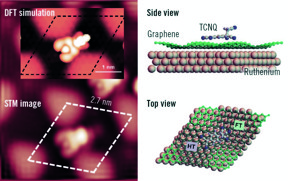 |
| Image of TCNQ-CH2CN molecule on a corrugated graphene layer (left) and representation of the calculated geometries (right). Adapted from Navarro et al. Sci. Adv. 2018. |
Abstract:
Graphene monolayers can be epitaxially grown on many single-crystal metal surfaces under ultra-high vacuum. On one side, these monolayers protect highly reactive metallic surfaces from contaminants, but on the other side, the piling of the layers as graphitic carbon poisons the activity of transition metal catalysts. The inertness of the graphite and the physical blockage of the active sites prevents chemical reactions occurring on the metal surface.
IMDEA Nanociencia and Universidad Autónoma de Madrid researchers have demonstrated that graphene deposited on a metal surface promotes an unusual chemical reaction that would hardly take place under noncatalyzed conditions.
Madrid, Spain | Posted on December 14th, 2018Researchers led by Fernando Martín, Emilio Pérez and Amadeo Vázquez de Parga (IMDEA Nanociencia and Universidad Autónoma de Madrid) have demonstrated that nanostructured graphene monolayers on a metal surface do promote a chemical reaction that would hardly take place under noncatalyzed conditions. A crystal of ruthenium, Ru(0001), has been covered with an epitaxially grown continuous graphene layer. Because of the difference in lattice parameters, a new superperiodicity appears on the graphene layer and modulates its electronic properties. Taking advantage of the modulation, the surface has been functionalized with cyanomethylene groups (-CH2CN), covalently bonded to the center of the hexagonal close-packed areas in the Moiré unit cell, and doped with TCNQ (7,7,8,8-tetracyano-p-quinodimethane). TCNQ is an electron acceptor molecule used to p-dope graphene films. When deposited on the graphene surface, this molecule is absorbed on a bridge position between two ripples. Here, it is worth to notice the important role of the surface and of the graphene layer in catalyzing the reaction of TCNQ and -CH2CN. The reaction of TCNQ with CH3CN (the pristine reactants are in gas phase) plus the loss of a hydrogen atom is very unlikely because of the high energy barrier (about 5 eV). The presence of the graphene layer reduces this energy barrier by a factor of 5, thus favoring the formation of the products.
The nanostructured graphene promotes the reaction in a threefold way: first, holds the -CH2CN in place; second, allows for an efficient charge transfer from the ruthenium; and third, prevents the absorption of TCNQ by ruthenium allowing the molecule to diffuse on the surface. “A similar clean reaction on pristine ruthenium is not possible, because the reactive character of ruthenium leads to the absorption of CH3CN and hinders the mobility of TCNQ molecules once absorbed on the surface” Amadeo says. The results confirm the catalytic character of graphene in this reaction. “Such a selectivity would be difficult to obtain by using other forms of carbon” Emilio confirms.
Further, the TCNQ molecules have been injected with electrons using the scanning tunneling microscope (STM). This individual manipulation of the molecules induces a C-C bond breaking, thus leading to the recovery of the initial reactants: CH2CN-graphene and TCNQ. The process is reversible and reproducible at a single-molecule level. As the researchers have observed a Kondo resonance, the reversibility of the process can be thought as a reversible magnetic switch controlled by a chemical reaction.
Fernando Martín, Emilio Pérez and Amadeo Vázquez de Parga are researchers at the Madrid’s Institute of Advanced Studies IMDEA Nanociencia. The work is a collaboration between IMDEA Nanociencia and Universidad Autónoma de Madrid, and the Condensed Matter Physics Center IFIMAC. The research has been co-funded by the Spanish Ministry of Economy and Competitiveness, the Government of the Region of Madrid and the European Research Council.
Article:
J. Navarro, M. Pisarra, B. Nieto-Ortega, J. Villalva, C. G. Ayani, C. Díaz, F. Calleja, R. Miranda, F. Martín, E. M. Pérez, A. L. Vázquez de Parga. Graphene catalyzes the reversible formation of a C–C bond between two molecules. Sci. Adv. 4, eaau9366 (2018).
####
For more information, please click here
Contacts:
Prof. Emilio Pérez
emilio.perez [at] imdea.org
http://www.nanociencia.imdea.org/home-en/people/item/emilio-perez-alvarez
Twitter: @emilioperezlab
Prof. Amadeo L. Vázquez de Parga
al.vazquezdeparga [at] uam.es
http://nanociencia.imdea.org/nanoscale-imaging-of-2d-materials/group-home
Comunicación científica IMDEA Nanociencia
divulgacion.nanociencia [at] imdea.org
+34 91 299 87 12
Twitter: @IMDEA_nano,
Facebook: @IMDEANanociencia
Copyright © IMDEA
If you have a comment, please Contact us.Issuers of news releases, not 7th Wave, Inc. or Nanotechnology Now, are solely responsible for the accuracy of the content.
Bookmark:


| Related News Press |
News and information
 Quantum computer improves AI predictions April 17th, 2026
Flexible sensor gains sensitivity under pressure April 17th, 2026
A reusable chip for particulate matter sensing April 17th, 2026
Detecting vibrational quantum beating in the predissociation dynamics of SF6 using time-resolved photoelectron spectroscopy April 17th, 2026
Magnetism/Magnons
Metasurfaces smooth light to boost magnetic sensing precision January 30th, 2026
Researchers develop molecular qubits that communicate at telecom frequencies October 3rd, 2025
First real-time observation of two-dimensional melting process: Researchers at Mainz University unveil new insights into magnetic vortex structures August 8th, 2025
Magnetism in new exotic material opens the way for robust quantum computers June 4th, 2025
Graphene/ Graphite
Electrifying results shed light on graphene foam as a potential material for lab grown cartilage June 6th, 2025
Govt.-Legislation/Regulation/Funding/Policy
Quantum computer improves AI predictions April 17th, 2026
Metasurfaces smooth light to boost magnetic sensing precision January 30th, 2026
New imaging approach transforms study of bacterial biofilms August 8th, 2025
Possible Futures
A fundamentally new therapeutic approach to cystic fibrosis: Nanobody repairs cellular defect April 17th, 2026
UC Irvine physicists discover method to reverse ‘quantum scrambling’ : The work addresses the problem of information loss in quantum computing system April 17th, 2026
Discoveries
Quantum computer improves AI predictions April 17th, 2026
Flexible sensor gains sensitivity under pressure April 17th, 2026
A reusable chip for particulate matter sensing April 17th, 2026
Detecting vibrational quantum beating in the predissociation dynamics of SF6 using time-resolved photoelectron spectroscopy April 17th, 2026
Materials/Metamaterials/Magnetoresistance
First real-time observation of two-dimensional melting process: Researchers at Mainz University unveil new insights into magnetic vortex structures August 8th, 2025
Researchers unveil a groundbreaking clay-based solution to capture carbon dioxide and combat climate change June 6th, 2025
A 1960s idea inspires NBI researchers to study hitherto inaccessible quantum states June 6th, 2025
Institute for Nanoscience hosts annual proposal planning meeting May 16th, 2025
Announcements
A fundamentally new therapeutic approach to cystic fibrosis: Nanobody repairs cellular defect April 17th, 2026
UC Irvine physicists discover method to reverse ‘quantum scrambling’ : The work addresses the problem of information loss in quantum computing system April 17th, 2026
Interviews/Book Reviews/Essays/Reports/Podcasts/Journals/White papers/Posters
A fundamentally new therapeutic approach to cystic fibrosis: Nanobody repairs cellular defect April 17th, 2026
UC Irvine physicists discover method to reverse ‘quantum scrambling’ : The work addresses the problem of information loss in quantum computing system April 17th, 2026
Research partnerships
Lab to industry: InSe wafer-scale breakthrough for future electronics August 8th, 2025
HKU physicists uncover hidden order in the quantum world through deconfined quantum critical points April 25th, 2025
 |
||
 |
||
| The latest news from around the world, FREE | ||
 |
||
|
|
||
| Premium Products | ||
 |
||
|
Only the news you want to read!
Learn More |
||
 |
||
|
Full-service, expert consulting
Learn More |
||
|
|
||