Home > Press > New optical sensor can determine if molecules are left or right 'handed'
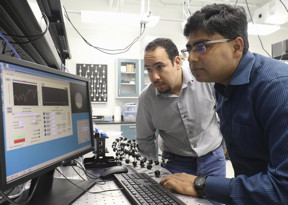 |
| A University of Central Florida team has designed a nanostructured optical sensor that for the first time can efficiently detect molecular chirality -- a property of molecular spatial twist that defines its biochemical properties. CREDIT University of Central Florida: Karen Norum |
Abstract:
A University of Central Florida team has designed a nanostructured optical sensor that for the first time can efficiently detect molecular chirality - a property of molecular spatial twist that defines its biochemical properties.
New optical sensor can determine if molecules are left or right 'handed'
Orlando, FL | Posted on June 13th, 2018Determining chirality is critical for new drug development.
Think of molecules as having little hands. They are not identical, but they serve almost undistinguishable functions. You can grip, pinch, punch and open your hands, regardless of whether you use your left or right hand. But when you get to some functions, such as writing, it matters if you are right-handed or left-handed.
Scientists have struggled to determine if molecules have unique left- or right-hand functions because their physical attributes such as length, weight, density, elasticity, etc. appear to be identical.
UCF's NanoScience Technology Center Associate Professor Debashis Chanda and Ph.D. student Abraham Vazquez-Guardado have figured out a unique way to do it. The interaction between light and the specially designed nanostructure they built creates a strong chiral light field - called superchiral light. Such a nanostructure does not have geometrical chirality yet it creates two opposite light chirality (left or right) on demand. When light and matter's chirality match, just as hand-shaking with our right hand, successful identification happens. Therefore, this rotating light field has the ability to probe and identify any chiral molecule like drugs, proteins or DNAs. The light field lets scientist see the tiny hands, so to speak.
"Chirality detection is vital in the drug-development industry, where newly synthesized chiral drugs also have two-handed strands and always form with the same likeliness during the synthesis process," Chanda said. "But while one chiral strand constitutes the active element in the drug, its opposite can turn out to be toxic or render detrimental side effects. Consequently, pharmacological and toxicological characterization of chirality plays a crucial role in the pharmaceutical drug industry and FDA approval process."
By being able to detect chirality at this level, scientists will have a better way to identify what may be causing bad side effects or perhaps finding places to upload life-saving drugs.
In this preliminary study, the UCF team demonstrated chiral molecule-detection sensitivity that is four times higher compared to the conventional technique, but without the extensive and tedious sample preparation and at much lower sample volume.
The single optical element thin-film chirality sensor, when fabricated based on low cost and large-area nanoimprinting technique, will immensely benefit drug design and protein-conformation identification, both of paramount importance in treating and understanding several diseases, Chanda added.
###
The Florida Space Institute/NASA, Northrop Grumman Corporation and DARPA help fund the research.
####
About University of Central Florida
Founded in 1963 with a commitment to expanding opportunity and demanding excellence, the University of Central Florida develops the talent needed to advance the prosperity and welfare of our society. With more than 66,000 students, UCF is one of the nation's largest universities, offering more than 200 degree programs at its main campus in Orlando and more than a dozen other locations in Central Florida and online. UCF was ranked by U.S. News & World Report as among the nation's top 25 most innovative universities along with Harvard, Stanford and Duke, and has been described by The Washington Post as "part of a vanguard that is demolishing the popular belief that exclusivity is a virtue in higher education." For more information, visit ucf.edu.
For more information, please click here
Contacts:
Zenaida Gonzalez Kotala
407-823-6120
Copyright © University of Central Florida
If you have a comment, please Contact us.Issuers of news releases, not 7th Wave, Inc. or Nanotechnology Now, are solely responsible for the accuracy of the content.
Bookmark:


| Related Links |
| Related News Press |
News and information
 Quantum computer improves AI predictions April 17th, 2026
Flexible sensor gains sensitivity under pressure April 17th, 2026
A reusable chip for particulate matter sensing April 17th, 2026
Detecting vibrational quantum beating in the predissociation dynamics of SF6 using time-resolved photoelectron spectroscopy April 17th, 2026
Imaging
Simple algorithm paired with standard imaging tool could predict failure in lithium metal batteries August 8th, 2025
First real-time observation of two-dimensional melting process: Researchers at Mainz University unveil new insights into magnetic vortex structures August 8th, 2025
Thin films
Tiny nanosheets, big leap: A new sensor detects ethanol at ultra-low levels January 30th, 2026
Govt.-Legislation/Regulation/Funding/Policy
Quantum computer improves AI predictions April 17th, 2026
Metasurfaces smooth light to boost magnetic sensing precision January 30th, 2026
New imaging approach transforms study of bacterial biofilms August 8th, 2025
Possible Futures
A fundamentally new therapeutic approach to cystic fibrosis: Nanobody repairs cellular defect April 17th, 2026
UC Irvine physicists discover method to reverse ‘quantum scrambling’ : The work addresses the problem of information loss in quantum computing system April 17th, 2026
Nanomedicine
A fundamentally new therapeutic approach to cystic fibrosis: Nanobody repairs cellular defect April 17th, 2026
New molecular technology targets tumors and simultaneously silences two ‘undruggable’ cancer genes August 8th, 2025
New imaging approach transforms study of bacterial biofilms August 8th, 2025
Electrifying results shed light on graphene foam as a potential material for lab grown cartilage June 6th, 2025
Sensors
Flexible sensor gains sensitivity under pressure April 17th, 2026
Tiny nanosheets, big leap: A new sensor detects ethanol at ultra-low levels January 30th, 2026
From sensors to smart systems: the rise of AI-driven photonic noses January 30th, 2026
Sensors innovations for smart lithium-based batteries: advancements, opportunities, and potential challenges August 8th, 2025
Discoveries
Quantum computer improves AI predictions April 17th, 2026
Flexible sensor gains sensitivity under pressure April 17th, 2026
A reusable chip for particulate matter sensing April 17th, 2026
Detecting vibrational quantum beating in the predissociation dynamics of SF6 using time-resolved photoelectron spectroscopy April 17th, 2026
Announcements
A fundamentally new therapeutic approach to cystic fibrosis: Nanobody repairs cellular defect April 17th, 2026
UC Irvine physicists discover method to reverse ‘quantum scrambling’ : The work addresses the problem of information loss in quantum computing system April 17th, 2026
Interviews/Book Reviews/Essays/Reports/Podcasts/Journals/White papers/Posters
A fundamentally new therapeutic approach to cystic fibrosis: Nanobody repairs cellular defect April 17th, 2026
UC Irvine physicists discover method to reverse ‘quantum scrambling’ : The work addresses the problem of information loss in quantum computing system April 17th, 2026
Grants/Sponsored Research/Awards/Scholarships/Gifts/Contests/Honors/Records
Quantum computer improves AI predictions April 17th, 2026
Detecting vibrational quantum beating in the predissociation dynamics of SF6 using time-resolved photoelectron spectroscopy April 17th, 2026
Metasurfaces smooth light to boost magnetic sensing precision January 30th, 2026
Nanobiotechnology
A fundamentally new therapeutic approach to cystic fibrosis: Nanobody repairs cellular defect April 17th, 2026
New molecular technology targets tumors and simultaneously silences two ‘undruggable’ cancer genes August 8th, 2025
New imaging approach transforms study of bacterial biofilms August 8th, 2025
Electrifying results shed light on graphene foam as a potential material for lab grown cartilage June 6th, 2025
Photonics/Optics/Lasers
Metasurfaces smooth light to boost magnetic sensing precision January 30th, 2026
From sensors to smart systems: the rise of AI-driven photonic noses January 30th, 2026
 |
||
 |
||
| The latest news from around the world, FREE | ||
 |
||
|
|
||
| Premium Products | ||
 |
||
|
Only the news you want to read!
Learn More |
||
 |
||
|
Full-service, expert consulting
Learn More |
||
|
|
||