Home > Press > Nano-saturn: Supramolecular complex formation: Anthracene macrocycle and C60 fullerene
 |
Abstract:
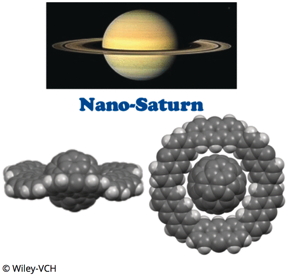
Saturn is the second largest planet in our solar system and has a characteristic ring. Japanese researchers have now synthesized a molecular "nano-Saturn". As the scientists report in the journal Angewandte Chemie, it consists of a spherical C(60) fullerene as the planet and a flat macrocycle made of six anthracene units as the ring. The structure is confirmed by spectroscopic and X-ray analyses.
Nano-saturn: Supramolecular complex formation: Anthracene macrocycle and C60 fullerene
Tokyo, Japan | Posted on June 8th, 2018Nano-Saturn systems with a spherical molecule and a macrocyclic ring have been a fascinating structural motif for researchers. The ring must have a rigid, circular form, and must hold the molecular sphere firmly in its midst. Fullerenes are ideal candidates for the nano-sphere. They are made of carbon atoms linked into a network of rings that form a hollow sphere. The most famous fullerene, C(60), consists of 60 carbon atoms arranged into 5- and 6-membered rings like the leather patches of a classic soccer ball. The electrons in their double bonds, knows as the π-electrons, are in a kind of "electron cloud", able to freely move about and have binding interactions with other molecules, such as a macrocycle that also has a "cloud" of pi-electrons. The attractive interactions between the electron clouds allow fullerenes to lodge in the cavities of such macrocycles.
A series of such complexes has previously been synthesized. Because of the positions of the electron clouds around the macrocycles, it was previously only possible to make rings that surround the fullerene like a belt or a tire. The ring around Saturn, however, is not like a "belt" or "tire", it is a very flat disc. Researchers working at the Tokyo Institute of Technology and Okayama University of Science (Japan) wanted to properly imitate this at nanoscale.
Their success resulted from a different type of bonding between the "nano-planet" and its "nano-ring". Instead of using the attraction between the pi-electron clouds of the fullerene and macrocycle, the team working with Shinji Toyota used the weak attractive interactions between the pi-electron cloud of the fullerene and non- π-electron of the carbon-hydrogen groups of the macrocycle.
To construct their "Saturn ring", the researchers chose to use anthracene units, molecules made of three aromatic six-membered carbon rings linked along their edges. They linked six of these units into a macrocycle whose cavity was the perfect size and shape for a C(60) fullerene. Eighteen hydrogen atoms of the macrocycle project into the middle of the cavity. In total, their interactions with the fullerene are enough to give the complex enough stability, as shown by computer simulations. By using X-ray analysis and NMR spectroscopy, the team was able to prove experimentally that they had produced Saturn-shaped complexes.
###
About the Author
Dr Shinji Toyota is professor at Tokyo Institute of Technology, Department of Chemistry, School of Science. His major research areas are physical organic chemistry, aromatic chemistry, supramolecular chemistry, and stereochemistry.
http://www.cms.titech.ac.jp/labo09-e/tran_09_eng.html
####
For more information, please click here
Contacts:
Mario Mueller
Copyright © Wiley
If you have a comment, please Contact us.Issuers of news releases, not 7th Wave, Inc. or Nanotechnology Now, are solely responsible for the accuracy of the content.
Bookmark:


| Related Links |
| Related News Press |
News and information
 Quantum computer improves AI predictions April 17th, 2026
Flexible sensor gains sensitivity under pressure April 17th, 2026
A reusable chip for particulate matter sensing April 17th, 2026
Detecting vibrational quantum beating in the predissociation dynamics of SF6 using time-resolved photoelectron spectroscopy April 17th, 2026
Imaging
Simple algorithm paired with standard imaging tool could predict failure in lithium metal batteries August 8th, 2025
Govt.-Legislation/Regulation/Funding/Policy
Quantum computer improves AI predictions April 17th, 2026
Metasurfaces smooth light to boost magnetic sensing precision January 30th, 2026
New imaging approach transforms study of bacterial biofilms August 8th, 2025
Possible Futures
A fundamentally new therapeutic approach to cystic fibrosis: Nanobody repairs cellular defect April 17th, 2026
UC Irvine physicists discover method to reverse ‘quantum scrambling’ : The work addresses the problem of information loss in quantum computing system April 17th, 2026
Nanotubes/Buckyballs/Fullerenes/Nanorods/Nanostrings/Nanosheets
Tiny nanosheets, big leap: A new sensor detects ethanol at ultra-low levels January 30th, 2026
Enhancing power factor of p- and n-type single-walled carbon nanotubes April 25th, 2025
Chainmail-like material could be the future of armor: First 2D mechanically interlocked polymer exhibits exceptional flexibility and strength January 17th, 2025
Innovative biomimetic superhydrophobic coating combines repair and buffering properties for superior anti-erosion December 13th, 2024
Discoveries
Quantum computer improves AI predictions April 17th, 2026
Flexible sensor gains sensitivity under pressure April 17th, 2026
A reusable chip for particulate matter sensing April 17th, 2026
Detecting vibrational quantum beating in the predissociation dynamics of SF6 using time-resolved photoelectron spectroscopy April 17th, 2026
Materials/Metamaterials/Magnetoresistance
First real-time observation of two-dimensional melting process: Researchers at Mainz University unveil new insights into magnetic vortex structures August 8th, 2025
Researchers unveil a groundbreaking clay-based solution to capture carbon dioxide and combat climate change June 6th, 2025
A 1960s idea inspires NBI researchers to study hitherto inaccessible quantum states June 6th, 2025
Institute for Nanoscience hosts annual proposal planning meeting May 16th, 2025
Announcements
A fundamentally new therapeutic approach to cystic fibrosis: Nanobody repairs cellular defect April 17th, 2026
UC Irvine physicists discover method to reverse ‘quantum scrambling’ : The work addresses the problem of information loss in quantum computing system April 17th, 2026
Interviews/Book Reviews/Essays/Reports/Podcasts/Journals/White papers/Posters
A fundamentally new therapeutic approach to cystic fibrosis: Nanobody repairs cellular defect April 17th, 2026
UC Irvine physicists discover method to reverse ‘quantum scrambling’ : The work addresses the problem of information loss in quantum computing system April 17th, 2026
Tools
Metasurfaces smooth light to boost magnetic sensing precision January 30th, 2026
From sensors to smart systems: the rise of AI-driven photonic noses January 30th, 2026
Japan launches fully domestically produced quantum computer: Expo visitors to experience quantum computing firsthand August 8th, 2025
Grants/Sponsored Research/Awards/Scholarships/Gifts/Contests/Honors/Records
Quantum computer improves AI predictions April 17th, 2026
Detecting vibrational quantum beating in the predissociation dynamics of SF6 using time-resolved photoelectron spectroscopy April 17th, 2026
Metasurfaces smooth light to boost magnetic sensing precision January 30th, 2026
 |
||
 |
||
| The latest news from around the world, FREE | ||
 |
||
|
|
||
| Premium Products | ||
 |
||
|
Only the news you want to read!
Learn More |
||
 |
||
|
Full-service, expert consulting
Learn More |
||
|
|
||