Home > Press > A nanotech sensor that turns molecular fingerprints into bar codes
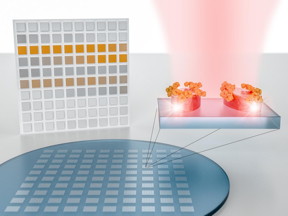 |
| The authors show a pixelated sensor metasurface for molecular spectroscopy. It consists of metapixels designed to concentrate light into nanometer-sized volumes in order to amplify and detect the absorption fingerprint of analyte molecules at specific resonance wavelengths. Simultaneous imaging-based read-out of all metapixels provides a spatial map of the molecular absorption fingerprint sampled at the individual resonance wavelengths. This pixelated absorption map can be seen as a two-dimensional barcode of the molecular fingerprint, which encodes the characteristic absorption bands as distinct features of the resulting image. CREDIT EPFL |
Abstract:
Infrared spectroscopy is the benchmark method for detecting and analyzing organic compounds. But it requires complicated procedures and large, expensive instruments, making device miniaturization challenging and hindering its use for some industrial and medical applications and for data collection out in the field, such as for measuring pollutant concentrations. Furthermore, it is fundamentally limited by low sensitivities and therefore requires large sample amounts.
A nanotech sensor that turns molecular fingerprints into bar codes
Lausanne, Switzerland | Posted on June 7th, 2018However, scientists at EPFL's School of Engineering and at Australian National University (ANU) have developed a compact and sensitive nanophotonic system that can identify a molecule's absorption characteristics without using conventional spectrometry.
Their system consists of an engineered surface covered with hundreds of tiny sensors called metapixels, which can generate a distinct bar code for every molecule that the surface comes into contact with. These bar codes can be massively analyzed and classified using advanced pattern recognition and sorting technology such as artificial neural networks. This research - which sits at the crossroads of physics, nanotechnology and big data - has been published in Science.
Translating molecules into bar codes
The chemical bonds in organic molecules each have a specific orientation and vibrational mode. That means every molecule has a set of characteristic energy levels, which are commonly located in the mid-infrared range - corresponding to wavelengths of around 4 to 10 microns. Therefore, each type of molecule absorbs light at different frequencies, giving each one a unique "signature." Infrared spectroscopy detects whether a given molecule is present in a sample by seeing if the sample absorbs light rays at the molecule's signature frequencies. However, such analyses require lab instruments with a hefty size and price tag.
The pioneering system developed by the EPFL scientists is both highly sensitive and capable of being miniaturized; it uses nanostructures that can trap light on the nanoscale and thereby provide very high detection levels for samples on the surface. "The molecules we want to detect are nanometric in scale, so bridging this size gap is an essential step," says Hatice Altug, head of EPFL's BioNanoPhotonic Systems Laboratory and a coauthor of the study.
The system's nanostructures are grouped into what are called metapixels so that each one resonates at a different frequency. When a molecule comes into contact with the surface, the way the molecule absorbs light changes the behavior of all the metapixels it touches.
"Importantly, the metapixels are arranged in such a way that different vibrational frequencies are mapped to different areas on the surface," says Andreas Tittl, lead author of the study.
This creates a pixelated map of light absorption that can be translated into a molecular bar code - all without using a spectrometer.
The scientists have already used their system to detect polymers, pesticides and organic compounds. What's more, their system is compatible with CMOS technology.
"Thanks to our sensors' unique optical properties, we can generate bar codes even with broadband light sources and detectors," says Aleksandrs Leitis, a coauthor of the study.
There are a number of potential applications for this new system. "For instance, it could be used to make portable medical testing devices that generate bar codes for each of the biomarkers found in a blood sample," says Dragomir Neshev, another coauthor of the study.
Artificial intelligence could be used in conjunction with this new technology to create and process a whole library of molecular bar codes for compounds ranging from protein and DNA to pesticides and polymers. That would give researchers a new tool for quickly and accurately spotting miniscule amounts of compounds present in complex samples.
###
Source:
Andreas Tittl, Aleksandrs Leitis, Mingkai Liu, Filiz Yesilkoy, Duk-Yong Choi, Dragomir N. Neshev, Yuri S. Kivshar, and Hatice Altug, "Imaging-based molecular barcoding with pixelated dielectric metasurfaces," Science
BioNanoPhotonic Systems Laboratory (BIOS) / Interfaculty Institute of Bioengineering IBI / School of Engineering - School of Life Sciences / EPFL Nonlinear Physics Centre, Research School of Physics and Engineering, Australian National University, Canberra
####
For more information, please click here
Contacts:
Hatice Altug
41-216-931-170
Copyright © Ecole Polytechnique Fédérale de Lausanne
If you have a comment, please Contact us.Issuers of news releases, not 7th Wave, Inc. or Nanotechnology Now, are solely responsible for the accuracy of the content.
Bookmark:


| Related News Press |
News and information
 Quantum computer improves AI predictions April 17th, 2026
Flexible sensor gains sensitivity under pressure April 17th, 2026
A reusable chip for particulate matter sensing April 17th, 2026
Detecting vibrational quantum beating in the predissociation dynamics of SF6 using time-resolved photoelectron spectroscopy April 17th, 2026
Possible Futures
A fundamentally new therapeutic approach to cystic fibrosis: Nanobody repairs cellular defect April 17th, 2026
UC Irvine physicists discover method to reverse ‘quantum scrambling’ : The work addresses the problem of information loss in quantum computing system April 17th, 2026
Nanomedicine
A fundamentally new therapeutic approach to cystic fibrosis: Nanobody repairs cellular defect April 17th, 2026
New molecular technology targets tumors and simultaneously silences two ‘undruggable’ cancer genes August 8th, 2025
New imaging approach transforms study of bacterial biofilms August 8th, 2025
Electrifying results shed light on graphene foam as a potential material for lab grown cartilage June 6th, 2025
Sensors
Flexible sensor gains sensitivity under pressure April 17th, 2026
Tiny nanosheets, big leap: A new sensor detects ethanol at ultra-low levels January 30th, 2026
From sensors to smart systems: the rise of AI-driven photonic noses January 30th, 2026
Sensors innovations for smart lithium-based batteries: advancements, opportunities, and potential challenges August 8th, 2025
Discoveries
Quantum computer improves AI predictions April 17th, 2026
Flexible sensor gains sensitivity under pressure April 17th, 2026
A reusable chip for particulate matter sensing April 17th, 2026
Detecting vibrational quantum beating in the predissociation dynamics of SF6 using time-resolved photoelectron spectroscopy April 17th, 2026
Announcements
A fundamentally new therapeutic approach to cystic fibrosis: Nanobody repairs cellular defect April 17th, 2026
UC Irvine physicists discover method to reverse ‘quantum scrambling’ : The work addresses the problem of information loss in quantum computing system April 17th, 2026
Interviews/Book Reviews/Essays/Reports/Podcasts/Journals/White papers/Posters
A fundamentally new therapeutic approach to cystic fibrosis: Nanobody repairs cellular defect April 17th, 2026
UC Irvine physicists discover method to reverse ‘quantum scrambling’ : The work addresses the problem of information loss in quantum computing system April 17th, 2026
Food/Agriculture/Supplements
New imaging approach transforms study of bacterial biofilms August 8th, 2025
SMART researchers pioneer first-of-its-kind nanosensor for real-time iron detection in plants February 28th, 2025
Environment
A reusable chip for particulate matter sensing April 17th, 2026
Researchers unveil a groundbreaking clay-based solution to capture carbon dioxide and combat climate change June 6th, 2025
Photonics/Optics/Lasers
Metasurfaces smooth light to boost magnetic sensing precision January 30th, 2026
From sensors to smart systems: the rise of AI-driven photonic noses January 30th, 2026
 |
||
 |
||
| The latest news from around the world, FREE | ||
 |
||
|
|
||
| Premium Products | ||
 |
||
|
Only the news you want to read!
Learn More |
||
 |
||
|
Full-service, expert consulting
Learn More |
||
|
|
||