Home > Press > Graphene oxide nanosheets could help bring lithium-metal batteries to market
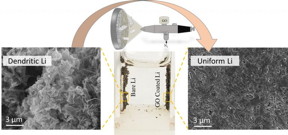 |
| Left: Dendrites forming on a lithium electrode. Right: Lithium plates uniformly on a lithium electrode in a battery with a graphene oxide nanosheet separator. Credit: Reza Shahbazian-Yassar. |
Abstract:
Lithium-metal batteries -- which can hold up to 10 times more charge than the lithium-ion batteries that currently power our phones, laptops and cars -- haven't been commercialized because of a fatal flaw: as these batteries charge and discharge, lithium is deposited unevenly on the electrodes. This buildup cuts the lives of these batteries too short to make them viable, and more importantly, can cause the batteries to short-circuit and catch fire.
Graphene oxide nanosheets could help bring lithium-metal batteries to market
Chicago, IL | Posted on March 23rd, 2018Now, researchers at the University of Illinois at Chicago have developed a solution to this problem in the form of a graphene-oxide coated 'nanosheet' that, when placed in between the two electrodes of a lithium-metal battery, prevents uneven plating of lithium and allows the battery to safely function for hundreds of charge/discharge cycles. They report their findings in the journal Advanced Functional Materials.
"Our findings demonstrate that two-dimensional materials -- in this case, graphene oxide -- can help regulate lithium deposition in such a way that extends the life of lithium-metal batteries," said Reza Shahbazian-Yassar, associate professor of mechanical and industrial engineering in the UIC College of Engineering and corresponding author of the paper.
Lithium-metal batteries are so useful because of their high-energy density and relatively light weights compared with conventional batteries. However, over the course of many charge-discharge cycles, lithium builds up unevenly on the battery's lithium metal electrode in a branching or 'dendritic' pattern and ultimately causes the battery to go dead. If the dendrites grow through the electrolyte solution and make contact with the other electrode, then the battery may experience a catastrophic event -- in other words, an explosion or fire.
In lithium-ion batteries, a separator is placed in the electrolyte. Usually made of a porous polymer or glass ceramic fibers, the separator allows lithium ions to flow through while keeping the other components blocked to prevent electrical shorts, which can lead to fires.
Reza and colleagues used a modified separator in a lithium-metal battery to modulate the flow of lithium ions to control the rate of lithium deposition and see if they could prevent dendrites from forming. They spray-coated a fiberglass separator with graphene oxide, producing what they called a nanosheet.
Using scanning electron microscopy and other imaging techniques, the researchers showed that when the nanosheet was used in a lithium-metal battery, a uniform film of lithium formed on the lithium electrode's surface, which actually improves battery function and makes the battery much safer, said Tara Foroozan, a graduate student in the UIC College of Engineering and first author on this study.
Molecular simulations, led by a team of researchers from Texas A & M University, suggested that the lithium ions become temporarily bonded to the graphene oxide, and then diffuse through areas of nanoscopic defects in the sheet. This delays the passage of lithium ions enough to prevent the formation of dendritic deposition of lithium on the electrode.
"The nanosheet slows the passage of lithium ions enough to allow for more uniform plating on lithium ions across the surface of the electrode, which helps preserve battery life," said Reza.
Results of phase-field modeling computations led by Farzad Mashayek, professor and head of mechanical and industrial engineering in the UIC College of Engineering and an author on the paper, indicated that graphene oxide can also mechanically suppress the growth of lithium dendrites.
"We show that two-dimensional graphene oxide materials are able to impede the formation of dendrites by changing the rate of lithium-ion diffusion as they pass through the graphene oxide layers," said Shahbazian-Yassar. "This method has very high potential for industrial application and scalability."
###
Vitaliy Soroosh, Sharifi-Asl, Ramasubramonian Deivanayagam, Zhennan Huang, and Ramin Rojaee from the UIC College of Engineering and Fernando Soto and Perla Balbuena from Texas A & M University are co-authors on the paper.
This research was funded by grant DMR-1620901 from the National Science Foundation and grant DE-EE0007766 from the U.S. Department of Energy.
####
For more information, please click here
Contacts:
Sharon Parmet
312-413-2695
Copyright © University of Illinois at Chicago
If you have a comment, please Contact us.Issuers of news releases, not 7th Wave, Inc. or Nanotechnology Now, are solely responsible for the accuracy of the content.
Bookmark:


| Related Links |
| Related News Press |
News and information
 Quantum computer improves AI predictions April 17th, 2026
Flexible sensor gains sensitivity under pressure April 17th, 2026
A reusable chip for particulate matter sensing April 17th, 2026
Detecting vibrational quantum beating in the predissociation dynamics of SF6 using time-resolved photoelectron spectroscopy April 17th, 2026
Graphene/ Graphite
Electrifying results shed light on graphene foam as a potential material for lab grown cartilage June 6th, 2025
Breakthrough in proton barrier films using pore-free graphene oxide: Kumamoto University researchers achieve new milestone in advanced coating technologies September 13th, 2024
Govt.-Legislation/Regulation/Funding/Policy
Quantum computer improves AI predictions April 17th, 2026
Metasurfaces smooth light to boost magnetic sensing precision January 30th, 2026
New imaging approach transforms study of bacterial biofilms August 8th, 2025
Possible Futures
A fundamentally new therapeutic approach to cystic fibrosis: Nanobody repairs cellular defect April 17th, 2026
UC Irvine physicists discover method to reverse ‘quantum scrambling’ : The work addresses the problem of information loss in quantum computing system April 17th, 2026
Discoveries
Quantum computer improves AI predictions April 17th, 2026
Flexible sensor gains sensitivity under pressure April 17th, 2026
A reusable chip for particulate matter sensing April 17th, 2026
Detecting vibrational quantum beating in the predissociation dynamics of SF6 using time-resolved photoelectron spectroscopy April 17th, 2026
Materials/Metamaterials/Magnetoresistance
First real-time observation of two-dimensional melting process: Researchers at Mainz University unveil new insights into magnetic vortex structures August 8th, 2025
Researchers unveil a groundbreaking clay-based solution to capture carbon dioxide and combat climate change June 6th, 2025
A 1960s idea inspires NBI researchers to study hitherto inaccessible quantum states June 6th, 2025
Institute for Nanoscience hosts annual proposal planning meeting May 16th, 2025
Announcements
A fundamentally new therapeutic approach to cystic fibrosis: Nanobody repairs cellular defect April 17th, 2026
UC Irvine physicists discover method to reverse ‘quantum scrambling’ : The work addresses the problem of information loss in quantum computing system April 17th, 2026
Interviews/Book Reviews/Essays/Reports/Podcasts/Journals/White papers/Posters
A fundamentally new therapeutic approach to cystic fibrosis: Nanobody repairs cellular defect April 17th, 2026
UC Irvine physicists discover method to reverse ‘quantum scrambling’ : The work addresses the problem of information loss in quantum computing system April 17th, 2026
Battery Technology/Capacitors/Generators/Piezoelectrics/Thermoelectrics/Energy storage
Decoding hydrogen‑bond network of electrolyte for cryogenic durable aqueous zinc‑ion batteries January 30th, 2026
COF scaffold membrane with gate‑lane nanostructure for efficient Li+/Mg2+ separation January 30th, 2026
MXene nanomaterials enter a new dimension Multilayer nanomaterial: MXene flakes created at Drexel University show new promise as 1D scrolls January 30th, 2026
Research partnerships
Lab to industry: InSe wafer-scale breakthrough for future electronics August 8th, 2025
HKU physicists uncover hidden order in the quantum world through deconfined quantum critical points April 25th, 2025
 |
||
 |
||
| The latest news from around the world, FREE | ||
 |
||
|
|
||
| Premium Products | ||
 |
||
|
Only the news you want to read!
Learn More |
||
 |
||
|
Full-service, expert consulting
Learn More |
||
|
|
||