Home > Press > Cleaning nanowires to get out more light
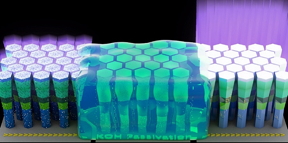 |
| Treating aluminum-gallium-nitride nanowires with a diluted potassium-hydroxide solution can enhance the ultraviolet light output power as compared to an untreated device. Reprinted with permission from Sun, H., Shakfa, M.K., Muhammed, M.M., Janjua, B., Li, K.-H., Lin, R., Ng, T.K., Roqan, I.S., Ooi, B.S. & Li, X. Surface-passivated AlGaN nanowires for enhanced luminescence of ultraviolet light emitting diodes. ACS Photonics advance online publication, 19 December 2017.© 2017 American Chemical Society; KAUST Heno Hwang |
Abstract:
A technique for reducing the loss of light at the surface of semiconductor nanostructures has been demonstrated by scientists at KAUST.
Cleaning nanowires to get out more light
Thuwal, Saudi Arabia | Posted on March 7th, 2018Some materials can efficiently convert the electrons in an electrical current into light. These so-called semiconductors are used to create light-emitting diodes or LEDs: small, light, energy-efficient, long-lasting devices that are increasingly prevalent in both lighting and display applications.
The color, or wavelength, of the emitted light can be determined by choosing the appropriate material. Gallium arsenide, for example, emits predominantly infrared light. For shorter wavelengths that move into the blue or ultraviolet region of the spectrum, scientists have turned to gallium nitride. Then, to tune down the emission wavelength, aluminum can be added, which alters the spacing between the atoms and increases the energy bandgap.
However, numerous factors prevent all the radiation created in the semiconductor escaping the device to act as an efficient light source. Firstly, most semiconducting materials have a high refractive index, which makes semiconductor-air interfaces highly reflected--at some angles all light bounces backwards in a process known as total internal reflectivity. A second limitation is that imperfections at the surface act as traps that reabsorb the light before it can escape.
Postdoc Haiding Sun and his KAUST colleagues, including his supervisor, Assistant Prof. Xiaohang Li, Prof. Boon Ooi and Assistant Prof. Iman Roqan, have developed LEDs that are made up of a tight array of dislocation-free nanometer-scale aluminum-gallium-nitride nanowires on a titanium-coated silicon substrate. More light can be efficiently extracted due to the presence of the air gaps between nanowires via scattering. The trade-off however is that arrays of nanowires have a larger surface area than a planar structure. "Because of the large surface-to-volume ratio of nanowires, their optical and electrical properties are highly sensitive to their surroundings," says Sun. "Surface states and defects will lead to low-efficiency light-emitting devices."
Sun and the team show that treating the nanowires in a diluted potassium-hydroxide solution can suppress the surface reabsorption by removing dangling chemical bonds and preventing oxidization. Their results showed that a 30 second treatment led to a 49.7 percent enhancement in the ultraviolet light output power as compared with an untreated device.
"We aim to improve our device's performance in several ways," says Sun. "For example, we will optimize the nanowire growth conditions, we will use quantum-well structures in the active region and we will use different metal substrates to improve the light-extraction efficiency."
####
For more information, please click here
Contacts:
Carolyn Unck
Copyright © King Abdullah University of Science and Technology
If you have a comment, please Contact us.Issuers of news releases, not 7th Wave, Inc. or Nanotechnology Now, are solely responsible for the accuracy of the content.
Bookmark:


| Related Links |
| Related News Press |
News and information
 Quantum computer improves AI predictions April 17th, 2026
Flexible sensor gains sensitivity under pressure April 17th, 2026
A reusable chip for particulate matter sensing April 17th, 2026
Detecting vibrational quantum beating in the predissociation dynamics of SF6 using time-resolved photoelectron spectroscopy April 17th, 2026
Chemistry
Projecting light to dispense liquids: A new route to ultra-precise microdroplets January 30th, 2026
From sensors to smart systems: the rise of AI-driven photonic noses January 30th, 2026
"Nanoreactor" cage uses visible light for catalytic and ultra-selective cross-cycloadditions October 3rd, 2025
Cambridge chemists discover simple way to build bigger molecules – one carbon at a time June 6th, 2025
Single-atom catalysts change spin state when boosted by a magnetic field June 4th, 2025
Display technology/LEDs/SS Lighting/OLEDs
Spinel-type sulfide semiconductors to operate the next-generation LEDs and solar cells For solar-cell absorbers and green-LED source October 3rd, 2025
Possible Futures
A fundamentally new therapeutic approach to cystic fibrosis: Nanobody repairs cellular defect April 17th, 2026
UC Irvine physicists discover method to reverse ‘quantum scrambling’ : The work addresses the problem of information loss in quantum computing system April 17th, 2026
Discoveries
Quantum computer improves AI predictions April 17th, 2026
Flexible sensor gains sensitivity under pressure April 17th, 2026
A reusable chip for particulate matter sensing April 17th, 2026
Detecting vibrational quantum beating in the predissociation dynamics of SF6 using time-resolved photoelectron spectroscopy April 17th, 2026
Materials/Metamaterials/Magnetoresistance
First real-time observation of two-dimensional melting process: Researchers at Mainz University unveil new insights into magnetic vortex structures August 8th, 2025
Researchers unveil a groundbreaking clay-based solution to capture carbon dioxide and combat climate change June 6th, 2025
A 1960s idea inspires NBI researchers to study hitherto inaccessible quantum states June 6th, 2025
Institute for Nanoscience hosts annual proposal planning meeting May 16th, 2025
Announcements
A fundamentally new therapeutic approach to cystic fibrosis: Nanobody repairs cellular defect April 17th, 2026
UC Irvine physicists discover method to reverse ‘quantum scrambling’ : The work addresses the problem of information loss in quantum computing system April 17th, 2026
Interviews/Book Reviews/Essays/Reports/Podcasts/Journals/White papers/Posters
A fundamentally new therapeutic approach to cystic fibrosis: Nanobody repairs cellular defect April 17th, 2026
UC Irvine physicists discover method to reverse ‘quantum scrambling’ : The work addresses the problem of information loss in quantum computing system April 17th, 2026
Quantum nanoscience
Beyond silicon: Electronics at the scale of a single molecule January 30th, 2026
MXene nanomaterials enter a new dimension Multilayer nanomaterial: MXene flakes created at Drexel University show new promise as 1D scrolls January 30th, 2026
ICFO researchers overcome long-standing bottleneck in single photon detection with twisted 2D materials August 8th, 2025
 |
||
 |
||
| The latest news from around the world, FREE | ||
 |
||
|
|
||
| Premium Products | ||
 |
||
|
Only the news you want to read!
Learn More |
||
 |
||
|
Full-service, expert consulting
Learn More |
||
|
|
||