Home > Press > Vanadium dioxyde: A revolutionary material for tomorrow's electronics: Phase-chance switch can now be performed at higher temperatures
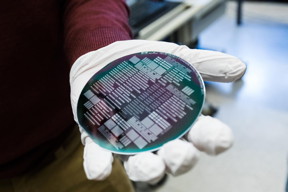 |
| This is a Vanadium Dioxyde chip developed at EPFL's NANOLAB. CREDIT EPFL / Jamani Caillet |
Abstract:
First came the switch. Then the transistor. Now another innovation stands to revolutionize the way we control the flow of electrons through a circuit: vanadium dioxide (VO2). A key characteristic of this compound is that it behaves as an insulator at room temperature but as a conductor at temperatures above 68°C. This behavior - also known as metal-insulator transition - is being studied in an ambitious EU Horizon 2020 project called Phase-Change Switch. EPFL was chosen to coordinate the project following a challenging selection process.
Vanadium dioxyde: A revolutionary material for tomorrow's electronics: Phase-chance switch can now be performed at higher temperatures
Lausanne, Switzerland | Posted on February 5th, 2018The project will last until 2020 and has been granted €3.9 million of EU funding. Due to the array of high-potential applications that could come out of this new technology, the project has attracted two major companies - Thales of France and the Swiss branch of IBM Research - as well as other universities, including Max-Planck-Gesellschaft in Germany and Cambridge University in the UK. Gesellschaft für Angewandte Mikro- und Optoelektronik (AMO GmbH), a spin-off of Aachen University in Germany, is also taking part in the research.
Scientists have long known about the electronic properties of VO2 but haven't been able to explain them until know. It turns out that its atomic structure changes as the temperature rises, transitioning from a crystalline structure at room temperature to a metallic one at temperatures above 68°C. And this transition happens in less than a nanosecond - a real advantage for electronics applications. "VO2 is also sensitive to other factors that could cause it to change phases, such as by injecting electrical power, optically, or by applying a THz radiation pulse," says Adrian Ionescu, the EPFL professor who heads the school's Nanoelectronic Devices Laboratory (Nanolab) and also serves as the Phase-Change Switch project coordinator.
The challenge: reaching higher temperatures
However, unlocking the full potential of VO2 has always been tricky because its transition temperature of 68°C is too low for modern electronic devices, where circuits must be able to run flawlessly at 100°C. But two EPFL researchers - Ionescu from the School of Engineering (STI) and Andreas Schüler from the School of Architecture, Civil and Environmental Engineering (ENAC) - may have found a solution to this problem, according to their joint research published in Applied Physics Letters in July 2017. They found that adding germanium to VO2 film can lift the material's phase change temperature to over 100°C.
Even more interesting findings from the Nanolab - especially for radiofrequency applications - were published in IEEE Access on 2 February 2018. For the first time ever, scientists were able to make ultra-compact, modulable frequency filters. Their technology also uses VO2 and phase-change switches, and is particularly effective in the frequency range crucial for space communication systems (the Ka band, with programmable frequency modulation between 28.2 and 35 GHz).
Neuromorphic processors and autonomous vehicles
These promising discoveries are likely to spur further research into applications for VO2 in ultra-low-power electronic devices. In addition to space communications, other fields could include neuromorphic computing and high-frequency radars for self-driving cars.
####
For more information, please click here
Contacts:
Adrian Ionescu
41-216-933-978
Copyright © Ecole Polytechnique Fédérale de Lausanne
If you have a comment, please Contact us.Issuers of news releases, not 7th Wave, Inc. or Nanotechnology Now, are solely responsible for the accuracy of the content.
Bookmark:


| Related Links |
| Related News Press |
News and information
 Quantum computer improves AI predictions April 17th, 2026
Flexible sensor gains sensitivity under pressure April 17th, 2026
A reusable chip for particulate matter sensing April 17th, 2026
Detecting vibrational quantum beating in the predissociation dynamics of SF6 using time-resolved photoelectron spectroscopy April 17th, 2026
Wireless/telecommunications/RF/Antennas/Microwaves
Researchers develop molecular qubits that communicate at telecom frequencies October 3rd, 2025
HKUST researchers develop new integration technique for efficient coupling of III-V and silicon February 16th, 2024
Govt.-Legislation/Regulation/Funding/Policy
Quantum computer improves AI predictions April 17th, 2026
Metasurfaces smooth light to boost magnetic sensing precision January 30th, 2026
New imaging approach transforms study of bacterial biofilms August 8th, 2025
Possible Futures
A fundamentally new therapeutic approach to cystic fibrosis: Nanobody repairs cellular defect April 17th, 2026
UC Irvine physicists discover method to reverse ‘quantum scrambling’ : The work addresses the problem of information loss in quantum computing system April 17th, 2026
Chip Technology
A reusable chip for particulate matter sensing April 17th, 2026
Metasurfaces smooth light to boost magnetic sensing precision January 30th, 2026
Nanoelectronics
Lab to industry: InSe wafer-scale breakthrough for future electronics August 8th, 2025
Interdisciplinary: Rice team tackles the future of semiconductors Multiferroics could be the key to ultralow-energy computing October 6th, 2023
Key element for a scalable quantum computer: Physicists from Forschungszentrum Jülich and RWTH Aachen University demonstrate electron transport on a quantum chip September 23rd, 2022
Reduced power consumption in semiconductor devices September 23rd, 2022
Discoveries
Quantum computer improves AI predictions April 17th, 2026
Flexible sensor gains sensitivity under pressure April 17th, 2026
A reusable chip for particulate matter sensing April 17th, 2026
Detecting vibrational quantum beating in the predissociation dynamics of SF6 using time-resolved photoelectron spectroscopy April 17th, 2026
Materials/Metamaterials/Magnetoresistance
First real-time observation of two-dimensional melting process: Researchers at Mainz University unveil new insights into magnetic vortex structures August 8th, 2025
Researchers unveil a groundbreaking clay-based solution to capture carbon dioxide and combat climate change June 6th, 2025
A 1960s idea inspires NBI researchers to study hitherto inaccessible quantum states June 6th, 2025
Institute for Nanoscience hosts annual proposal planning meeting May 16th, 2025
Announcements
A fundamentally new therapeutic approach to cystic fibrosis: Nanobody repairs cellular defect April 17th, 2026
UC Irvine physicists discover method to reverse ‘quantum scrambling’ : The work addresses the problem of information loss in quantum computing system April 17th, 2026
Interviews/Book Reviews/Essays/Reports/Podcasts/Journals/White papers/Posters
A fundamentally new therapeutic approach to cystic fibrosis: Nanobody repairs cellular defect April 17th, 2026
UC Irvine physicists discover method to reverse ‘quantum scrambling’ : The work addresses the problem of information loss in quantum computing system April 17th, 2026
Automotive/Transportation
Decoding hydrogen‑bond network of electrolyte for cryogenic durable aqueous zinc‑ion batteries January 30th, 2026
Sensors innovations for smart lithium-based batteries: advancements, opportunities, and potential challenges August 8th, 2025
Simple algorithm paired with standard imaging tool could predict failure in lithium metal batteries August 8th, 2025
Research partnerships
Lab to industry: InSe wafer-scale breakthrough for future electronics August 8th, 2025
HKU physicists uncover hidden order in the quantum world through deconfined quantum critical points April 25th, 2025
 |
||
 |
||
| The latest news from around the world, FREE | ||
 |
||
|
|
||
| Premium Products | ||
 |
||
|
Only the news you want to read!
Learn More |
||
 |
||
|
Full-service, expert consulting
Learn More |
||
|
|
||