Home > Press > Nanowrinkles could save billions in shipping and aquaculture Surfaces inspired by carnivorous plants delay degradation by marine fouling
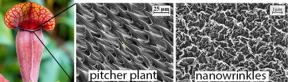 |
| The Nepenthes pitcher plant (left) and its nanowrinkled 'mouth' (centre) inspired the engineered nanomaterial (right). CREDIT Sydney Nano |
Abstract:
A team of chemistry researchers from the University of Sydney Nano Institute has developed nanostructured surface coatings that have anti-fouling properties without using any toxic components.
Nanowrinkles could save billions in shipping and aquaculture Surfaces inspired by carnivorous plants delay degradation by marine fouling
Sydney, Australia | Posted on January 17th, 2018Biofouling - the build-up of damaging biological material - is a huge economic issue, costing the aquaculture and shipping industries billions of dollars a year in maintenance and extra fuel usage. It is estimated that the increased drag on ship hulls due to biofouling costs the shipping industry in Australia $320 million a year a b.
Since the banning of the toxic anti-fouling agent tributyltin, the need for new non-toxic methods to stop marine biofouling has been pressing.
Leader of the research team, Associate Professor Chiara Neto, said: "We are keen to understand how these surfaces work and also push the boundaries of their application, especially for energy efficiency. Slippery coatings are expected to be drag-reducing, which means that objects, such as ships, could move through water with much less energy required."
The new materials were tested tied to shark netting in Sydney's Watson Bay, showing that the nanomaterials were efficient at resisting biofouling in a marine environment.
The research has been published in ACS Applied Materials & Interfaces.
The new coating uses 'nanowrinkles' inspired by the carnivorous Nepenthes pitcher plant. The plant traps a layer of water on the tiny structures around the rim of its opening. This creates a slippery layer causing insects to aquaplane on the surface, before they slip into the pitcher where they are digested.
Nanostructures utilise materials engineered at the scale of billionths of a metre - 100,000 times smaller than the width of a human hair. Associate Professor Neto's group at Sydney Nano is developing nanoscale materials for future development in industry.
Biofouling can occur on any surface that is wet for a long period of time, for example aquaculture nets, marine sensors and cameras, and ship hulls. The slippery surface developed by the Neto group stops the initial adhesion of bacteria, inhibiting the formation of a biofilm from which larger marine fouling organisms can grow.
The interdisciplinary University of Sydney team included biofouling expert Professor Truis Smith-Palmer of St Francis Xavier University in Nova Scotia, Canada, who was on sabbatical visit to the Neto group for a year, partially funded by the Faculty of Science scheme for visiting women.
In the lab, the slippery surfaces resisted almost all fouling from a common species of marine bacteria, while control Teflon samples without the lubricating layer were completely fouled. Not satisfied with testing the surfaces under highly controlled lab conditions with only one type of bacteria the team also tested the surfaces in the ocean, with the help of marine biologist Professor Ross Coleman.
Test surfaces were attached to swimming nets at Watsons Bay baths in Sydney Harbour for a period of seven weeks. In the much harsher marine environment, the slippery surfaces were still very efficient at resisting fouling.
The antifouling coatings are mouldable and transparent, making their application ideal for underwater cameras and sensors.
####
For more information, please click here
Contacts:
Marcus Strom
61-423-982-485
Copyright © University of Sydney
If you have a comment, please Contact us.Issuers of news releases, not 7th Wave, Inc. or Nanotechnology Now, are solely responsible for the accuracy of the content.
Bookmark:


| Related Links |
| Related News Press |
News and information
 Quantum computer improves AI predictions April 17th, 2026
Flexible sensor gains sensitivity under pressure April 17th, 2026
A reusable chip for particulate matter sensing April 17th, 2026
Detecting vibrational quantum beating in the predissociation dynamics of SF6 using time-resolved photoelectron spectroscopy April 17th, 2026
Imaging
Chemistry
Projecting light to dispense liquids: A new route to ultra-precise microdroplets January 30th, 2026
From sensors to smart systems: the rise of AI-driven photonic noses January 30th, 2026
"Nanoreactor" cage uses visible light for catalytic and ultra-selective cross-cycloadditions October 3rd, 2025
Marine/Watercraft
Strain-sensing smart skin ready to deploy: Nanotube-embedded coating detects threats from wear and tear in large structures July 15th, 2022
A sunlight-driven “self-healing” anti-corrosion coating May 27th, 2022
Quantum tech in space? Scientists design remote monitoring system for inaccessible quantum devices February 11th, 2022
Possible Futures
A fundamentally new therapeutic approach to cystic fibrosis: Nanobody repairs cellular defect April 17th, 2026
UC Irvine physicists discover method to reverse ‘quantum scrambling’ : The work addresses the problem of information loss in quantum computing system April 17th, 2026
Discoveries
Quantum computer improves AI predictions April 17th, 2026
Flexible sensor gains sensitivity under pressure April 17th, 2026
A reusable chip for particulate matter sensing April 17th, 2026
Detecting vibrational quantum beating in the predissociation dynamics of SF6 using time-resolved photoelectron spectroscopy April 17th, 2026
Announcements
A fundamentally new therapeutic approach to cystic fibrosis: Nanobody repairs cellular defect April 17th, 2026
UC Irvine physicists discover method to reverse ‘quantum scrambling’ : The work addresses the problem of information loss in quantum computing system April 17th, 2026
Interviews/Book Reviews/Essays/Reports/Podcasts/Journals/White papers/Posters
A fundamentally new therapeutic approach to cystic fibrosis: Nanobody repairs cellular defect April 17th, 2026
UC Irvine physicists discover method to reverse ‘quantum scrambling’ : The work addresses the problem of information loss in quantum computing system April 17th, 2026
Tools
Metasurfaces smooth light to boost magnetic sensing precision January 30th, 2026
From sensors to smart systems: the rise of AI-driven photonic noses January 30th, 2026
Japan launches fully domestically produced quantum computer: Expo visitors to experience quantum computing firsthand August 8th, 2025
Food/Agriculture/Supplements
New imaging approach transforms study of bacterial biofilms August 8th, 2025
SMART researchers pioneer first-of-its-kind nanosensor for real-time iron detection in plants February 28th, 2025
 |
||
 |
||
| The latest news from around the world, FREE | ||
 |
||
|
|
||
| Premium Products | ||
 |
||
|
Only the news you want to read!
Learn More |
||
 |
||
|
Full-service, expert consulting
Learn More |
||
|
|
||