Home > Press > Scientists make transparent materials absorb light
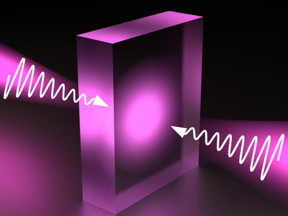 |
| This is a schematic of a virtual light absorption process: A layer of a transparent material is exposed to light beams from both sides, with the light intensity increasing in time. Image courtesy of the researchers. CREDIT MIPT Press Office |
Abstract:
A group of physicists from Russia, Sweden, and the U.S. has demonstrated a highly unusual optical effect: They managed to "virtually" absorb light using a material that has no light-absorbing capacity. The research findings, published in Optica, break new ground for the creation of memory elements for light.
Scientists make transparent materials absorb light
Moscow, Russia | Posted on December 1st, 2017The absorption of electromagnetic radiation -- light, among other things -- is one of the main effects of electromagnetism. This process takes place when electromagnetic energy is converted to heat or another kind of energy within an absorbing material (for instance, during electron excitation). Coal, black paint, and carbon nanotube arrays -- also known as Vantablack -- look black because they absorb the energy of the incident light almost completely. Other materials, such as glass or quartz, have no absorbing properties and therefore look transparent.
In their theoretical research, the results of which were published in the journal Optica, the physicists managed to dispel that simple and intuitive notion by making a completely transparent material appear perfectly absorbing. To achieve that, the researchers employed special mathematical properties of the scattering matrix -- a function that relates an incident electromagnetic field with the one scattered by the system. When a light beam of time-independent intensity hits a transparent object, the light does not get absorbed but is scattered by the material -- a phenomenon caused by the unitary property of the scattering matrix. It turned out, however, that if the intensity of the incident beam is varied with time in a certain fashion, the unitary property can be disrupted, at least for some time. In particular, if the intensity growth is exponential, the total incident light energy will accumulate in the transparent material without leaving it (fig. 1). That being the case, the system will appear perfectly absorbing from the outside.
To illustrate the effect, the researchers examined a thin layer of a transparent dielectric and calculated the intensity profile required for the absorption of the incident light. The calculations confirmed that when the incident wave intensity grows exponentially (the dotted line on fig. 2), the light is neither transmitted nor reflected (the solid curve on fig. 2). That is, the layer looks perfectly absorbing despite the fact that it lacks the actual absorption capacity. However, when the exponential growth of the incident wave amplitude comes to a halt (at t = 0), the energy locked in the layer is released.
"Our theoretical findings appear to be rather counterintuitive. Up until we started our research, we couldn't even imagine that it would be possible to 'pull off such a trick' with a transparent structure," says Denis Baranov, a doctoral student at MIPT and one of the authors of the study. "However, it was the mathematics that led us to the effect. Who knows, electrodynamics may well harbor other fascinating phenomena."
The results of the study not only broaden our general understanding of how light behaves when it interacts with common transparent materials, but also have a wide range of practical applications. To give an example, the accumulation of light in a transparent material may help design optical memory devices that would store optical information without any losses and release it when needed.
####
For more information, please click here
Contacts:
Ilyana Zolotareva
7-977-771-4699
Copyright © Moscow Institute of Physics and Technology
If you have a comment, please Contact us.Issuers of news releases, not 7th Wave, Inc. or Nanotechnology Now, are solely responsible for the accuracy of the content.
Bookmark:


| Related Links |
| Related News Press |
News and information
 Quantum computer improves AI predictions April 17th, 2026
Flexible sensor gains sensitivity under pressure April 17th, 2026
A reusable chip for particulate matter sensing April 17th, 2026
Detecting vibrational quantum beating in the predissociation dynamics of SF6 using time-resolved photoelectron spectroscopy April 17th, 2026
Possible Futures
A fundamentally new therapeutic approach to cystic fibrosis: Nanobody repairs cellular defect April 17th, 2026
UC Irvine physicists discover method to reverse ‘quantum scrambling’ : The work addresses the problem of information loss in quantum computing system April 17th, 2026
Memory Technology
Researchers tackle the memory bottleneck stalling quantum computing October 3rd, 2025
First real-time observation of two-dimensional melting process: Researchers at Mainz University unveil new insights into magnetic vortex structures August 8th, 2025
Utilizing palladium for addressing contact issues of buried oxide thin film transistors April 5th, 2024
Nanotubes/Buckyballs/Fullerenes/Nanorods/Nanostrings/Nanosheets
Tiny nanosheets, big leap: A new sensor detects ethanol at ultra-low levels January 30th, 2026
Enhancing power factor of p- and n-type single-walled carbon nanotubes April 25th, 2025
Chainmail-like material could be the future of armor: First 2D mechanically interlocked polymer exhibits exceptional flexibility and strength January 17th, 2025
Innovative biomimetic superhydrophobic coating combines repair and buffering properties for superior anti-erosion December 13th, 2024
Optical computing/Photonic computing
ICFO researchers overcome long-standing bottleneck in single photon detection with twisted 2D materials August 8th, 2025
Programmable electron-induced color router array May 14th, 2025
Discoveries
Quantum computer improves AI predictions April 17th, 2026
Flexible sensor gains sensitivity under pressure April 17th, 2026
A reusable chip for particulate matter sensing April 17th, 2026
Detecting vibrational quantum beating in the predissociation dynamics of SF6 using time-resolved photoelectron spectroscopy April 17th, 2026
Materials/Metamaterials/Magnetoresistance
First real-time observation of two-dimensional melting process: Researchers at Mainz University unveil new insights into magnetic vortex structures August 8th, 2025
Researchers unveil a groundbreaking clay-based solution to capture carbon dioxide and combat climate change June 6th, 2025
A 1960s idea inspires NBI researchers to study hitherto inaccessible quantum states June 6th, 2025
Institute for Nanoscience hosts annual proposal planning meeting May 16th, 2025
Announcements
A fundamentally new therapeutic approach to cystic fibrosis: Nanobody repairs cellular defect April 17th, 2026
UC Irvine physicists discover method to reverse ‘quantum scrambling’ : The work addresses the problem of information loss in quantum computing system April 17th, 2026
Interviews/Book Reviews/Essays/Reports/Podcasts/Journals/White papers/Posters
A fundamentally new therapeutic approach to cystic fibrosis: Nanobody repairs cellular defect April 17th, 2026
UC Irvine physicists discover method to reverse ‘quantum scrambling’ : The work addresses the problem of information loss in quantum computing system April 17th, 2026
Photonics/Optics/Lasers
Metasurfaces smooth light to boost magnetic sensing precision January 30th, 2026
From sensors to smart systems: the rise of AI-driven photonic noses January 30th, 2026
 |
||
 |
||
| The latest news from around the world, FREE | ||
 |
||
|
|
||
| Premium Products | ||
 |
||
|
Only the news you want to read!
Learn More |
||
 |
||
|
Full-service, expert consulting
Learn More |
||
|
|
||