Home > Press > Graphene oxide making any material suitable to create biosensors: Scientists from Tomsk Polytechnic University have developed a new tool for biomedical research focused on single-cell investigation
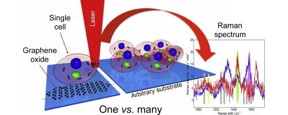 |
| Single cell immobilization on GO modified substrates. CREDIT Tomsk Polytechnic University |
Abstract:
TPU scientist Raul Rodrigez and his colleagues from Lithuania and Germany were the first in the world to suggest how with the help of graphene oxide, in fact ordinary graphene as in pencils, but oxidized to make the surface of any material suitable for immobilization of living cells. Devices with such coatings will make it possible to detect and study individual living cells, including dangerous microorganisms, cancer cells and dangerous substances in the human body. In future, this technology will allow creating flexible diagnostic devices implanted under the skin. The study outcomes were published in Sensors and Actuators B: Chemical.
Graphene oxide making any material suitable to create biosensors: Scientists from Tomsk Polytechnic University have developed a new tool for biomedical research focused on single-cell investigation
Tomsk, Russia | Posted on November 27th, 2017The study was conducted by the researchers from Tomsk Polytechnic University, the University of Vilnius, the Center for Physical Sciences and Technology (Lithuania) and the Chemnitz University of Technology (Germany).
'Medical scientists are still trying to find an answer to the question related to metastatic spread. Studying communication of cells in the process of their formation is a possible answer to this question. For this purpose it is necessary to be able to distinguish the behavior of bulk cell samples from the behavior of single cells,' - tells Professor Raul Rodrigez from the Department of Lasers and Lighting Engineering.
The technology developed by Tomsk scientists and their colleagues allows monitoring cell colonies and separate the cells of interest from all the others. Moreover, it will be more affordable than existing counterparts.
He adds that the study of communication and interaction of cells is currently important for many areas in medicine. The same technology can help in the development of biosensors.
'When creating biosensors there is the same problem as when creating implants which are implanted into the human body. In implants the interaction of cells with their surface is determined by wettability. Wettable surfaces enhance the attachment of living cells to bioimplants, as well as their proliferation and so on. The surface of biosensors should also be well wetted so that we can ensure the attachment of cells or bacteria to the sensors,' says Professor Rodrigez.
The scientist explains that water can help understand what a wettable or hydrophilic surface means. When water droplets fall on the surface of a material and spread over it, it means that the interaction between the droplets and the surface is high and the material is hydrophilic. If water droplets gather in balls, the interaction between water molecules with each other is more than with the surface, it means the material is hydrophobic.
'The simple technology using graphene oxide allows us to make any material hydrophilic and therefore suitable for creating inexpensive biosensors,' - says TPU professor.
In their work the scientists demonstrated this effect by the example of ordinary yeast cells deposited on several arbitrary substrates of glass, silicon and other materials coated with graphene oxide. The study results showed that cells are well attached to modified substrates. Such improved surfaces led to the appearance of areas where single cells could be observed. Figuratively speaking, cells fell into 'traps' and could not come together, as it usually does on surface. Using this property, it would be possible to study how cells behave in the isolated state and compare their behavior in the colony.
For manufacturing biosensors it is supposed to create electrical contacts on the same coating.
####
For more information, please click here
Contacts:
Kristina Nabokova
7-382-270-5685
Copyright © Tomsk Polytechnic University
If you have a comment, please Contact us.Issuers of news releases, not 7th Wave, Inc. or Nanotechnology Now, are solely responsible for the accuracy of the content.
Bookmark:


| Related Links |
| Related News Press |
News and information
 Quantum computer improves AI predictions April 17th, 2026
Flexible sensor gains sensitivity under pressure April 17th, 2026
A reusable chip for particulate matter sensing April 17th, 2026
Detecting vibrational quantum beating in the predissociation dynamics of SF6 using time-resolved photoelectron spectroscopy April 17th, 2026
Cancer
New molecular technology targets tumors and simultaneously silences two ‘undruggable’ cancer genes August 8th, 2025
Ben-Gurion University of the Negev researchers several steps closer to harnessing patient's own T-cells to fight off cancer June 6th, 2025
Self-propelled protein-based nanomotors for enhanced cancer therapy by inducing ferroptosis June 6th, 2025
Display technology/LEDs/SS Lighting/OLEDs
Spinel-type sulfide semiconductors to operate the next-generation LEDs and solar cells For solar-cell absorbers and green-LED source October 3rd, 2025
Graphene/ Graphite
Electrifying results shed light on graphene foam as a potential material for lab grown cartilage June 6th, 2025
Possible Futures
A fundamentally new therapeutic approach to cystic fibrosis: Nanobody repairs cellular defect April 17th, 2026
UC Irvine physicists discover method to reverse ‘quantum scrambling’ : The work addresses the problem of information loss in quantum computing system April 17th, 2026
Nanomedicine
A fundamentally new therapeutic approach to cystic fibrosis: Nanobody repairs cellular defect April 17th, 2026
New molecular technology targets tumors and simultaneously silences two ‘undruggable’ cancer genes August 8th, 2025
New imaging approach transforms study of bacterial biofilms August 8th, 2025
Electrifying results shed light on graphene foam as a potential material for lab grown cartilage June 6th, 2025
Sensors
Flexible sensor gains sensitivity under pressure April 17th, 2026
Tiny nanosheets, big leap: A new sensor detects ethanol at ultra-low levels January 30th, 2026
From sensors to smart systems: the rise of AI-driven photonic noses January 30th, 2026
Sensors innovations for smart lithium-based batteries: advancements, opportunities, and potential challenges August 8th, 2025
Announcements
A fundamentally new therapeutic approach to cystic fibrosis: Nanobody repairs cellular defect April 17th, 2026
UC Irvine physicists discover method to reverse ‘quantum scrambling’ : The work addresses the problem of information loss in quantum computing system April 17th, 2026
Interviews/Book Reviews/Essays/Reports/Podcasts/Journals/White papers/Posters
A fundamentally new therapeutic approach to cystic fibrosis: Nanobody repairs cellular defect April 17th, 2026
UC Irvine physicists discover method to reverse ‘quantum scrambling’ : The work addresses the problem of information loss in quantum computing system April 17th, 2026
Nanobiotechnology
A fundamentally new therapeutic approach to cystic fibrosis: Nanobody repairs cellular defect April 17th, 2026
New molecular technology targets tumors and simultaneously silences two ‘undruggable’ cancer genes August 8th, 2025
New imaging approach transforms study of bacterial biofilms August 8th, 2025
Electrifying results shed light on graphene foam as a potential material for lab grown cartilage June 6th, 2025
 |
||
 |
||
| The latest news from around the world, FREE | ||
 |
||
|
|
||
| Premium Products | ||
 |
||
|
Only the news you want to read!
Learn More |
||
 |
||
|
Full-service, expert consulting
Learn More |
||
|
|
||