Home > Press > Argon is not the 'dope' for metallic hydrogen
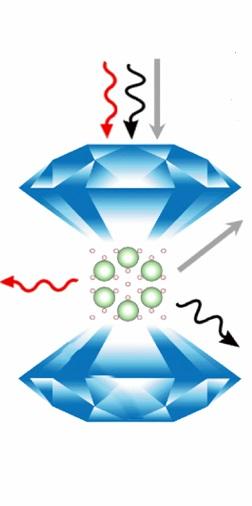 |
| This is an illustration of Ar(H2)2 in the diamond anvil cell. The arrows represent different ways that spectroscopic tools study the effect of extreme pressures on the crystal structure and molecular structure of the compound. (For experts, the red arrow represents Raman spectroscopy, the black arrow represents synchrotron x-ray diffraction, and the gray arrow represents optical absorption spectroscopy.) CREDIT Image courtesy of Cheng Ji. |
Abstract:
Hydrogen is both the simplest and the most-abundant element in the universe, so studying it can teach scientists about the essence of matter. And yet there are still many hydrogen secrets to unlock, including how best to force it into a superconductive, metallic state with no electrical resistance.
Argon is not the 'dope' for metallic hydrogen
Washington, DC | Posted on March 24th, 2017"Although theoretically ideal for energy transfer or storage, metallic hydrogen is extremely challenging to produce experimentally," said Ho-kwang "Dave" Mao, who led a team of physicists in researching the effect of the noble gas argon on pressurized hydrogen.
It has long been proposed that introducing impurities into a sample of molecular hydrogen, H2, could help ease the transition to a metallic state. So Mao and his team set out to study the intermolecular interactions of hydrogen that's weakly-bound, or "doped," with argon, Ar(H2)2, under extreme pressures. The idea is that the impurity could change the nature of the bonds between the hydrogen molecules, reducing the pressure necessary to induce the nonmetal-to-metal transition. Previous research had indicated that Ar(H2)2 might be a good candidate.
Surprisingly, they discovered that the addition of argon did not facilitate the molecular changes needed to initiate a metallic state in hydrogen. Their findings are published by the Proceedings of the National Academy of Sciences.
The team brought the argon-doped hydrogen up to 3.5 million times normal atmospheric pressure--or 358 gigapascals--inside a diamond anvil cell and observed its structural changes using advanced spectroscopic tools.
What they found was that hydrogen stayed in its molecular form even up to the highest pressures, indicating that argon is not the facilitator many had hoped it would be.
"Counter to predictions, the addition of argon did not create a kind of 'chemical pressure' on the hydrogen, pushing its molecules closer together. Rather, it had the opposite effect," said lead author Cheng Ji.
###
The study's other co-authors are: Carnegie's Alexander Goncharov, Dmitry Popov, Bing Li, Junyue Wang, Yue Meng, Jesse Smith, and Wenge Yang; as well as Vivekanand Shukla, Naresh Jena, and Rajeev Ahuja of Uppsala University; and Vitali Prakpenka of the University of Chicago.
This work was supported by the U.S. National Science Foundation, the U.S. Department of Energy, the Chinese Academy of Sciences Visiting Professorship for Senior International Scientists and Recruitment of Foreign Experts, the European Erasmus Fellowship program, and the Swedish Research Council.
####
About Carnegie Institution for Science
The Carnegie Institution for Science (carnegiescience.edu) is a private, nonprofit organization headquartered in Washington, D.C., with six research departments throughout the U.S. Since its founding in 1902, the Carnegie Institution has been a pioneering force in basic scientific research. Carnegie scientists are leaders in plant biology, developmental biology, astronomy, materials science, global ecology, and Earth and planetary science.
For more information, please click here
Contacts:
Cheng Ji
Copyright © Carnegie Institution for Science
If you have a comment, please Contact us.Issuers of news releases, not 7th Wave, Inc. or Nanotechnology Now, are solely responsible for the accuracy of the content.
Bookmark:


| Related Links |
| Related News Press |
News and information
 Quantum computer improves AI predictions April 17th, 2026
Flexible sensor gains sensitivity under pressure April 17th, 2026
A reusable chip for particulate matter sensing April 17th, 2026
Detecting vibrational quantum beating in the predissociation dynamics of SF6 using time-resolved photoelectron spectroscopy April 17th, 2026
Govt.-Legislation/Regulation/Funding/Policy
Quantum computer improves AI predictions April 17th, 2026
Metasurfaces smooth light to boost magnetic sensing precision January 30th, 2026
New imaging approach transforms study of bacterial biofilms August 8th, 2025
Possible Futures
A fundamentally new therapeutic approach to cystic fibrosis: Nanobody repairs cellular defect April 17th, 2026
UC Irvine physicists discover method to reverse ‘quantum scrambling’ : The work addresses the problem of information loss in quantum computing system April 17th, 2026
Chip Technology
A reusable chip for particulate matter sensing April 17th, 2026
Metasurfaces smooth light to boost magnetic sensing precision January 30th, 2026
Discoveries
Quantum computer improves AI predictions April 17th, 2026
Flexible sensor gains sensitivity under pressure April 17th, 2026
A reusable chip for particulate matter sensing April 17th, 2026
Detecting vibrational quantum beating in the predissociation dynamics of SF6 using time-resolved photoelectron spectroscopy April 17th, 2026
Materials/Metamaterials/Magnetoresistance
First real-time observation of two-dimensional melting process: Researchers at Mainz University unveil new insights into magnetic vortex structures August 8th, 2025
Researchers unveil a groundbreaking clay-based solution to capture carbon dioxide and combat climate change June 6th, 2025
A 1960s idea inspires NBI researchers to study hitherto inaccessible quantum states June 6th, 2025
Institute for Nanoscience hosts annual proposal planning meeting May 16th, 2025
Announcements
A fundamentally new therapeutic approach to cystic fibrosis: Nanobody repairs cellular defect April 17th, 2026
UC Irvine physicists discover method to reverse ‘quantum scrambling’ : The work addresses the problem of information loss in quantum computing system April 17th, 2026
Interviews/Book Reviews/Essays/Reports/Podcasts/Journals/White papers/Posters
A fundamentally new therapeutic approach to cystic fibrosis: Nanobody repairs cellular defect April 17th, 2026
UC Irvine physicists discover method to reverse ‘quantum scrambling’ : The work addresses the problem of information loss in quantum computing system April 17th, 2026
Energy
Sensors innovations for smart lithium-based batteries: advancements, opportunities, and potential challenges August 8th, 2025
Simple algorithm paired with standard imaging tool could predict failure in lithium metal batteries August 8th, 2025
Battery Technology/Capacitors/Generators/Piezoelectrics/Thermoelectrics/Energy storage
Decoding hydrogen‑bond network of electrolyte for cryogenic durable aqueous zinc‑ion batteries January 30th, 2026
COF scaffold membrane with gate‑lane nanostructure for efficient Li+/Mg2+ separation January 30th, 2026
MXene nanomaterials enter a new dimension Multilayer nanomaterial: MXene flakes created at Drexel University show new promise as 1D scrolls January 30th, 2026
Grants/Sponsored Research/Awards/Scholarships/Gifts/Contests/Honors/Records
Quantum computer improves AI predictions April 17th, 2026
Detecting vibrational quantum beating in the predissociation dynamics of SF6 using time-resolved photoelectron spectroscopy April 17th, 2026
Metasurfaces smooth light to boost magnetic sensing precision January 30th, 2026
Research partnerships
Lab to industry: InSe wafer-scale breakthrough for future electronics August 8th, 2025
HKU physicists uncover hidden order in the quantum world through deconfined quantum critical points April 25th, 2025
 |
||
 |
||
| The latest news from around the world, FREE | ||
 |
||
|
|
||
| Premium Products | ||
 |
||
|
Only the news you want to read!
Learn More |
||
 |
||
|
Full-service, expert consulting
Learn More |
||
|
|
||