Home > Press > Scientists discover new 'boat' form of promising semiconductor: GeSe Uncommon form attenuates semiconductor's band gap size
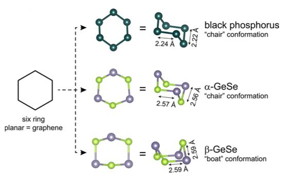 |
| This is the building blocks of graphene, black phosphorus, α-GeSe, and β-GeSe. CREDIT Cava lab |
Abstract:
Princeton researchers have discovered a new form of the simple compound GeSe that has surprisingly escaped detection until now. This so-called beta-GeSe compound has a ring type structure like graphene and its monolayer form could have similarly valuable properties for electronic applications, according to the study published in the Journal of the American Chemical Society.
Scientists discover new 'boat' form of promising semiconductor: GeSe Uncommon form attenuates semiconductor's band gap size
Princeton, NJ | Posted on March 23rd, 2017Graphene has been hailed as a two-dimensional wonder material for electronics but its lack of a band gap has hindered its development for devices. As such, a closely related material, black phosphorus, has been receiving intense research attention because it has a small band gap and a high charge carrier mobility, and can easily be reduced to nanometer thicknesses. The researchers calculated that GeSe is highly analogous to black phosphorus and can be considered a pseudo-group-V element.
Under extreme pressure, black phosphorus is transformed into a simple cubic form, so the team wondered if the same could be done to GeSe and heated the abundant alpha-GeSe form of the compound to 1200 °C under 6 GPa of pressure or 60,000 times atmospheric pressure.
"What we found was not only a new kind of GeSe--which is already unconventional by itself in that you rarely find new binary compounds anymore--but that it has this uncommon 'boat' conformation that we were amazed by," said first author of the study Fabian von Rohr, a postdoctoral researcher in the laboratory of Robert Cava, the Russell Wellman Moore Professor of Chemistry.
beta-GeSe's rare "boat" form is likely stabilized by the slightly smaller distance between its layers, while black phosphorus and alpha-GeSe exist in standard "chair" conformations. The difference in structures gives rise to the compounds' different electronic properties. The researchers found that beta-GeSe possesses a band gap size in between that of black phosphorus and alpha-GeSe, which could prove promising for future applications. GeSe is also an attractive material for electronics because it's robust under ambient conditions while black phosphorus is reactive to both air and water.
####
For more information, please click here
Contacts:
Tien Nguyen
609-258-6523
Copyright © Princeton University
If you have a comment, please Contact us.Issuers of news releases, not 7th Wave, Inc. or Nanotechnology Now, are solely responsible for the accuracy of the content.
Bookmark:


| Related Links |
| Related News Press |
News and information
 Quantum computer improves AI predictions April 17th, 2026
Flexible sensor gains sensitivity under pressure April 17th, 2026
A reusable chip for particulate matter sensing April 17th, 2026
Detecting vibrational quantum beating in the predissociation dynamics of SF6 using time-resolved photoelectron spectroscopy April 17th, 2026
2 Dimensional Materials
Flexible sensor gains sensitivity under pressure April 17th, 2026
Govt.-Legislation/Regulation/Funding/Policy
Quantum computer improves AI predictions April 17th, 2026
Metasurfaces smooth light to boost magnetic sensing precision January 30th, 2026
New imaging approach transforms study of bacterial biofilms August 8th, 2025
Possible Futures
A fundamentally new therapeutic approach to cystic fibrosis: Nanobody repairs cellular defect April 17th, 2026
UC Irvine physicists discover method to reverse ‘quantum scrambling’ : The work addresses the problem of information loss in quantum computing system April 17th, 2026
Chip Technology
A reusable chip for particulate matter sensing April 17th, 2026
Metasurfaces smooth light to boost magnetic sensing precision January 30th, 2026
Nanoelectronics
Lab to industry: InSe wafer-scale breakthrough for future electronics August 8th, 2025
Interdisciplinary: Rice team tackles the future of semiconductors Multiferroics could be the key to ultralow-energy computing October 6th, 2023
Key element for a scalable quantum computer: Physicists from Forschungszentrum Jülich and RWTH Aachen University demonstrate electron transport on a quantum chip September 23rd, 2022
Reduced power consumption in semiconductor devices September 23rd, 2022
Discoveries
Quantum computer improves AI predictions April 17th, 2026
Flexible sensor gains sensitivity under pressure April 17th, 2026
A reusable chip for particulate matter sensing April 17th, 2026
Detecting vibrational quantum beating in the predissociation dynamics of SF6 using time-resolved photoelectron spectroscopy April 17th, 2026
Announcements
A fundamentally new therapeutic approach to cystic fibrosis: Nanobody repairs cellular defect April 17th, 2026
UC Irvine physicists discover method to reverse ‘quantum scrambling’ : The work addresses the problem of information loss in quantum computing system April 17th, 2026
Interviews/Book Reviews/Essays/Reports/Podcasts/Journals/White papers/Posters
A fundamentally new therapeutic approach to cystic fibrosis: Nanobody repairs cellular defect April 17th, 2026
UC Irvine physicists discover method to reverse ‘quantum scrambling’ : The work addresses the problem of information loss in quantum computing system April 17th, 2026
Grants/Sponsored Research/Awards/Scholarships/Gifts/Contests/Honors/Records
Quantum computer improves AI predictions April 17th, 2026
Detecting vibrational quantum beating in the predissociation dynamics of SF6 using time-resolved photoelectron spectroscopy April 17th, 2026
Metasurfaces smooth light to boost magnetic sensing precision January 30th, 2026
 |
||
 |
||
| The latest news from around the world, FREE | ||
 |
||
|
|
||
| Premium Products | ||
 |
||
|
Only the news you want to read!
Learn More |
||
 |
||
|
Full-service, expert consulting
Learn More |
||
|
|
||