Home > Press > Optical fingerprint can reveal pollutants in the air: Researchers at Chalmers University of Technology have proposed a new, sophisticated method of detecting molecules with sensors based on ultra-thin nanomaterials
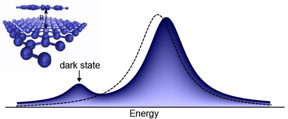 |
| Molecules are identified by activating dark electronic states in the sensor material, resulting in a new visible peak. The altered optical fingerprint of the material proves the presence of molecules. CREDIT Maja Feierabend and Ermin Malic |
Abstract:
More efficient sensors are needed to be able to detect environmental pollution. Researchers at Chalmers University of Technology have proposed a new, sophisticated method of detecting molecules with sensors based on ultra-thin nanomaterials. The novel method could improve environmental sensing in the future. The results are published today in the scientific journal Nature Communications.
Optical fingerprint can reveal pollutants in the air: Researchers at Chalmers University of Technology have proposed a new, sophisticated method of detecting molecules with sensors based on ultra-thin nanomaterials
Gothenburg, Sweden | Posted on March 15th, 2017"This could open up new possibilities for the detection of environmental gases. Our method is more robust than conventional sensors, which rely on small changes in optical properties", says Maja Feierabend, PhD student at the Department of Physics and the main author of the article from Chalmers University of Technology and Technische Universität Berlin.
Together with her supervisor, Associate Professor Ermin Malic, and Gunnar Berghäuser, postdoctoral researcher at Chalmers, she has proposed a new type of chemical nanosensor that consists of atomically thin nanomaterials that are extremely sensitive to changes in their surroundings.
If you shine light on the sensor, you will see the optical fingerprint of the material itself. Molecules are identified by activating dark electronic states in the sensor material. If there are molecules on its surface, they will interact with these dark states and switch them on, making them visible. The result is an altered optical fingerprint, containing new features that prove the presence of the molecules.
"Our method has promising potential, paving the way for ultra-thin, fast, efficient and accurate sensors. In the future, this could hopefully lead to highly sensitive and selective sensors that can be used in environmental research", says Ermin Malic.
The researchers have filed a patent application for the novel sensor method. The next step is to work with experimental physicists and chemists to demonstrate the proof-of-principle for this new class of chemical sensors.
####
For more information, please click here
Contacts:
Christian Borg
46-317-723-395
Copyright © Chalmers University of Technology
If you have a comment, please Contact us.Issuers of news releases, not 7th Wave, Inc. or Nanotechnology Now, are solely responsible for the accuracy of the content.
Bookmark:


| Related Links |
| Related News Press |
News and information
 Quantum computer improves AI predictions April 17th, 2026
Flexible sensor gains sensitivity under pressure April 17th, 2026
A reusable chip for particulate matter sensing April 17th, 2026
Detecting vibrational quantum beating in the predissociation dynamics of SF6 using time-resolved photoelectron spectroscopy April 17th, 2026
Chemistry
Projecting light to dispense liquids: A new route to ultra-precise microdroplets January 30th, 2026
From sensors to smart systems: the rise of AI-driven photonic noses January 30th, 2026
"Nanoreactor" cage uses visible light for catalytic and ultra-selective cross-cycloadditions October 3rd, 2025
Cambridge chemists discover simple way to build bigger molecules – one carbon at a time June 6th, 2025
Possible Futures
A fundamentally new therapeutic approach to cystic fibrosis: Nanobody repairs cellular defect April 17th, 2026
UC Irvine physicists discover method to reverse ‘quantum scrambling’ : The work addresses the problem of information loss in quantum computing system April 17th, 2026
Sensors
Flexible sensor gains sensitivity under pressure April 17th, 2026
Tiny nanosheets, big leap: A new sensor detects ethanol at ultra-low levels January 30th, 2026
From sensors to smart systems: the rise of AI-driven photonic noses January 30th, 2026
Sensors innovations for smart lithium-based batteries: advancements, opportunities, and potential challenges August 8th, 2025
Discoveries
Quantum computer improves AI predictions April 17th, 2026
Flexible sensor gains sensitivity under pressure April 17th, 2026
A reusable chip for particulate matter sensing April 17th, 2026
Detecting vibrational quantum beating in the predissociation dynamics of SF6 using time-resolved photoelectron spectroscopy April 17th, 2026
Announcements
A fundamentally new therapeutic approach to cystic fibrosis: Nanobody repairs cellular defect April 17th, 2026
UC Irvine physicists discover method to reverse ‘quantum scrambling’ : The work addresses the problem of information loss in quantum computing system April 17th, 2026
Interviews/Book Reviews/Essays/Reports/Podcasts/Journals/White papers/Posters
A fundamentally new therapeutic approach to cystic fibrosis: Nanobody repairs cellular defect April 17th, 2026
UC Irvine physicists discover method to reverse ‘quantum scrambling’ : The work addresses the problem of information loss in quantum computing system April 17th, 2026
Environment
A reusable chip for particulate matter sensing April 17th, 2026
Researchers unveil a groundbreaking clay-based solution to capture carbon dioxide and combat climate change June 6th, 2025
Photonics/Optics/Lasers
Metasurfaces smooth light to boost magnetic sensing precision January 30th, 2026
From sensors to smart systems: the rise of AI-driven photonic noses January 30th, 2026
 |
||
 |
||
| The latest news from around the world, FREE | ||
 |
||
|
|
||
| Premium Products | ||
 |
||
|
Only the news you want to read!
Learn More |
||
 |
||
|
Full-service, expert consulting
Learn More |
||
|
|
||