Home > Press > Direct radiolabeling of nanomaterials: Directly radiolabeled nanographene materials without chelators are suitable for bioimaging applications
 |
| © Wiley-VCH |
Abstract:
Positron emission tomography plays a pivotal role for monitoring the distribution and accumulation of radiolabeled nanomaterials in living subjects. The radioactive metals are usually connected to the nanomaterial through an anchor, a so-called chelator, but this chemical binding can be omitted if nanographene is used, as American scientists report in the journal Angewandte Chemie. The replacement of chelator-based labeling by intrinsic labeling significantly enhances the bioimaging accuracy and reduces biases.
Direct radiolabeling of nanomaterials: Directly radiolabeled nanographene materials without chelators are suitable for bioimaging applications
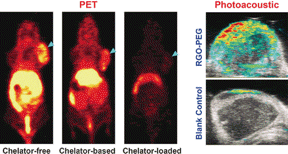
Hoboken, NJ | Posted on February 9th, 2017Nanoparticles are very promising substances for biodiagnostics (e.g., detecting cancerous tissue) and biotherapy (e.g., destroying tumors by molecular agents), because they are not as fast metabolized as normal pharmaceuticals and they particularly enrich in tumors through an effect called enhanced permeability and retention (EPR). Chelators, which have a macrocyclic structure, are used to anchor the radioactive element (e.g., copper-64) onto the nanoparticles' surface. The tracers are then detected and localized in the body with the help of a positron emission tomography (PET) scanner. However, the use of a chelator can also be problematic, because it can detach from the nanoparticles or bias the imaging. Therefore, the group of Weibo Cai at University of Wisconsin-Madison, USA, sought for chelator-free solutions--and found it in nanographene, one of the most promising substances in nanotechnology.
Nanographene offers the electronic system to provide special binding electrons for some transition metal ions. "π bonds of nanographene are able to provide the additional electron to stably incorporate the (64)Cu(2+) acceptor ions onto the surface of graphene," the authors wrote. Thus, it was possible to directly and stably attach the copper isotope to reduced graphene oxide nanomaterials stabilized by poly(ethylene glycol) (PEG), and this system was used for several bioimaging tests including the detection of tumors in mice.
After injection in the mouse model, the scientists observed long blood circulation and high tumor uptake. "Prolonged blood circulation of (64)Cu-RGO-PEG [...] induced a prompt and persistent tumor uptake via EPR effect," they wrote. Moreover, the directly radiolabeled nanographene was readily prepared by simply mixing both components and heating them. This simple chelator-free, intrinsically labeled system may provide an attractive alternative to the chelator-based radiolabeling, which is still the "gold standard" in bioimaging.
###
About the Author
Dr. Cai is an Associate Professor with joint appointment in the Departments of Radiology and Medical Physics at the University of Wisconsin-Madison, USA. His laboratory's research projects are focused on molecular imaging, molecular therapy, and nanotechnology. Dr. Cai has received many awards for his research.
mi.wisc.edu/
####
For more information, please click here
Contacts:
Mario Mueller
Copyright © Wiley
If you have a comment, please Contact us.Issuers of news releases, not 7th Wave, Inc. or Nanotechnology Now, are solely responsible for the accuracy of the content.
Bookmark:


| Related Links |
| Related News Press |
News and information
 Quantum computer improves AI predictions April 17th, 2026
Flexible sensor gains sensitivity under pressure April 17th, 2026
A reusable chip for particulate matter sensing April 17th, 2026
Detecting vibrational quantum beating in the predissociation dynamics of SF6 using time-resolved photoelectron spectroscopy April 17th, 2026
Imaging
Simple algorithm paired with standard imaging tool could predict failure in lithium metal batteries August 8th, 2025
Graphene/ Graphite
Electrifying results shed light on graphene foam as a potential material for lab grown cartilage June 6th, 2025
Breakthrough in proton barrier films using pore-free graphene oxide: Kumamoto University researchers achieve new milestone in advanced coating technologies September 13th, 2024
Possible Futures
A fundamentally new therapeutic approach to cystic fibrosis: Nanobody repairs cellular defect April 17th, 2026
UC Irvine physicists discover method to reverse ‘quantum scrambling’ : The work addresses the problem of information loss in quantum computing system April 17th, 2026
Nanomedicine
A fundamentally new therapeutic approach to cystic fibrosis: Nanobody repairs cellular defect April 17th, 2026
New molecular technology targets tumors and simultaneously silences two ‘undruggable’ cancer genes August 8th, 2025
New imaging approach transforms study of bacterial biofilms August 8th, 2025
Electrifying results shed light on graphene foam as a potential material for lab grown cartilage June 6th, 2025
Discoveries
Quantum computer improves AI predictions April 17th, 2026
Flexible sensor gains sensitivity under pressure April 17th, 2026
A reusable chip for particulate matter sensing April 17th, 2026
Detecting vibrational quantum beating in the predissociation dynamics of SF6 using time-resolved photoelectron spectroscopy April 17th, 2026
Materials/Metamaterials/Magnetoresistance
First real-time observation of two-dimensional melting process: Researchers at Mainz University unveil new insights into magnetic vortex structures August 8th, 2025
Researchers unveil a groundbreaking clay-based solution to capture carbon dioxide and combat climate change June 6th, 2025
A 1960s idea inspires NBI researchers to study hitherto inaccessible quantum states June 6th, 2025
Institute for Nanoscience hosts annual proposal planning meeting May 16th, 2025
Announcements
A fundamentally new therapeutic approach to cystic fibrosis: Nanobody repairs cellular defect April 17th, 2026
UC Irvine physicists discover method to reverse ‘quantum scrambling’ : The work addresses the problem of information loss in quantum computing system April 17th, 2026
Interviews/Book Reviews/Essays/Reports/Podcasts/Journals/White papers/Posters
A fundamentally new therapeutic approach to cystic fibrosis: Nanobody repairs cellular defect April 17th, 2026
UC Irvine physicists discover method to reverse ‘quantum scrambling’ : The work addresses the problem of information loss in quantum computing system April 17th, 2026
 |
||
 |
||
| The latest news from around the world, FREE | ||
 |
||
|
|
||
| Premium Products | ||
 |
||
|
Only the news you want to read!
Learn More |
||
 |
||
|
Full-service, expert consulting
Learn More |
||
|
|
||