Home > Press > Diamond nanothread: Versatile new material could prove priceless for manufacturing: Would you dress in diamond nanothreads? It's not as far-fetched as you might think
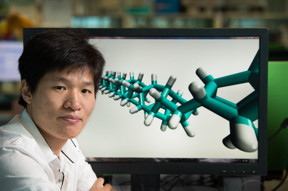 |
| This is QUT's Dr Haifei Zhan with model of diamond nanothread. CREDIT Anthony Weate, QUT |
Abstract:
Would you dress in diamond nanothreads? It's not as far-fetched as you might think. And you'll have a Brisbane-based carbon chemist and engineer to thank for it.
Diamond nanothread: Versatile new material could prove priceless for manufacturing: Would you dress in diamond nanothreads? It's not as far-fetched as you might think
Brisbane, Australia | Posted on November 3rd, 2016QUT's Dr Haifei Zhan is leading a global effort to work out how many ways humanity can use a newly-invented material with enormous potential - diamond nanothread (DNT).
First created by Pennsylvania State University last year, one-dimensional DNT is similar to carbon nanotubes, hollow cylindrical tubes 10,000 times smaller than human hair, stronger than steel - but brittle.
"DNT, by comparison, is even thinner, incorporating kinks of hydrogen in the carbon's hollow structure, called Stone-Wale (SW) transformation defects, which I've discovered reduces brittleness and adds flexibility," said Dr Zhan, from QUT's School of Chemistry, Physics and Mechanical Engineering.
"That structure makes DNT a great candidate for a range of uses. It's possible DNT may become as ubiquitous a plastic in the future, used in everything from clothing to cars.
"I feel very lucky to have this chance to study a new material in depth - blue-sky applied research opportunities like this are rare."
DNT does not look like a rock diamond. Rather, its name refers to the way the carbon atoms are packed together, similar to diamond, giving it its phenomenal strength.
Dr Zhan has been modelling the properties of DNT since it was invented, using large-scale molecular dynamics simulations and high-performance computing.
He was the first to realise the SW defects were the key to DNT's versatility.
"While both carbon nanotubes and DNT have great potential, the more I model DNT properties, the more it looks to be a superior material," Dr Zhan said.
"The SW defects give DNT a flexibility that rigid carbon nanotubes can't replicate - think of it as the difference between sewing with uncooked spaghetti and cooked spaghetti.
"My simulations have shown that the SW defects act like hinges, connecting straight sections of DNT. And by changing the spacing of those defects, we can a change - or tune - the flexibility of the DNT."
That research is published in the peer-reviewed publication Nanoscale.
Dr Zhan has also published a number of other results from his DNT-modelling research:
The thermal conductivity of DNT can be tuned by changing the spacing between the SW defects (Carbon).
SW defects create irregular surfaces on the DNT, allowing it to bond well with polymers. DNT could therefore be used as reinforcement for nanocomposite materials (Advanced Function Materials).
The mechanical properties of DNT vary significantly depending on its exact atomic structure, including tensile behaviour. Temperature also affects the mechanical properties. While DNT likely behaves like a flexible elastic rod, the mechanical properties could be tailored for specific purposes (Carbon).
"Further modelling is needed to fully investigate all the properties of DNT. However, I am excited about the potential range of applications it could be used for, given we've proven we can control its flexibility, conductivity and strength," Dr Zhang said.
"Carbon is the most abundant element on the planet. It's a renewable resource, so the cost of the raw material is extremely low.
"Once the manufacturing costs are viable, DNT would likely be used primarily in mechanical applications, combined with other materials to make ultra-strong, light-weight composites and components - such as plane fuselages.
"I plan to test how DNT performs as a two-dimensional networked structure - a sheet or layer - for potential use in flexible electronics and screens.
"I also want to test is viability as a fibre for textiles or rope, from bullet-proof vests and hard-wearing work gear to a replacement for steel cables in bridge construction.
"There's already talk in the global carbon community of DNT being the best candidate yet for building a space elevator. It would be a real honour if my research contributed to the development of DNTs for that purpose."
####
About Queensland University of Technology
QUT is part of a national collaborative group of five major Australian universities that form the ATN (Australian Technology Network of Universities).
For more information, please click here
Contacts:
Kate Haggman
07 3138 0358
After hours
Rose Trapnell
QUT Media team leader
0407 585 901
Copyright © Queensland University of Technology
If you have a comment, please Contact us.Issuers of news releases, not 7th Wave, Inc. or Nanotechnology Now, are solely responsible for the accuracy of the content.
Bookmark:


| Related Links |
 - Paper in Advanced Function Materials:
| Related News Press |
News and information
Quantum computer improves AI predictions April 17th, 2026
Flexible sensor gains sensitivity under pressure April 17th, 2026
A reusable chip for particulate matter sensing April 17th, 2026
Detecting vibrational quantum beating in the predissociation dynamics of SF6 using time-resolved photoelectron spectroscopy April 17th, 2026
Flexible Electronics
Flexible sensor gains sensitivity under pressure April 17th, 2026
Flexible electronics integrated with paper-thin structure for use in space January 17th, 2025
Beyond wires: Bubble technology powers next-generation electronics:New laser-based bubble printing technique creates ultra-flexible liquid metal circuits November 8th, 2024
Display technology/LEDs/SS Lighting/OLEDs
Spinel-type sulfide semiconductors to operate the next-generation LEDs and solar cells For solar-cell absorbers and green-LED source October 3rd, 2025
Law enforcement/Anti-Counterfeiting/Security/Loss prevention
Chainmail-like material could be the future of armor: First 2D mechanically interlocked polymer exhibits exceptional flexibility and strength January 17th, 2025
Possible Futures
A fundamentally new therapeutic approach to cystic fibrosis: Nanobody repairs cellular defect April 17th, 2026
UC Irvine physicists discover method to reverse ‘quantum scrambling’ : The work addresses the problem of information loss in quantum computing system April 17th, 2026
Discoveries
Quantum computer improves AI predictions April 17th, 2026
Flexible sensor gains sensitivity under pressure April 17th, 2026
A reusable chip for particulate matter sensing April 17th, 2026
Detecting vibrational quantum beating in the predissociation dynamics of SF6 using time-resolved photoelectron spectroscopy April 17th, 2026
Materials/Metamaterials/Magnetoresistance
First real-time observation of two-dimensional melting process: Researchers at Mainz University unveil new insights into magnetic vortex structures August 8th, 2025
Researchers unveil a groundbreaking clay-based solution to capture carbon dioxide and combat climate change June 6th, 2025
A 1960s idea inspires NBI researchers to study hitherto inaccessible quantum states June 6th, 2025
Institute for Nanoscience hosts annual proposal planning meeting May 16th, 2025
Announcements
A fundamentally new therapeutic approach to cystic fibrosis: Nanobody repairs cellular defect April 17th, 2026
UC Irvine physicists discover method to reverse ‘quantum scrambling’ : The work addresses the problem of information loss in quantum computing system April 17th, 2026
Interviews/Book Reviews/Essays/Reports/Podcasts/Journals/White papers/Posters
A fundamentally new therapeutic approach to cystic fibrosis: Nanobody repairs cellular defect April 17th, 2026
UC Irvine physicists discover method to reverse ‘quantum scrambling’ : The work addresses the problem of information loss in quantum computing system April 17th, 2026
Military
Quantum engineers ‘squeeze’ laser frequency combs to make more sensitive gas sensors January 17th, 2025
Chainmail-like material could be the future of armor: First 2D mechanically interlocked polymer exhibits exceptional flexibility and strength January 17th, 2025
Single atoms show their true color July 5th, 2024
NRL charters Navy’s quantum inertial navigation path to reduce drift April 5th, 2024
Automotive/Transportation
Decoding hydrogen‑bond network of electrolyte for cryogenic durable aqueous zinc‑ion batteries January 30th, 2026
Sensors innovations for smart lithium-based batteries: advancements, opportunities, and potential challenges August 8th, 2025
Simple algorithm paired with standard imaging tool could predict failure in lithium metal batteries August 8th, 2025
Aerospace/Space
Decoding hydrogen‑bond network of electrolyte for cryogenic durable aqueous zinc‑ion batteries January 30th, 2026
ICFO researchers overcome long-standing bottleneck in single photon detection with twisted 2D materials August 8th, 2025
Onion-like nanoparticles found in aircraft exhaust May 14th, 2025
Construction
Temperature-sensing building material changes color to save energy January 27th, 2023
Strain-sensing smart skin ready to deploy: Nanotube-embedded coating detects threats from wear and tear in large structures July 15th, 2022
A sunlight-driven “self-healing” anti-corrosion coating May 27th, 2022
Polymer fibers with graphene nanotubes make it possible to heat hard-to-reach, complex-shaped items February 11th, 2022
 |
||
 |
||
| The latest news from around the world, FREE | ||
 |
||
|
|
||
| Premium Products | ||
 |
||
|
Only the news you want to read!
Learn More |
||
 |
||
|
Full-service, expert consulting
Learn More |
||
|
|
||