Home > Press > New method increases energy density in lithium batteries: Novel technique may lead to longer battery life in portable electronics and electrical vehicles
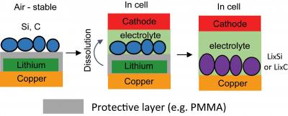 |
| This is an illustration showing the procedure to fabricate the trilayer electrode. PMMA is used to protect lithium and make the trilayer electrode stable in ambient air. PMMA is dissolved in battery electrolyte and graphite contacts with lithium to compensate the loss due to reduction of electrolyte. CREDIT Yuan Yang, Columbia Engineering |
Abstract:
Yuan Yang, assistant professor of materials science and engineering at Columbia Engineering, has developed a new method to increase the energy density of lithium (Li-ion) batteries. He has built a trilayer structure that is stable even in ambient air, which makes the battery both longer lasting and cheaper to manufacture. The work, which may improve the energy density of lithium batteries by 10-30%, is published online today in Nano Letters.
New method increases energy density in lithium batteries: Novel technique may lead to longer battery life in portable electronics and electrical vehicles
New York, NY | Posted on October 24th, 2016"When lithium batteries are charged the first time, they lose anywhere from 5-20% energy in that first cycle," says Yang. "Through our design, we've been able to gain back this loss, and we think our method has great potential to increase the operation time of batteries for portable electronics and electrical vehicles."
During the first charge of a lithium battery after its production, a portion of liquid electrolyte is reduced to a solid phase and coated onto the negative electrode of the battery. This process, usually done before batteries are shipped from a factory, is irreversible and lowers the energy stored in the battery. The loss is approximately 10% for state-of-the-art negative electrodes, but can reach as high as 20-30% for next-generation negative electrodes with high capacity, such as silicon, because these materials have large volume expansion and high surface area. The large initial loss reduces achievable capacity in a full cell and thus compromises the gain in energy density and cycling life of these nanostructured electrodes.
The traditional approach to compensating for this loss has been to put certain lithium-rich materials in the electrode. However, most of these materials are not stable in ambient air. Manufacturing batteries in dry air, which has no moisture at all, is a much more expensive process than manufacturing in ambient air. Yang has developed a new trilayer electrode structure to fabricate lithiated battery anodes in ambient air. In these electrodes, he protected the lithium with a layer of the polymer PMMA to prevent lithium from reacting with air and moisture, and then coated the PMMA with such active materials as artificial graphite or silicon nanoparticles. The PMMA layer was then dissolved in the battery electrolyte, thus exposing the lithium to the electrode materials. "This way we were able to avoid any contact with air between unstable lithium and a lithiated electrode," Yang explains, "so the trilayer-structured electrode can be operated in ambient air. This could be an attractive advance towards mass production of lithiated battery electrodes."
Yang's method lowered the loss capacity in state-of-the-art graphite electrodes from 8% to 0.3%, and in silicon electrodes, from 13% to -15%. The -15% figure indicates that there was more lithium than needed, and the "extra" lithium can be used to further enhance cycling life of batteries, as the excess can compensate for capacity loss in subsequent cycles. Because the energy density, or capacity, of lithium-ion batteries has been increasing 5-7% annually over the past 25 years, Yang's results point to a possible solution to enhance the capacity of Li-ion batteries. His group is now trying to reduce the thickness of the polymer coating so that it will occupy a smaller volume in the lithium battery, and to scale up his technique.
"This three-layer electrode structure is indeed a smart design that enables processing of lithium-metal-containing electrodes under ambient conditions," notes Hailiang Wang, assistant professor of chemistry at Yale University, who was not involved with the study. "The initial Coulombic efficiency of electrodes is a big concern for the Li-ion battery industry, and this effective and easy-to-use technique of compensating irreversible Li ion loss will attract interest."
###
The study received startup funding from Columbia Engineering, and additional support from the Lenfest Center for Sustainable Energy.
####
About Columbia University School of Engineering and Applied Science
Columbia Engineering is one of the top engineering schools in the U.S. and one of the oldest in the nation. Based in New York City, the School offers programs to both undergraduate and graduate students who undertake a course of study leading to the bachelor's, master's, or doctoral degree in engineering and applied science.
Columbia Engineering's nine departments offer 16 majors and more than 30 minors in engineering and the liberal arts, including an interdisciplinary minor in entrepreneurship with Columbia Business School. With facilities specifically designed and equipped to meet the laboratory and research needs of faculty and students, Columbia Engineering is home to a broad array of basic and advanced research installations, from the Columbia Nano Initiative and Data Science Institute to the Columbia Genome Center. These interdisciplinary centers in science and engineering, big data, nanoscience, and genomic research are leading the way in their respective fields while our engineers and scientists collaborate across the University to solve theoretical and practical problems in many other significant areas.
For more information, please click here
Contacts:
Holly Evarts
347-453-7408
Copyright © Columbia University School of Engineering and Applied Science
If you have a comment, please Contact us.Issuers of news releases, not 7th Wave, Inc. or Nanotechnology Now, are solely responsible for the accuracy of the content.
Bookmark:


| Related Links |
| Related News Press |
News and information
 Quantum computer improves AI predictions April 17th, 2026
Flexible sensor gains sensitivity under pressure April 17th, 2026
A reusable chip for particulate matter sensing April 17th, 2026
Detecting vibrational quantum beating in the predissociation dynamics of SF6 using time-resolved photoelectron spectroscopy April 17th, 2026
Discoveries
Quantum computer improves AI predictions April 17th, 2026
Flexible sensor gains sensitivity under pressure April 17th, 2026
A reusable chip for particulate matter sensing April 17th, 2026
Detecting vibrational quantum beating in the predissociation dynamics of SF6 using time-resolved photoelectron spectroscopy April 17th, 2026
Announcements
A fundamentally new therapeutic approach to cystic fibrosis: Nanobody repairs cellular defect April 17th, 2026
UC Irvine physicists discover method to reverse ‘quantum scrambling’ : The work addresses the problem of information loss in quantum computing system April 17th, 2026
Interviews/Book Reviews/Essays/Reports/Podcasts/Journals/White papers/Posters
A fundamentally new therapeutic approach to cystic fibrosis: Nanobody repairs cellular defect April 17th, 2026
UC Irvine physicists discover method to reverse ‘quantum scrambling’ : The work addresses the problem of information loss in quantum computing system April 17th, 2026
Automotive/Transportation
Decoding hydrogen‑bond network of electrolyte for cryogenic durable aqueous zinc‑ion batteries January 30th, 2026
Sensors innovations for smart lithium-based batteries: advancements, opportunities, and potential challenges August 8th, 2025
Simple algorithm paired with standard imaging tool could predict failure in lithium metal batteries August 8th, 2025
Battery Technology/Capacitors/Generators/Piezoelectrics/Thermoelectrics/Energy storage
Decoding hydrogen‑bond network of electrolyte for cryogenic durable aqueous zinc‑ion batteries January 30th, 2026
COF scaffold membrane with gate‑lane nanostructure for efficient Li+/Mg2+ separation January 30th, 2026
MXene nanomaterials enter a new dimension Multilayer nanomaterial: MXene flakes created at Drexel University show new promise as 1D scrolls January 30th, 2026
Grants/Sponsored Research/Awards/Scholarships/Gifts/Contests/Honors/Records
Quantum computer improves AI predictions April 17th, 2026
Detecting vibrational quantum beating in the predissociation dynamics of SF6 using time-resolved photoelectron spectroscopy April 17th, 2026
Metasurfaces smooth light to boost magnetic sensing precision January 30th, 2026
 |
||
 |
||
| The latest news from around the world, FREE | ||
 |
||
|
|
||
| Premium Products | ||
 |
||
|
Only the news you want to read!
Learn More |
||
 |
||
|
Full-service, expert consulting
Learn More |
||
|
|
||