Home > Press > Physicists use lasers to capture first snapshots of rapid chemical bonds breaking
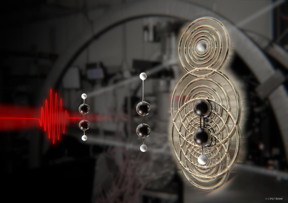 |
| An intense laser, represented in red, is used to affect an acetylene molecule -- composed of two hydrogen atoms, represented as white balls, and two carbon atoms, represented as black balls -- to strip out an electron and initiate the break up of the molecule. After nine femtoseconds, the laser drives the free electron back to the elongated molecule to create an image. Kansas State University researchers were able to decode the image and create the first real-time observation of a molecule breaking up. CREDIT ICFO-The Institute of Photonic Sciences and Scixel |
Abstract:
Lasers have successfully recorded a chemical reaction that happens as fast as a quadrillionth of a second, which could help scientists understand and control chemical reactions.
Physicists use lasers to capture first snapshots of rapid chemical bonds breaking
Manhattan, KS | Posted on October 21st, 2016The idea for using a laser to record a few femtoseconds of a molecule's extremely fast vibrations as it breaks apart came from Kansas State University physicists. Chii-Dong Lin, university distinguished professor of physics, and Anh-Thu Le, research associate professor in James R. Macdonald Laboratory, are part of an international collaborative project published in the Oct. 21 issue of Science.
"If you want to see something that happens very, very fast, you need a tool that can measure a very, very tiny time period," Lin said. "The only light available in femtosecond measurements is a laser."
A femtosecond is one-millionth of a billionth of a second, which is a million times shorter than a nanosecond. Until recently, there was no way to measure what happens during a chemical reaction in that short of a period.
Lin's research group made its first molecular movie of an oxygen molecule using lasers in 2012, but to record a larger molecule -- such as the four-atom acetylene molecule -- they needed a more advanced laser. After five years of collaboration with Jens Biegert's group from ICFO-The Institute of Photonic Sciences, a member of The Barcelona Institute of Science and Technology, Lin's idea became reality.
The international team used the molecule's own electrons to scatter the molecule -- a process called mid-infrared laser-induced electron diffraction, or LIED -- and capture snapshots of acetylene as it is breaking apart. An intense laser is used to affectan acetylene molecule -- composed of two hydrogen atoms and two carbon atoms -- to strip out an electron and initiate the breakup of the molecule. After nine femtoseconds, the laser drives the free electron back to the elongated molecule to create an image.
"Scientists will eventually be able to apply this tool in chemistry, biology and other physical sciences to look at different types of molecules and processes," Lin said.
According to Lin, acetylene's four-atom chemical structure provides multiple possibilities where the bonds could break. Being able to measure where and when those breaks occur can help researchers better understand chemical reactions, which Lin said will lead to better control of a reaction and is applicable to multiple areas of science.
"In order to control something, you have to know where it is first," Lin said. "If you throw a ball over a house, you can't see what happens to it, so you can't control it anymore. But if you have a way to see each second of the ball in the air, you can figure out why it ends up where it does and potentially change the way you throw it to control the outcome or to influence it in real time."
Lin's research group started working with Kansas State University distinguished professor emeritus Lew Cocke's research group in 2008 to conduct the first LIED experiment, which led to the current development. The initial experiments enabled the researchers to apply their theory to decode signals from electrons that produce the image. By decoding the image, the researchers accurately measured the molecule's new bond distances, which are smaller than one hundred-millionth of a centimeter.
"Since the snapshots, which are taken by the electrons, occur in a very strong laser field, it was thought to be nearly impossible to decode the electron information and measure the small distances," said Le, who provided critical decoding of the molecule's structure in the snapshot from Barcelona. "This is the first real-time observation of the breakup of a molecule within nine femtoseconds."
###
The international collaborators are from the ICFO-The Institute of Photonic Sciences, The Barcelona Institute of Science and Technology, and Catalan Institution for Research and Advanced Studies, all in Spain; the Leiden University in The Netherlands; The University of Kassel, the Center for Free-Electron Laser Science, Max Planck Institute for Nuclear Physics, Physikalisch-Technische Bundesanstalt and University of Jena, all in Germany; and Aarhus University in Denmark.
####
For more information, please click here
Contacts:
Chii-Dong Lin
785-532-1617
Copyright © Kansas State University
If you have a comment, please Contact us.Issuers of news releases, not 7th Wave, Inc. or Nanotechnology Now, are solely responsible for the accuracy of the content.
Bookmark:


| Related News Press |
News and information
 Quantum computer improves AI predictions April 17th, 2026
Flexible sensor gains sensitivity under pressure April 17th, 2026
A reusable chip for particulate matter sensing April 17th, 2026
Detecting vibrational quantum beating in the predissociation dynamics of SF6 using time-resolved photoelectron spectroscopy April 17th, 2026
Imaging
Chemistry
Projecting light to dispense liquids: A new route to ultra-precise microdroplets January 30th, 2026
From sensors to smart systems: the rise of AI-driven photonic noses January 30th, 2026
"Nanoreactor" cage uses visible light for catalytic and ultra-selective cross-cycloadditions October 3rd, 2025
Possible Futures
A fundamentally new therapeutic approach to cystic fibrosis: Nanobody repairs cellular defect April 17th, 2026
UC Irvine physicists discover method to reverse ‘quantum scrambling’ : The work addresses the problem of information loss in quantum computing system April 17th, 2026
Discoveries
Quantum computer improves AI predictions April 17th, 2026
Flexible sensor gains sensitivity under pressure April 17th, 2026
A reusable chip for particulate matter sensing April 17th, 2026
Detecting vibrational quantum beating in the predissociation dynamics of SF6 using time-resolved photoelectron spectroscopy April 17th, 2026
Announcements
A fundamentally new therapeutic approach to cystic fibrosis: Nanobody repairs cellular defect April 17th, 2026
UC Irvine physicists discover method to reverse ‘quantum scrambling’ : The work addresses the problem of information loss in quantum computing system April 17th, 2026
Interviews/Book Reviews/Essays/Reports/Podcasts/Journals/White papers/Posters
A fundamentally new therapeutic approach to cystic fibrosis: Nanobody repairs cellular defect April 17th, 2026
UC Irvine physicists discover method to reverse ‘quantum scrambling’ : The work addresses the problem of information loss in quantum computing system April 17th, 2026
Photonics/Optics/Lasers
Metasurfaces smooth light to boost magnetic sensing precision January 30th, 2026
From sensors to smart systems: the rise of AI-driven photonic noses January 30th, 2026
Research partnerships
Lab to industry: InSe wafer-scale breakthrough for future electronics August 8th, 2025
HKU physicists uncover hidden order in the quantum world through deconfined quantum critical points April 25th, 2025
 |
||
 |
||
| The latest news from around the world, FREE | ||
 |
||
|
|
||
| Premium Products | ||
 |
||
|
Only the news you want to read!
Learn More |
||
 |
||
|
Full-service, expert consulting
Learn More |
||
|
|
||