Home > Press > Nanowires as sensors in new type of atomic force microscope
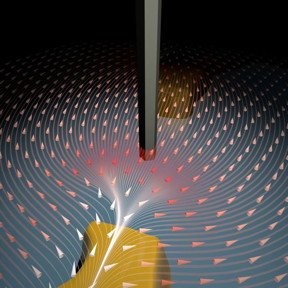 |
| A nanowire sensor measures size and direction of forces. CREDIT University of Basel, Department of Physics |
Abstract:
A new type of atomic force microscope (AFM) uses nanowires as tiny sensors. Unlike standard AFM, the device with a nanowire sensor enables measurements of both the size and direction of forces. Physicists at the University of Basel and at the EPF Lausanne have described these results in the recent issue of Nature Nanotechnology.
Nanowires as sensors in new type of atomic force microscope
Basel, Switzerland | Posted on October 17th, 2016Nanowires are extremely tiny filamentary crystals which are built-up molecule by molecule from various materials and which are now being very actively studied by scientists all around the world because of their exceptional properties.
The wires normally have a diameter of 100 nanometers and therefore possess only about one thousandth of a hair thickness. Because of this tiny dimension, they have a very large surface in comparison to their volume. This fact, their small mass and flawless crystal lattice make them very attractive in a variety of nanometer-scale sensing applications, including as sensors of biological and chemical samples, and as pressure or charge sensors.
Measurement of direction and size
The team of Argovia Professor Martino Poggio from the Swiss Nanoscience Institute (SNI) and the Department of Physics at the University of Basel has now demonstrated that nanowires can also be used as force sensors in atomic force microscopes. Based on their special mechanical properties, nanowires vibrate along two perpendicular axes at nearly the same frequency. When they are integrated into an AFM, the researchers can measure changes in the perpendicular vibrations caused by different forces. Essentially, they use the nanowires like tiny mechanical compasses that point out both the direction and size of the surrounding forces.
Image of the two-dimensional force field
The scientists from Basel describe how they imaged a patterned sample surface using a nanowire sensor. Together with colleagues from the EPF Lausanne, who grew the nanowires, they mapped the two-dimensional force field above the sample surface using their nanowire "compass". As a proof-of-principle, they also mapped out test force fields produced by tiny electrodes.
The most challenging technical aspect of the experiments was the realization of an apparatus that could simultaneously scan a nanowire above a surface and monitor its vibration along two perpendicular directions. With their study, the scientists have demonstrated a new type of AFM that could extend the technique's numerous applications even further.
AFM - today widely used
The development of AFM 30 years ago was honored with the conferment of the Kavli-Prize beginning of September this year. Professor Christoph Gerber of the SNI and Department of Physics at the University of Basel is one of the awardees, who has substantially contributed to the wide use of AFM in different fields, including solid-state physics, materials science, biology, and medicine.
The various different types of AFM are most often carried out using cantilevers made from crystalline Si as the mechanical sensor. "Moving to much smaller nanowire sensors may now allow for even further improvements on an already amazingly successful technique", Martino Poggio comments his approach.
###
The study was supported by the European Research Council Starting Grant NWScan, the Swiss Nanoscience Institute, the Canton Aargau, the Swiss National Science Foundation, and the National Center of Competence in Research for Quantum Science and Technology.
####
For more information, please click here
Contacts:
Olivia Poisson
Copyright © University of Basel
If you have a comment, please Contact us.Issuers of news releases, not 7th Wave, Inc. or Nanotechnology Now, are solely responsible for the accuracy of the content.
Bookmark:


| Related Links |
| Related News Press |
News and information
 Quantum computer improves AI predictions April 17th, 2026
Flexible sensor gains sensitivity under pressure April 17th, 2026
A reusable chip for particulate matter sensing April 17th, 2026
Detecting vibrational quantum beating in the predissociation dynamics of SF6 using time-resolved photoelectron spectroscopy April 17th, 2026
Imaging
Simple algorithm paired with standard imaging tool could predict failure in lithium metal batteries August 8th, 2025
Sensors
Flexible sensor gains sensitivity under pressure April 17th, 2026
Tiny nanosheets, big leap: A new sensor detects ethanol at ultra-low levels January 30th, 2026
From sensors to smart systems: the rise of AI-driven photonic noses January 30th, 2026
Sensors innovations for smart lithium-based batteries: advancements, opportunities, and potential challenges August 8th, 2025
Discoveries
Quantum computer improves AI predictions April 17th, 2026
Flexible sensor gains sensitivity under pressure April 17th, 2026
A reusable chip for particulate matter sensing April 17th, 2026
Detecting vibrational quantum beating in the predissociation dynamics of SF6 using time-resolved photoelectron spectroscopy April 17th, 2026
Announcements
A fundamentally new therapeutic approach to cystic fibrosis: Nanobody repairs cellular defect April 17th, 2026
UC Irvine physicists discover method to reverse ‘quantum scrambling’ : The work addresses the problem of information loss in quantum computing system April 17th, 2026
Tools
Metasurfaces smooth light to boost magnetic sensing precision January 30th, 2026
From sensors to smart systems: the rise of AI-driven photonic noses January 30th, 2026
Japan launches fully domestically produced quantum computer: Expo visitors to experience quantum computing firsthand August 8th, 2025
Grants/Sponsored Research/Awards/Scholarships/Gifts/Contests/Honors/Records
Quantum computer improves AI predictions April 17th, 2026
Detecting vibrational quantum beating in the predissociation dynamics of SF6 using time-resolved photoelectron spectroscopy April 17th, 2026
Metasurfaces smooth light to boost magnetic sensing precision January 30th, 2026
 |
||
 |
||
| The latest news from around the world, FREE | ||
 |
||
|
|
||
| Premium Products | ||
 |
||
|
Only the news you want to read!
Learn More |
||
 |
||
|
Full-service, expert consulting
Learn More |
||
|
|
||