Home > Press > Nanoscale engineering transforms particles into 'LEGO-like' building blocks
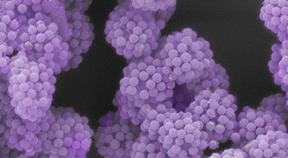 |
| Tiny particles transformed into “LEGO- like” modular building blocks. |
Abstract:
Led by the University of Melbourne and published today in Nature Nanotechnology, the work holds promise for micro and nano scale applications including drug delivery, chemical sensing and energy storage.
Nanoscale engineering transforms particles into 'LEGO-like' building blocks
Melbourne, Australia | Posted on October 12th, 2016Frank Caruso, Professor and ARC Australian Laureate Fellow, Department of Chemical and Biomolecular Engineering said that the team nanoengineered building blocks to tailor the development of advanced materials.
"Nano-objects are difficult to manipulate, as they're too tiny to see directly by eye, far too small to hold, and often have incompatible surfaces for assembling into ordered structures," he said.
"Assembling LEGO bricks into complex shapes is relatively easy, as LEGO studs ensure the blocks stick together wherever you want.
"So we used a similar strategy as a basis for assembling nano-objects into complex architectures by first coating them with a universally adhesive material (a polyphenol) so that they resemble the studs on LEGO bricks.
"This allows for a range of nano-objects to stick together around a template, where the template determines the final shape of the assembled structure," Professor Caruso said.
Different materials can be assembled using this approach. This simple and modular approach has been demonstrated for 15 representative materials to form different sizes, shapes, compositions and functionalities.
Compositions include polymeric particles, metal oxide particles and wires, noble metal nanoparticles, coordination polymer nanowires, nanosheets and nanocubes, and biologicals.
The building blocks can be used to construct complex 3D superstructures, including core-satellite, hollow, hierarchically organised supraparticles, and macroscopic hybrid materials.
"Many previous methods have been limited by particle-specific assembly," Professor Caruso said.
"However, this new polyphenol-based particle approach can be adapted to different functions and allows different building blocks to be assembled into super-structures," he said.
The "studs" in the LEGO brick-like structures, known as C/G studs from the polyphenols, provide a superstructuring process for assembling and inter-locking the building blocks using multiple anchor points.
The "C/G studs" on the building block nanoparticles can further interact with a secondary substrate and/or coordinate with metal ions, interlocking the structures.
This provides a platform for the rapid generation of superstructured assemblies with enhanced chemical diversity and structural flexibility across a wide range of length scales, from nanometres to centimetres.
####
For more information, please click here
Contacts:
Anne Rahilly
61-390-355-380
Copyright © University of Melbourne
If you have a comment, please Contact us.Issuers of news releases, not 7th Wave, Inc. or Nanotechnology Now, are solely responsible for the accuracy of the content.
Bookmark:


| Related News Press |
News and information
 Quantum computer improves AI predictions April 17th, 2026
Flexible sensor gains sensitivity under pressure April 17th, 2026
A reusable chip for particulate matter sensing April 17th, 2026
Detecting vibrational quantum beating in the predissociation dynamics of SF6 using time-resolved photoelectron spectroscopy April 17th, 2026
Chemistry
Projecting light to dispense liquids: A new route to ultra-precise microdroplets January 30th, 2026
From sensors to smart systems: the rise of AI-driven photonic noses January 30th, 2026
"Nanoreactor" cage uses visible light for catalytic and ultra-selective cross-cycloadditions October 3rd, 2025
Cambridge chemists discover simple way to build bigger molecules – one carbon at a time June 6th, 2025
Possible Futures
A fundamentally new therapeutic approach to cystic fibrosis: Nanobody repairs cellular defect April 17th, 2026
UC Irvine physicists discover method to reverse ‘quantum scrambling’ : The work addresses the problem of information loss in quantum computing system April 17th, 2026
Sensors
Flexible sensor gains sensitivity under pressure April 17th, 2026
Tiny nanosheets, big leap: A new sensor detects ethanol at ultra-low levels January 30th, 2026
From sensors to smart systems: the rise of AI-driven photonic noses January 30th, 2026
Sensors innovations for smart lithium-based batteries: advancements, opportunities, and potential challenges August 8th, 2025
Discoveries
Quantum computer improves AI predictions April 17th, 2026
Flexible sensor gains sensitivity under pressure April 17th, 2026
A reusable chip for particulate matter sensing April 17th, 2026
Detecting vibrational quantum beating in the predissociation dynamics of SF6 using time-resolved photoelectron spectroscopy April 17th, 2026
Announcements
A fundamentally new therapeutic approach to cystic fibrosis: Nanobody repairs cellular defect April 17th, 2026
UC Irvine physicists discover method to reverse ‘quantum scrambling’ : The work addresses the problem of information loss in quantum computing system April 17th, 2026
Interviews/Book Reviews/Essays/Reports/Podcasts/Journals/White papers/Posters
A fundamentally new therapeutic approach to cystic fibrosis: Nanobody repairs cellular defect April 17th, 2026
UC Irvine physicists discover method to reverse ‘quantum scrambling’ : The work addresses the problem of information loss in quantum computing system April 17th, 2026
Energy
Sensors innovations for smart lithium-based batteries: advancements, opportunities, and potential challenges August 8th, 2025
Simple algorithm paired with standard imaging tool could predict failure in lithium metal batteries August 8th, 2025
Battery Technology/Capacitors/Generators/Piezoelectrics/Thermoelectrics/Energy storage
Decoding hydrogen‑bond network of electrolyte for cryogenic durable aqueous zinc‑ion batteries January 30th, 2026
COF scaffold membrane with gate‑lane nanostructure for efficient Li+/Mg2+ separation January 30th, 2026
MXene nanomaterials enter a new dimension Multilayer nanomaterial: MXene flakes created at Drexel University show new promise as 1D scrolls January 30th, 2026
 |
||
 |
||
| The latest news from around the world, FREE | ||
 |
||
|
|
||
| Premium Products | ||
 |
||
|
Only the news you want to read!
Learn More |
||
 |
||
|
Full-service, expert consulting
Learn More |
||
|
|
||