Home > Press > On-surface chemistry leads to novel products: On-surface chemical Reactions can lead to novel chemical compounds not yet synthesized by solution chemistry.
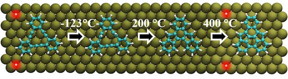 |
| Catalyzed by the copper atoms of the surface, the precursor molecule alters its structure and spatial arrangement when heated gradually. The researchers were able to monitor the synthesis of the end product, which has not been synthesized yet by solution chemistry, with the aid of an ultra-high-resolution atomic force microscope.
Illustration: University of Basel, Department of Physics |
Abstract:
On-surface chemical reactions can lead to novel chemical compounds not yet synthesized by solution chemistry. The first-step, second-step, and third-step products can be analyzed in detail using a high-resolution atomic force microscope, as demonstrated in Nature Communications by scientists from the Swiss Nanoscience Institute and the Department of Physics at Basel University and their colleagues from Japan and Finland.
On-surface chemistry leads to novel products: On-surface chemical Reactions can lead to novel chemical compounds not yet synthesized by solution chemistry.
Basel, Switzerland | Posted on September 13th, 2016In numerous nanotechnology applications, individual molecules are placed on surfaces to fulfill specific functions - such as conducting an electrical current or emitting a light signal. Ideally, scientists will synthetize these sometimes extremely complex chemical compounds directly on the surface. The on-surface chemical reactions can be followed step by step with the aid of ultra-high-resolution atomic force microscopes. The data obtained also enables them to calculate the precise molecular structure and the energetics along the path.
For their experiments, colleagues of Professor Ernst Meyer from the University of Basel selected a molecule consisting of three benzene rings joined by a triple bond. When the researchers apply this molecule to a silver surface, the molecules arrange themselves in a consistent pattern -- but there is no chemical reaction.
Copper as a catalyst
On a copper surface, however, the molecules react already at a temperature of -123 °C. Catalyzed by the copper atoms, the precursor molecule incorporates two hydrogen atoms thereby altering its structure and spatial arrangement. When the sample is heated to 200 °C, a further reaction step takes place in which two pentagonal rings are formed. A further increase in temperature to 400 °C causes a cleaving of hydrogen atoms and forms a further carbon-carbon bond. The final two reaction steps lead to aromatic hydrocarbon compounds, which had previously not been synthetized in solution chemistry.
The researchers conducted these experiments in ultra-high vacuum conditions and were able to monitor the synthesis using a high-resolution atomic force microscope with a carbon monoxide terminated tip. Comparative computer calculations generated the precise molecular structure, which perfectly matched the microscope images.
Tailored nanostructures
Through their experiments, the international research team has shown that on-surface chemistry can lead to novel products. "This extremely pure form of chemistry provides us with tailored on-surface nanostructures that can be used in a variety of ways," says Meyer, commenting on the work largely performed by Dr. Shigeki Kawai. In the example presented, the copper surface functions as a catalyst; the chemical reaction of the precursor molecules is controlled by adding heat and can be monitored via atomic force microscopy.
####
For more information, please click here
Contacts:
Reto Caluori
41-612-672-495
Copyright © University of Basel
If you have a comment, please Contact us.Issuers of news releases, not 7th Wave, Inc. or Nanotechnology Now, are solely responsible for the accuracy of the content.
Bookmark:


| Related Links |
| Related News Press |
News and information
 Quantum computer improves AI predictions April 17th, 2026
Flexible sensor gains sensitivity under pressure April 17th, 2026
A reusable chip for particulate matter sensing April 17th, 2026
Detecting vibrational quantum beating in the predissociation dynamics of SF6 using time-resolved photoelectron spectroscopy April 17th, 2026
Imaging
Chemistry
Projecting light to dispense liquids: A new route to ultra-precise microdroplets January 30th, 2026
From sensors to smart systems: the rise of AI-driven photonic noses January 30th, 2026
"Nanoreactor" cage uses visible light for catalytic and ultra-selective cross-cycloadditions October 3rd, 2025
Possible Futures
A fundamentally new therapeutic approach to cystic fibrosis: Nanobody repairs cellular defect April 17th, 2026
UC Irvine physicists discover method to reverse ‘quantum scrambling’ : The work addresses the problem of information loss in quantum computing system April 17th, 2026
Molecular Nanotechnology
Quantum pumping in molecular junctions August 16th, 2024
Scientists push the boundaries of manipulating light at the submicroscopic level March 3rd, 2023
First electric nanomotor made from DNA material: Synthetic rotary motors at the nanoscale perform mechanical work July 22nd, 2022
Discoveries
Quantum computer improves AI predictions April 17th, 2026
Flexible sensor gains sensitivity under pressure April 17th, 2026
A reusable chip for particulate matter sensing April 17th, 2026
Detecting vibrational quantum beating in the predissociation dynamics of SF6 using time-resolved photoelectron spectroscopy April 17th, 2026
Announcements
A fundamentally new therapeutic approach to cystic fibrosis: Nanobody repairs cellular defect April 17th, 2026
UC Irvine physicists discover method to reverse ‘quantum scrambling’ : The work addresses the problem of information loss in quantum computing system April 17th, 2026
Interviews/Book Reviews/Essays/Reports/Podcasts/Journals/White papers/Posters
A fundamentally new therapeutic approach to cystic fibrosis: Nanobody repairs cellular defect April 17th, 2026
UC Irvine physicists discover method to reverse ‘quantum scrambling’ : The work addresses the problem of information loss in quantum computing system April 17th, 2026
Tools
Metasurfaces smooth light to boost magnetic sensing precision January 30th, 2026
From sensors to smart systems: the rise of AI-driven photonic noses January 30th, 2026
Japan launches fully domestically produced quantum computer: Expo visitors to experience quantum computing firsthand August 8th, 2025
 |
||
 |
||
| The latest news from around the world, FREE | ||
 |
||
|
|
||
| Premium Products | ||
 |
||
|
Only the news you want to read!
Learn More |
||
 |
||
|
Full-service, expert consulting
Learn More |
||
|
|
||