Home > Press > Researchers watch catalysts at work
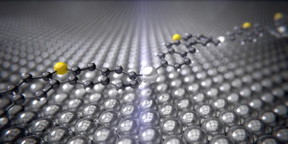 |
| The intermediate product of the Ullmann reaction with the silver catalyst (silver) between the carbon rings (black) and sulfur atoms (yellow) curves like a bridge over the silver surface. CREDITL University of Basel, Department of Physics |
Abstract:
Physicists at the University of Basel have succeeded in watching a silver catalyst at work for the first time with the aid of an atomic force microscope. The observations made during an Ullmann reaction have allowed the researchers to calculate the energy turnover and, potentially, to optimize the catalysis. The study, which was performed with experts from Japan and Iran, has been published in the scientific journal Small.
Researchers watch catalysts at work
Basel, Switzerland | Posted on August 19th, 2016The Ullmann reaction examined is a chemical reaction in which silver atoms catalyze the bond between two carbon atoms to which iodine was previously bonded. Although scientists have known about this type of reaction since 1901 and used it for many important chemical conversions, it was not previously possible to observe the intermediate product of the reaction in detail.
Using an atomic force microscope, the team of researchers led by Professor Ernst Meyer and Dr. Shigeki Kawai from the Swiss Nanoscience Institute and the Department of Physics at the University of Basel has now succeeded in displaying this reaction at atomic resolution.
Surprisingly, it was revealed that the silver atoms react with the molecules at temperatures of around -120°C and seem to curve like a bridge over a river. In the second stage of the reaction, which requires the temperature to be increased to around 105°C and generates the end product, the silver atoms are freed again and two carbon atoms bond together.
Calculating energy
The Ullmann reaction has been used for chemical syntheses for a long time now. Interest in this linking of carbon atoms has recently increased again because it can be used to bind organic molecules to surfaces and produce solvent-free polymers. Detailed observations of how the catalysts work enable scientists to better understand the reaction process.
Previous analyses failed to show the spatial arrangement of the organometallic intermediate product. The detailed images now obtained are the first to allow project partner Professor Stefan Goedecker (Department of Physics, University of Basel) to calculate the energy turnover of the Ullmann reaction examined. This data confirms the unusual spatial arrangement of the intermediate product and indicates how the reaction could be optimized.
Relatively low temperatures
The observed curving and flexibility of the molecules is probably the reason why the reaction requires relatively low temperatures of 105°C. The molecules are subject to mechanical tension and can therefore react more easily, that is at lower temperatures. If other catalysts could be used to generate intermediate products like these that are subject to tension, then catalytic reactions could also be possible at lower temperatures. This would make ecological and economic sense because traditional catalysts with platinum, rhodium, or palladium often require high operating temperatures of 500°C, which leads to the emission of waste gases in a cold state.
###
The research work was the result of a collaboration between the Department of Physics at the University of Basel, the National Institute of Materials Science (Japan), the Japan Science and Technology Agency (Japan), the University of Tokyo (Japan), and Shadid Beheshti University (Iran).
####
For more information, please click here
Contacts:
Olivia Poisson
Copyright © University of Basel
If you have a comment, please Contact us.Issuers of news releases, not 7th Wave, Inc. or Nanotechnology Now, are solely responsible for the accuracy of the content.
Bookmark:


| Related Links |
| Related News Press |
News and information
 Quantum computer improves AI predictions April 17th, 2026
Flexible sensor gains sensitivity under pressure April 17th, 2026
A reusable chip for particulate matter sensing April 17th, 2026
Detecting vibrational quantum beating in the predissociation dynamics of SF6 using time-resolved photoelectron spectroscopy April 17th, 2026
Chemistry
Projecting light to dispense liquids: A new route to ultra-precise microdroplets January 30th, 2026
From sensors to smart systems: the rise of AI-driven photonic noses January 30th, 2026
"Nanoreactor" cage uses visible light for catalytic and ultra-selective cross-cycloadditions October 3rd, 2025
Cambridge chemists discover simple way to build bigger molecules – one carbon at a time June 6th, 2025
Govt.-Legislation/Regulation/Funding/Policy
Quantum computer improves AI predictions April 17th, 2026
Metasurfaces smooth light to boost magnetic sensing precision January 30th, 2026
New imaging approach transforms study of bacterial biofilms August 8th, 2025
Discoveries
Quantum computer improves AI predictions April 17th, 2026
Flexible sensor gains sensitivity under pressure April 17th, 2026
A reusable chip for particulate matter sensing April 17th, 2026
Detecting vibrational quantum beating in the predissociation dynamics of SF6 using time-resolved photoelectron spectroscopy April 17th, 2026
Announcements
A fundamentally new therapeutic approach to cystic fibrosis: Nanobody repairs cellular defect April 17th, 2026
UC Irvine physicists discover method to reverse ‘quantum scrambling’ : The work addresses the problem of information loss in quantum computing system April 17th, 2026
Interviews/Book Reviews/Essays/Reports/Podcasts/Journals/White papers/Posters
A fundamentally new therapeutic approach to cystic fibrosis: Nanobody repairs cellular defect April 17th, 2026
UC Irvine physicists discover method to reverse ‘quantum scrambling’ : The work addresses the problem of information loss in quantum computing system April 17th, 2026
Environment
A reusable chip for particulate matter sensing April 17th, 2026
Researchers unveil a groundbreaking clay-based solution to capture carbon dioxide and combat climate change June 6th, 2025
Automotive/Transportation
Decoding hydrogen‑bond network of electrolyte for cryogenic durable aqueous zinc‑ion batteries January 30th, 2026
Sensors innovations for smart lithium-based batteries: advancements, opportunities, and potential challenges August 8th, 2025
Simple algorithm paired with standard imaging tool could predict failure in lithium metal batteries August 8th, 2025
Grants/Sponsored Research/Awards/Scholarships/Gifts/Contests/Honors/Records
Quantum computer improves AI predictions April 17th, 2026
Detecting vibrational quantum beating in the predissociation dynamics of SF6 using time-resolved photoelectron spectroscopy April 17th, 2026
Metasurfaces smooth light to boost magnetic sensing precision January 30th, 2026
Research partnerships
Lab to industry: InSe wafer-scale breakthrough for future electronics August 8th, 2025
HKU physicists uncover hidden order in the quantum world through deconfined quantum critical points April 25th, 2025
 |
||
 |
||
| The latest news from around the world, FREE | ||
 |
||
|
|
||
| Premium Products | ||
 |
||
|
Only the news you want to read!
Learn More |
||
 |
||
|
Full-service, expert consulting
Learn More |
||
|
|
||