Home > Press > Next generation anode to improve lithium-ion batteries: Silicon-tin nanocomposite developed at UCR could lead to low cost, long lasting rechargeable batteries for electronic devices and electric vehicles
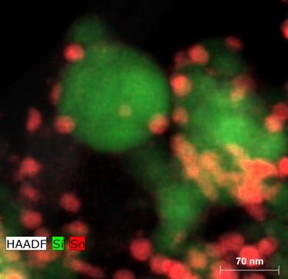 |
| The silicon-tin nanocomposite developed at UCR viewed by high angle angular dark field imaging. The larger green particles are silicon and the smaller red particles are tin. CREDIT: UC Riverside |
Abstract:
Researchers at the University of California, Riverside have created a new silicon-tin nanocomposite anode that could lead to lithium-ion batteries that can be charged and discharged more times before they reach the end of their useful lives. The longer-lasting batteries could be used in everything from handheld electronic devices to electric vehicles.
Next generation anode to improve lithium-ion batteries: Silicon-tin nanocomposite developed at UCR could lead to low cost, long lasting rechargeable batteries for electronic devices and electric vehicles
Riverside, CA | Posted on August 5th, 2016Titled "Tin Nanoparticles as an Effective Conductive Addition in Silicon Anodes," a paper describing the research was published Wednesday (Aug. 3) in the journal Scientific Reports. The project was led by Lorenzo Mangolini, an associate professor of mechanical engineering and materials science and engineering in UCR's Bourns College of Engineering.
Lithium-ion batteries, the most popular rechargeable batteries in personal electronics, are composed of three main parts: an anode, a cathode, and a lithium salt dissolved in an organic solvent. While graphite is the material of choice for most anodes, its performance is a limiting factor in making better batteries and expanding their applications.
Both silicon and tin have been investigated as novel high-performance alternatives for graphite anodes. In the current research, Mangolini's group showed for the first time that combining both materials into a single composite leads to dramatic improvements in battery performance. In addition to tripling the charge capacity offered by graphite, the silicon-tin nanocomposite is extremely stable over many charge-discharge cycles, essentially extending its useful life. These features, coupled with a simple manufacturing process, could help the expansion of lithium-ion batteries for use in next-generation vehicles.
"Lithium-ion batteries are growing in popularity for electric vehicles and aerospace applications, but there is a clear need to alleviate range anxiety--the fear that a vehicle won't have enough charge to reach its destination--before we will see large-scale adoption. Any technology that can help is welcome, as long as it is simple and scalable, and our technology meets both those criteria," Mangolini said.
Mangolini said adding tin to the silicon, rather than another conductive material such as carbon black, would circumvent the low conductivity of silicon without decreasing energy storage.
"The synergistic effects between these two materials lead to batteries that exceed the performance of each of the two components alone, an improvement that is a result of the high electrical conductivity and good energy storage capacity of tin. This can be achieved with the addition of even minor amounts of tin, as small as 2 percent by weight," he said.
###
In addition to Mangolini, the research team comprised Lanlan Zhong, a graduate student in materials science and engineering and the first author on the paper; Chad Beaudette, an undergraduate in mechanical engineering; Juchen Guo, assistant professor of chemical and environmental engineering; and Krassimir Bozhilov, associate adjunct professor of materials science and engineering and manager of UCR's Central Facility for Advanced Microscopy and Microanalysis.
####
For more information, please click here
Contacts:
Sarah Nightingale
951-827-4580
Copyright © University of California - Riverside
If you have a comment, please Contact us.Issuers of news releases, not 7th Wave, Inc. or Nanotechnology Now, are solely responsible for the accuracy of the content.
Bookmark:


| Related Links |
| Related News Press |
News and information
 Quantum computer improves AI predictions April 17th, 2026
Flexible sensor gains sensitivity under pressure April 17th, 2026
A reusable chip for particulate matter sensing April 17th, 2026
Detecting vibrational quantum beating in the predissociation dynamics of SF6 using time-resolved photoelectron spectroscopy April 17th, 2026
Govt.-Legislation/Regulation/Funding/Policy
Quantum computer improves AI predictions April 17th, 2026
Metasurfaces smooth light to boost magnetic sensing precision January 30th, 2026
New imaging approach transforms study of bacterial biofilms August 8th, 2025
Possible Futures
A fundamentally new therapeutic approach to cystic fibrosis: Nanobody repairs cellular defect April 17th, 2026
UC Irvine physicists discover method to reverse ‘quantum scrambling’ : The work addresses the problem of information loss in quantum computing system April 17th, 2026
Discoveries
Quantum computer improves AI predictions April 17th, 2026
Flexible sensor gains sensitivity under pressure April 17th, 2026
A reusable chip for particulate matter sensing April 17th, 2026
Detecting vibrational quantum beating in the predissociation dynamics of SF6 using time-resolved photoelectron spectroscopy April 17th, 2026
Materials/Metamaterials/Magnetoresistance
First real-time observation of two-dimensional melting process: Researchers at Mainz University unveil new insights into magnetic vortex structures August 8th, 2025
Researchers unveil a groundbreaking clay-based solution to capture carbon dioxide and combat climate change June 6th, 2025
A 1960s idea inspires NBI researchers to study hitherto inaccessible quantum states June 6th, 2025
Institute for Nanoscience hosts annual proposal planning meeting May 16th, 2025
Announcements
A fundamentally new therapeutic approach to cystic fibrosis: Nanobody repairs cellular defect April 17th, 2026
UC Irvine physicists discover method to reverse ‘quantum scrambling’ : The work addresses the problem of information loss in quantum computing system April 17th, 2026
Interviews/Book Reviews/Essays/Reports/Podcasts/Journals/White papers/Posters
A fundamentally new therapeutic approach to cystic fibrosis: Nanobody repairs cellular defect April 17th, 2026
UC Irvine physicists discover method to reverse ‘quantum scrambling’ : The work addresses the problem of information loss in quantum computing system April 17th, 2026
Energy
Sensors innovations for smart lithium-based batteries: advancements, opportunities, and potential challenges August 8th, 2025
Simple algorithm paired with standard imaging tool could predict failure in lithium metal batteries August 8th, 2025
Automotive/Transportation
Decoding hydrogen‑bond network of electrolyte for cryogenic durable aqueous zinc‑ion batteries January 30th, 2026
Sensors innovations for smart lithium-based batteries: advancements, opportunities, and potential challenges August 8th, 2025
Simple algorithm paired with standard imaging tool could predict failure in lithium metal batteries August 8th, 2025
Battery Technology/Capacitors/Generators/Piezoelectrics/Thermoelectrics/Energy storage
Decoding hydrogen‑bond network of electrolyte for cryogenic durable aqueous zinc‑ion batteries January 30th, 2026
COF scaffold membrane with gate‑lane nanostructure for efficient Li+/Mg2+ separation January 30th, 2026
MXene nanomaterials enter a new dimension Multilayer nanomaterial: MXene flakes created at Drexel University show new promise as 1D scrolls January 30th, 2026
 |
||
 |
||
| The latest news from around the world, FREE | ||
 |
||
|
|
||
| Premium Products | ||
 |
||
|
Only the news you want to read!
Learn More |
||
 |
||
|
Full-service, expert consulting
Learn More |
||
|
|
||